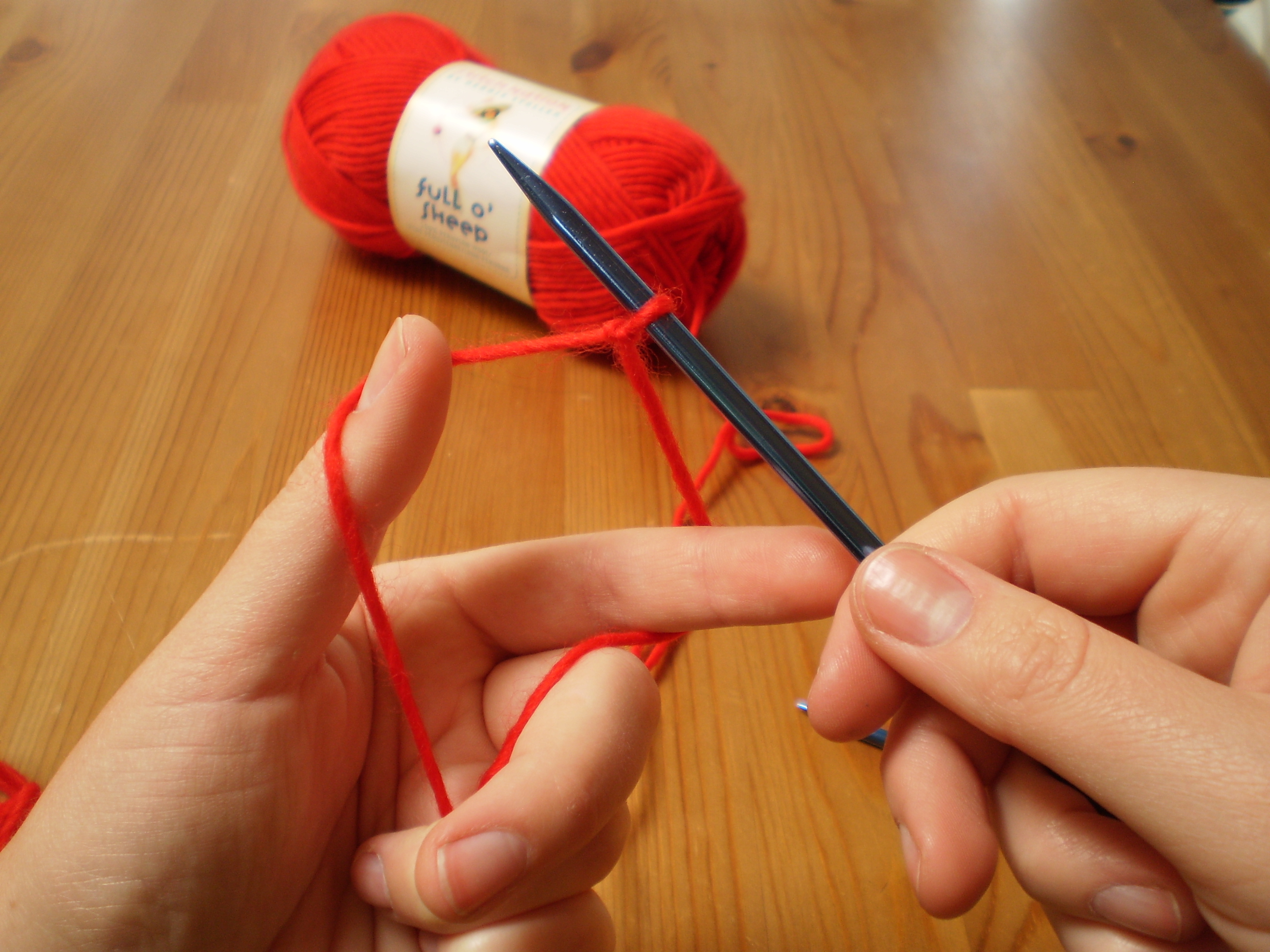
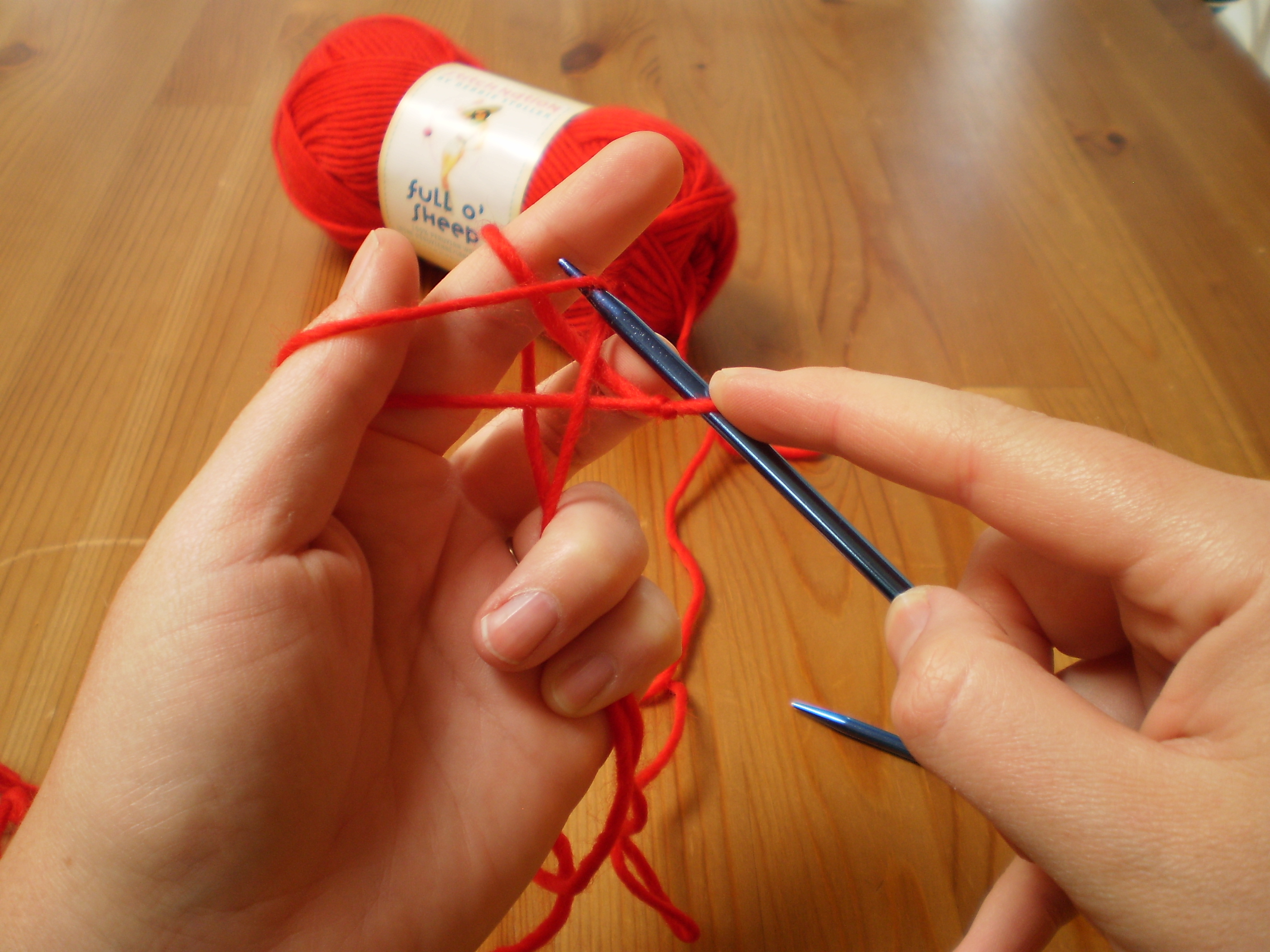
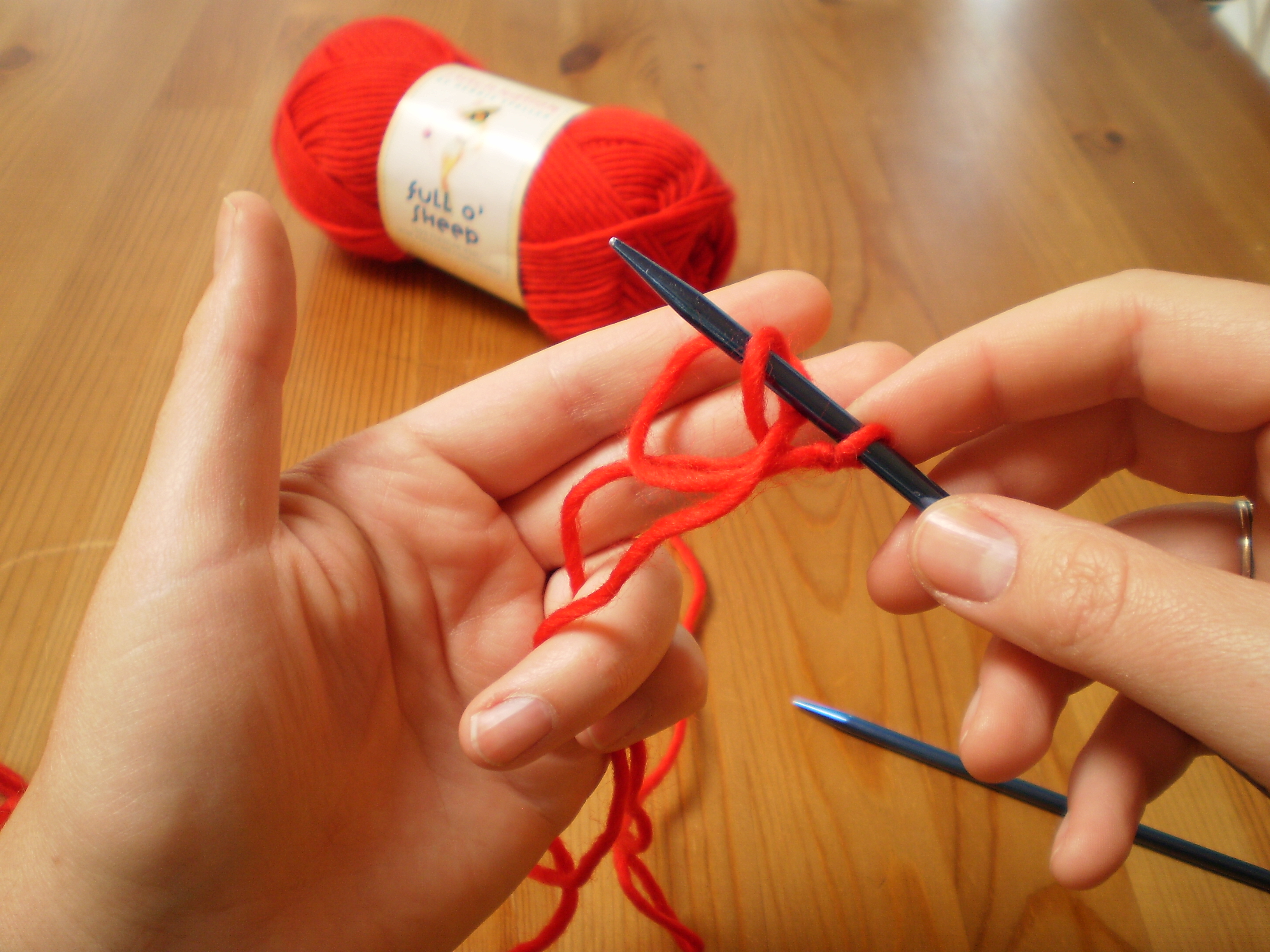
Tag Archives: knitting

Going with the Flow

Peggy Sue is dead.  (Not the person, the cardigan.)  I tried to fix it.  I wanted the pattern to work so much!  But, alas, it was not meant to be.  I started off with the wrong gauge (I knew this was going to happen.  I took a swatch and everything.  I’m just dumb.), and didn’t compensate accordingly.  My sweater was turning out much too small.  I got all the way to the armpits (it’s a top-down sweater) before I realized the error of my ways.

I ripped it out, and tried again on bigger needles, but the fabric just didn’t look right.  This time I only got halfway through the shoulders (thank goodness). I ripped it out again.

Then I got pissed and threw it in a corner of my craft closet.  It sat there for a while gathering dust while I sulked.

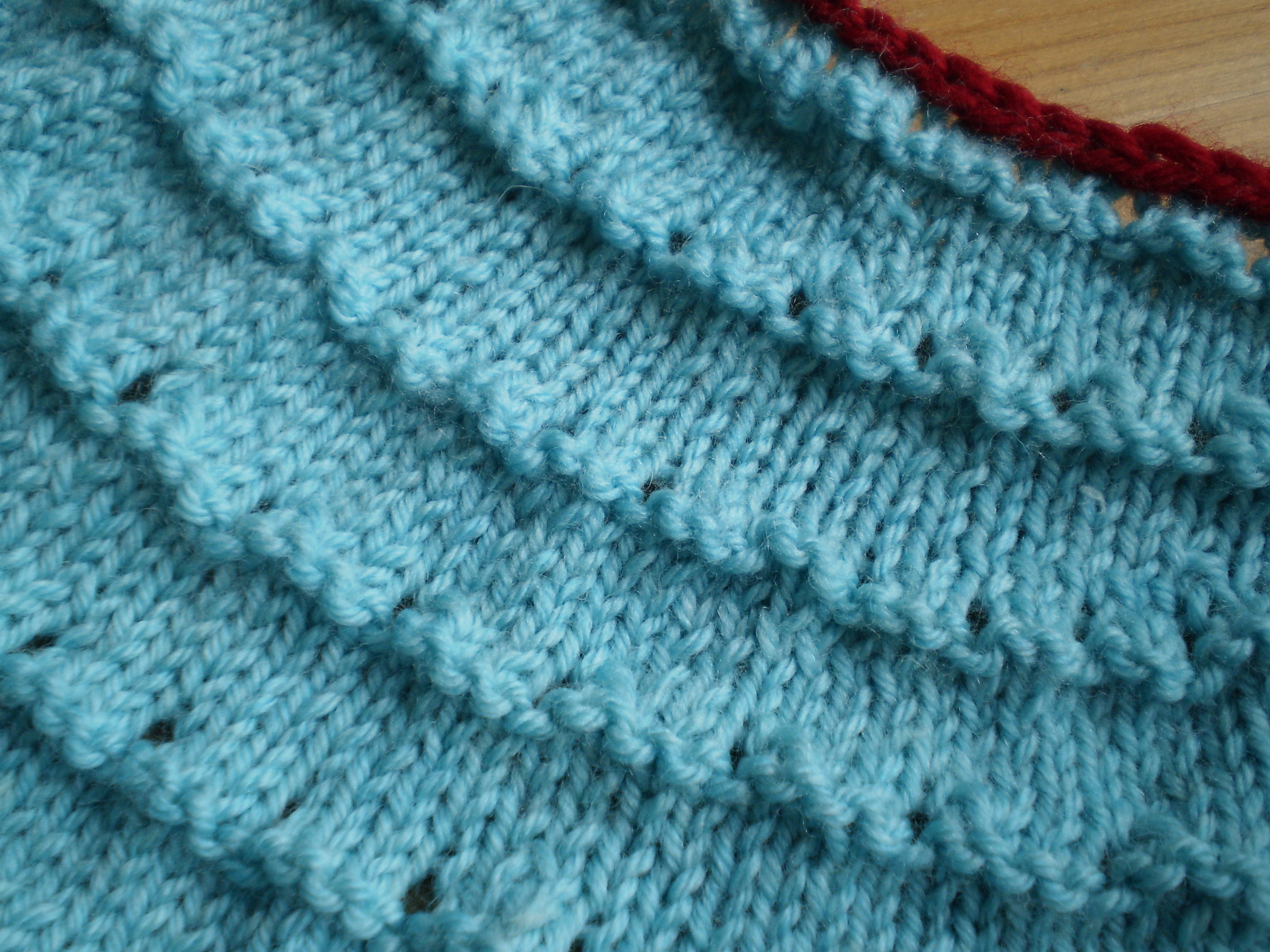
Now, I’m knitting up my pretty blue yarn again.  It’s still going to be a girly blue cardigan, but this time I’m sort of making my own pattern.  I’m using my new favorite sweater book, the Knitter’s Handy Book of Top-Down Sweaters.  It’s a Seamless Yoke Cardigan, based in part on her Feather and Fan Flare sweater.  It’s at a nice fine gauge (or at least fine compared to sweaters I’ve made before).  I like to make my sweaters with chunky yarn and big needles, but I wanted this sweater to turn out a little fancier and girlier than my usual projects).  But, instead of the fussy little cables on Peggy Sue, I’m using decorative increases and garter ridges around the yoke, hem and cuffs.  And, since it’s a yoke sweater, not a raglan, I think it will be more flattering on me.

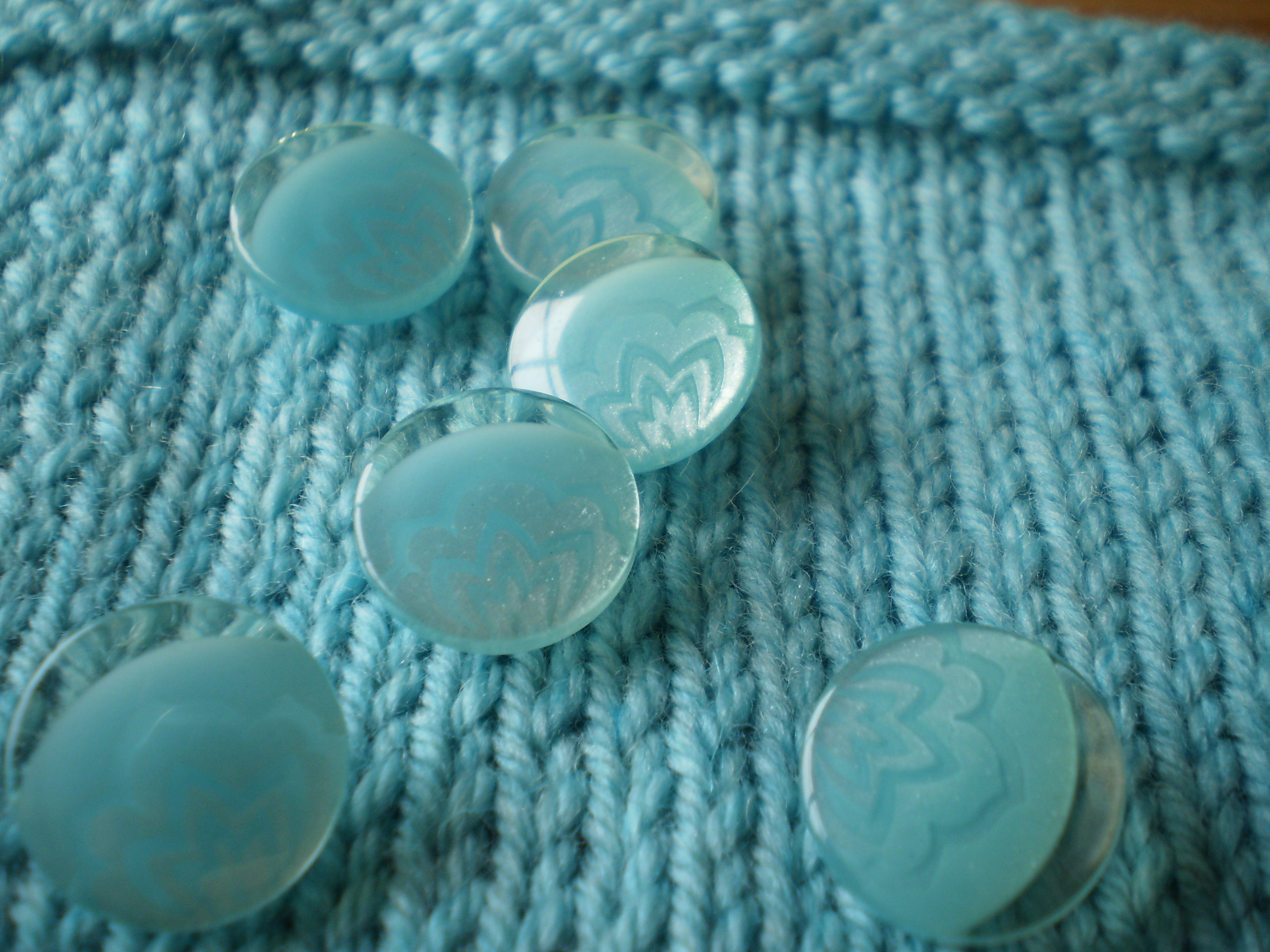
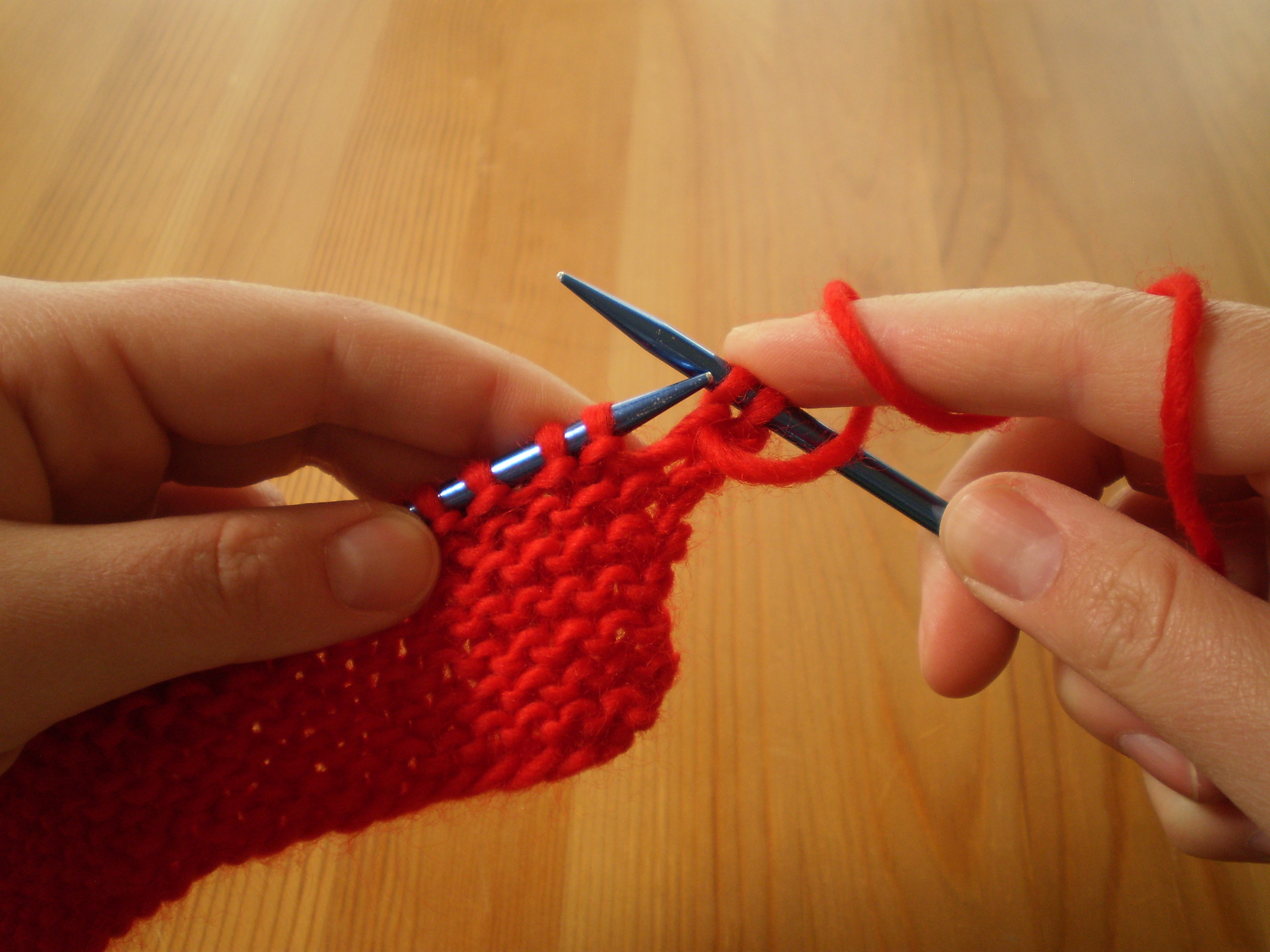
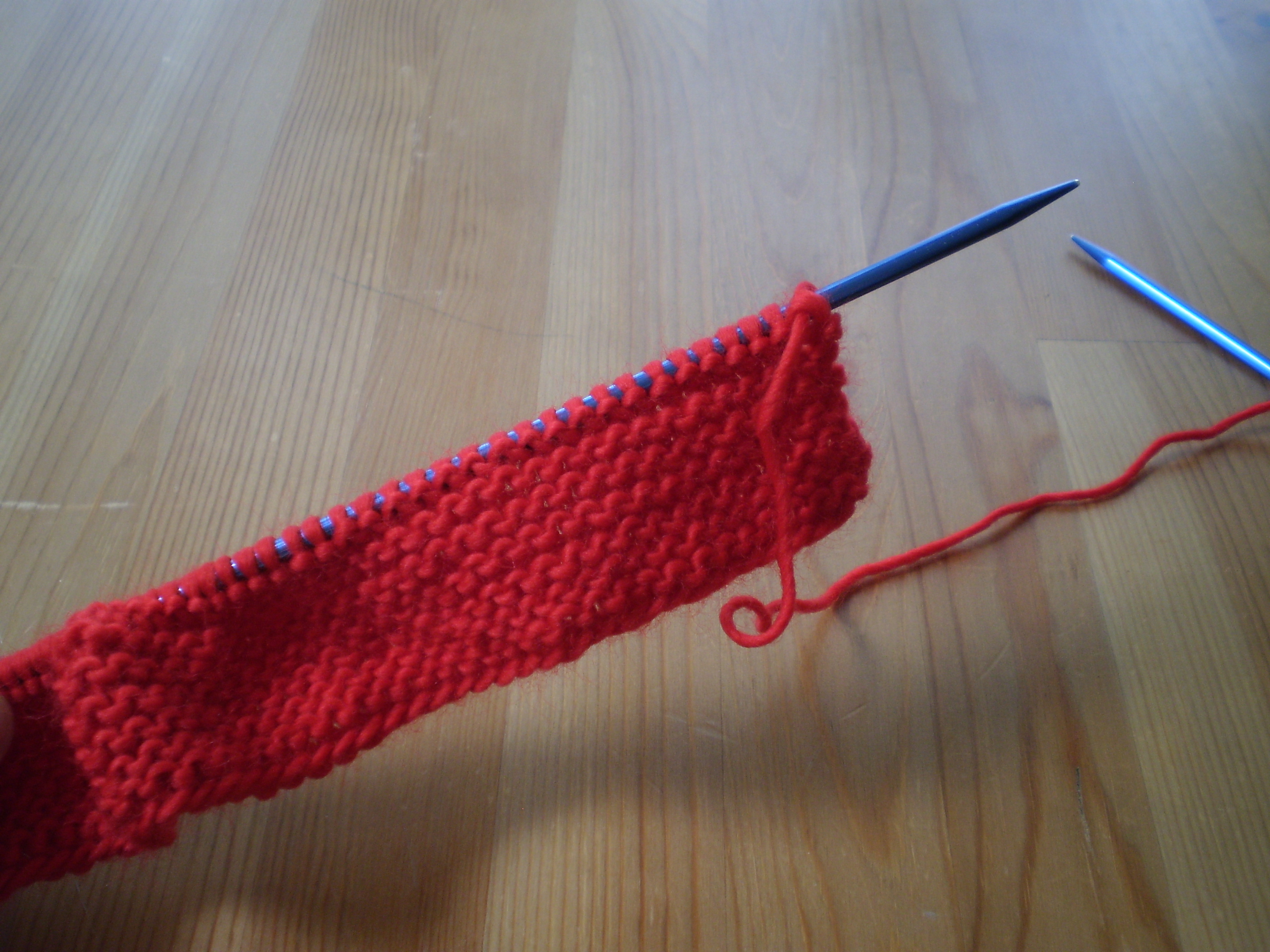
OLYMPUS DIGITAL CAMERAThe funny thing is, though, that now that I’ve got it growing on my needles, I really like the contrast between the red yarn of my provisional cast-on and the pale aqua blue.  It’s making me think that I want to use red or maroon buttons on the sweater.  Which is ridiculous, since the whole point of making this sweater in the first place was to use my pretty blue buttons.

OLYMPUS DIGITAL CAMERABut, I suppose that takes me back to my original point: It’s important to stay flexible when you’re knitting.  It’s so easy to get bogged down in the details, and keep slogging through a project that you no longer love, or something that you figure out won’t work for you.  And, it’s so hard to abandon a project that you’ve poured hours and hours of your life into. But, it’s so much more satisfying (and fun!) to make something that you love than to slave away, determined to finish the project as you planned in the beginning.  Just because you start on a project, doesn’t mean that it’s the one you have to finish.

How have you had to be flexible when you work on a project?

n00b Hat, Part 5: Finishing

You’re so close to finishing your hat, I can smell it.  (Or maybe that’s the spiced apple cider heating up on my stove…mmm, I love fall.) In fact, you are totally done with your knitting, and all that’s left is to do your finishing.  In this case, that means sewing up the seam along the back of the hat, so that it ends up… well… hat-shaped.

Start out by cutting your working yarn, leaving a good 18-inch tail on your project.  Thread this tail onto your tapestry needle.

OLYMPUS DIGITAL CAMERAThen, turn your hat over, so that you can see the purl side facing up.  Carefully use your tapestry needle to thread your tail from the left, through  the 8 remaining stitches.

OLYMPUS DIGITAL CAMERAOnce you have your last stitches safely contained on your tail, you can remove your knitting needle (So long, knitting needle!) and pull the tail snug.  This makes a nice little rosette-dealy at the top of your hat. See?

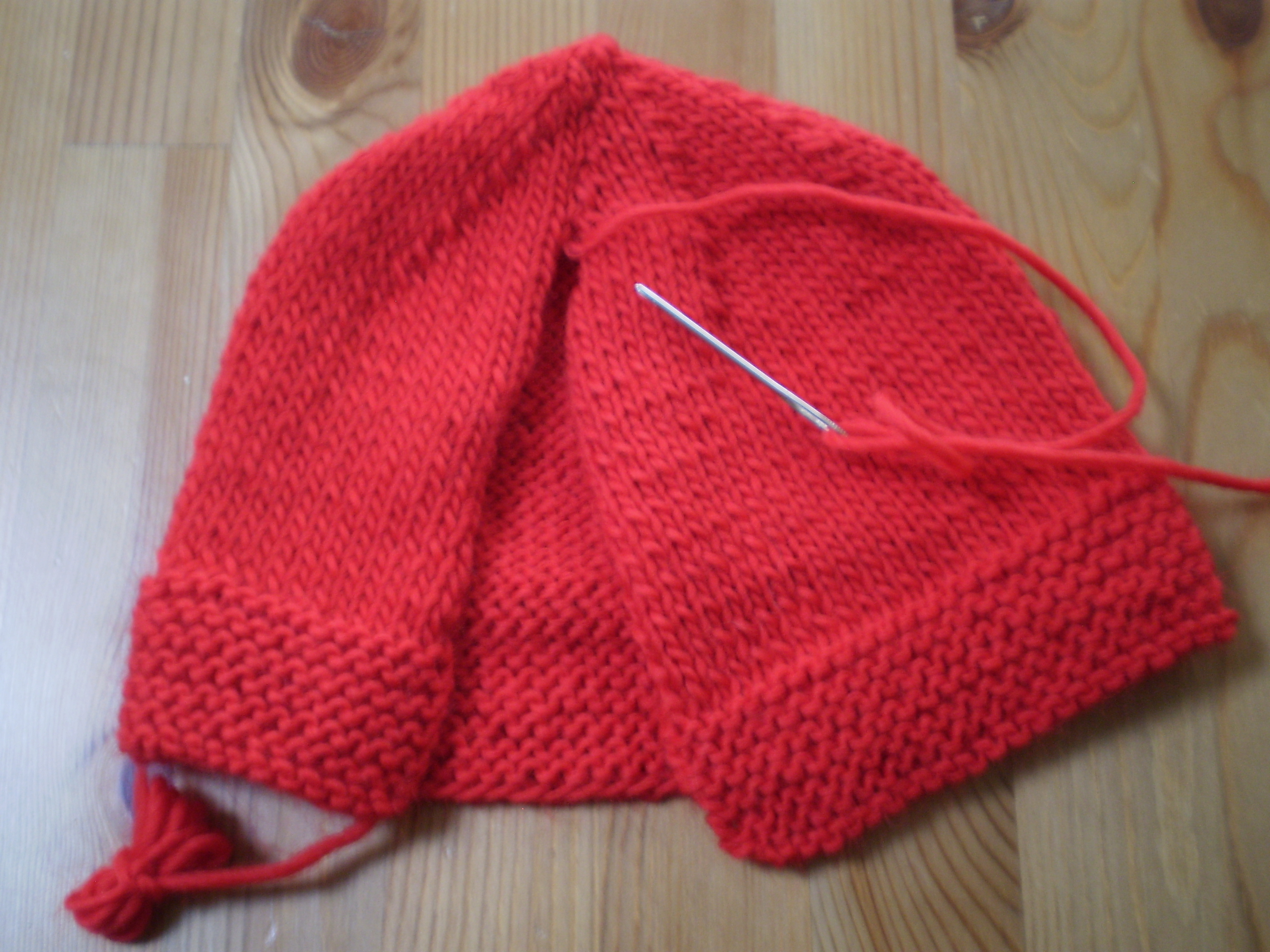
OLYMPUS DIGITAL CAMERANow, sew the two edges of your knitting together, using your yarn tail.  I like to use a mattress stitch, but feel free to use whatever you are most comfortable with (whip stitch will also work well).  Try to make your seam as neat as possible, but don’t worry too much (since the seam is worked with the same yarn as the rest of the hat, even messy stitching won’t show up too much).

OLYMPUS DIGITAL CAMERAWhen you’ve finished sewing up the hat, it should look like this.  Very hat-like.  (Hattish? Hat-esque?)

OLYMPUS DIGITAL CAMERASee how you still have those two pesky ends?  We have to do something with them (unless you like big hunks of yarn hanging down off your hat, I suppose).  So, turn your hat inside-out.  See the seam allowance that you made by sewing the two sides of your hat together?  Sew your yarn up through that for a couple inches.  (Throw in a knot or a securing stitch, if you want.) Then, cut your tails, leaving a 1-2 inches dangling inside the hat.

OLYMPUS DIGITAL CAMERAAnd that’s it!  You’re done!  You have a great knitted cap!  Congratulations!

If you have questions, please let me know, and I’ll be happy to help!

n00b Hat, Part 3: the Purl Stitch

Have you got your garter stitch brim done?  Awesome!  Send me a photo, if you like.  I’d love to actually see it, instead of just pretending to see it.

So, your hat should look something like this:

OLYMPUS DIGITAL CAMERAIf it’s a little longer or shorter, no worries.  If it’s a little lumpier, also no worries.

Today we’re going to start working on the middle part of the hat, which we’ll work in stockinet stitch.  Stockinet stitch is a simple knitting pattern where you alternate knitting one row, and purling one row.  When you imagine a basic knit sweater, the smooth-looking parts are stockinet stitch.

You already know how to do knit stitches, so I guess it’s time to learn how to do purl stitches.  The purl stitch is worked very similarly to the knit stitch, except that it’s mirrored (don’t worry… it sounds worse than it is).

Just like before, you’re going to start with your knitting on your left side and your empty needle on your right.  Take the tip of your right-hand needle, and poke it through the back of the first stitch.  Keep your yarn in front of your knitting.  (See how it’s backwards from working a knit stitch?)

OLYMPUS DIGITAL CAMERAThen, wrap your yarn around the tip of your right-hand needle.

OLYMPUS DIGITAL CAMERAAnd pull the new stitch through the old stitch, from front to back.

OLYMPUS DIGITAL CAMERAOLYMPUS DIGITAL CAMERAAnd, just like before, you slip the old stitch off the left needle.

OLYMPUS DIGITAL CAMERA

Does that make sense?  Let’s try it again.

Keep your yarn in front of your knitting.  Insert the tip of your needle into the back of the stitch. Wrap your yarn around the tip of your needle, and pull the new stitch through.  Drop your old stitch off the left-hand needle.

OLYMPUS DIGITAL CAMERAOLYMPUS DIGITAL CAMERAOLYMPUS DIGITAL CAMERAOLYMPUS DIGITAL CAMERAKeep going!  Purl the whole row.

Now that you’ve purled a whole row, do you see how knitting and purling are very similar?  For both, you insert your right-hand needle, wrap your yarn around, pull the new stitch through, then drop the old stitch off.  Here’s a quick summary of the differences between knitting and purling:

Knitting: Insert your needle into the front of the stitch, keeping your yarn behind the knitting.  Wrap your yarn around the needle tip, and pull the new stitch through from back to front.

Purling: Insert your needle into the back of the stitch, keeping your yarn in front of the knitting.  Wrap your yarn around the needle tip, and pull the new stitch through from front to back.

OK, so, since we’re doing the stockinet stitch pattern, it’s time for another knit row.  (Remember, knit one row, purl one row.)  So, turn your knitting around and knit back.

Then purl a row.

Then knit a row.

Then purl a row.

Simple!

But, what if you have to (I don’t know) sleep or something?  How will you remember what to do next?  Easy; just “read” your knitting.  “Reading” your knitting means that you look at the stitches you’ve already worked to figure out what to do next.

After a few rows of stockinette stitch, you’ll see that your hat has two different textures.  The bumpy and squishy garter stitch at the bottom, and the smooth stockinet at the top.

OLYMPUS DIGITAL CAMERAStockinet has two different sides.  The “right side” is the side with the little V-shaped stitches.  When you see this side facing you, it’s time to knit.

OLYMPUS DIGITAL CAMERAThe “wrong side” is the side with little bumps.  When you see this side, it’s time to purl.  (You can think of the bumps as “pearls,” if that helps.  Get it? Pearls=purl.  Clever clever.)

OLYMPUS DIGITAL CAMERAKeep going, knitting one row and purling one row until your whole hat measures about 5 inches from the cast-on edge.  If you have a smaller head, you can make your hat a little shorter, if you have a bigger head (or lots of hair) you can make your hat a little longer.  I like to err on the too long side, since you can always roll up the brim, if it’s too big.

OLYMPUS DIGITAL CAMERANext week, we’ll make the crown of the hat, and I’ll show you how to do decreases.

n00b Hat, Part 2: Casting on and the knit stitch

Are you as excited as I am about this project? Doubtful.  Possible, but doubtful.  I am very excited.  One of my favorite things to do is teaching people how to knit, so this is totally up my alley.

So, let’s jump right in and start casting on.  Knitted fabric is made of a whole series of loops that all interlock in a very specific way.  These loops give the finished fabric stretch, which is what makes knitting so awesome for making sweaters, socks, and hats.  The first row of loops is created by casting on.  We’ll be doing a long-tail cast on, since it’s the most versatile way to do a cast on.  (I use it on 90% of all my projects).

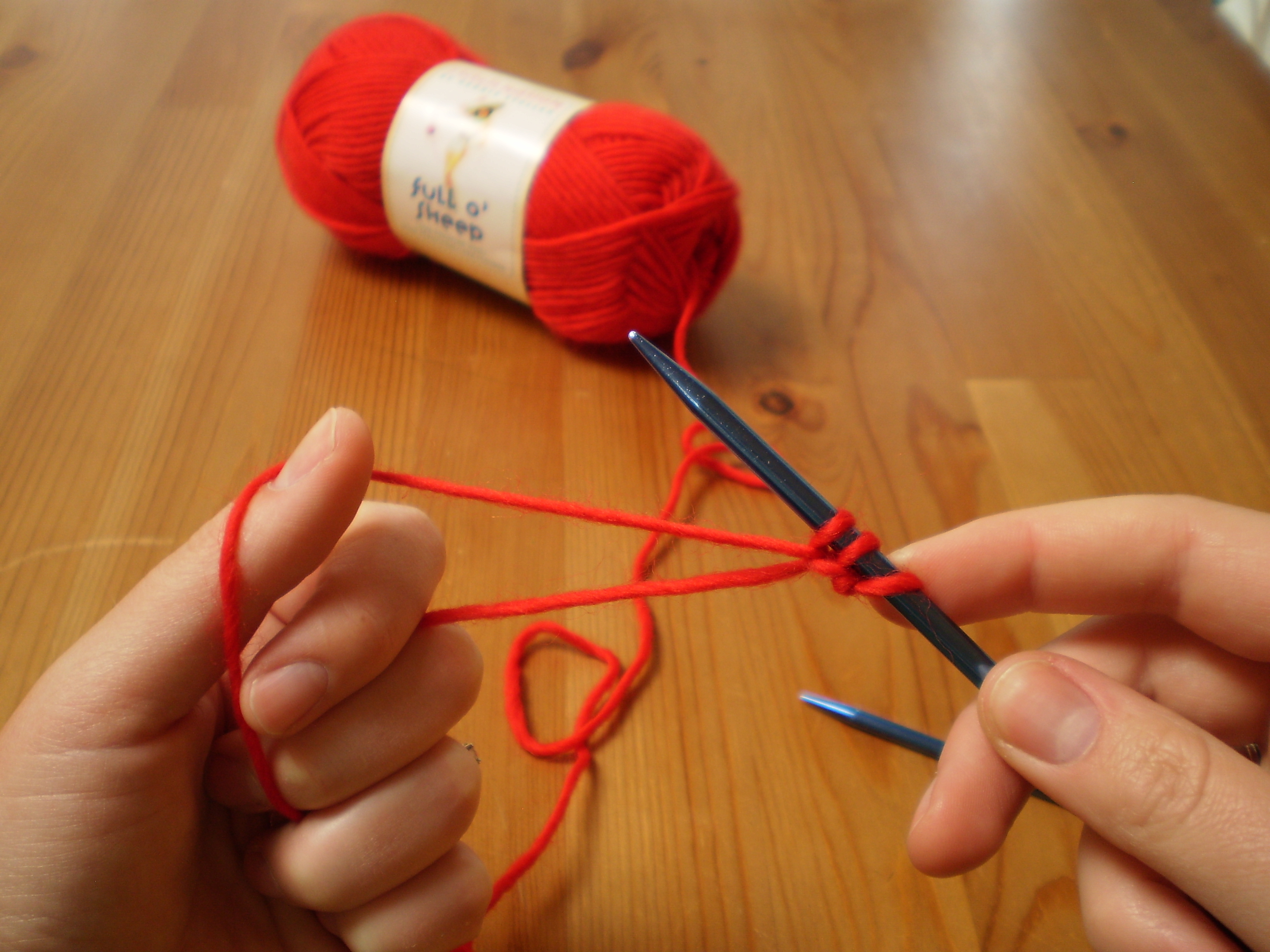
Start by measuring out a long tail (duh) that is about 4 times as long as your finished project.  (Since this is a hat, you can wrap your yarn around your head 4 times to estimate your length.)  Then, make a slip knot at the point that you measured.  In this case, you’ll have your ball of yarn on one side of the slip knot, and about 6 or 7 feet of yarn on the other end.  Slip the slip knot on your needle and tighten the loop so that it won’t fall off the needle.

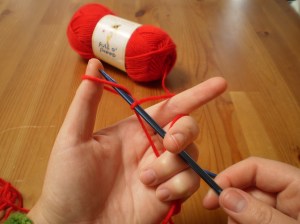
OLYMPUS DIGITAL CAMERANow, with your non-dominant hand, grab both the ball yarn and the tail yarn with your pinky and ring finger.  Then, slip your thumb and index finger between the two ends of yarn.  Make sure that the tail yarn is the one wrapped around your thumb.

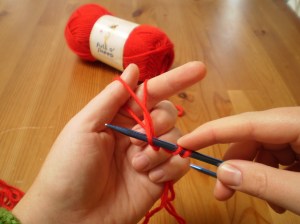
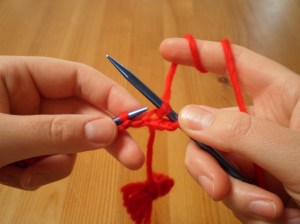
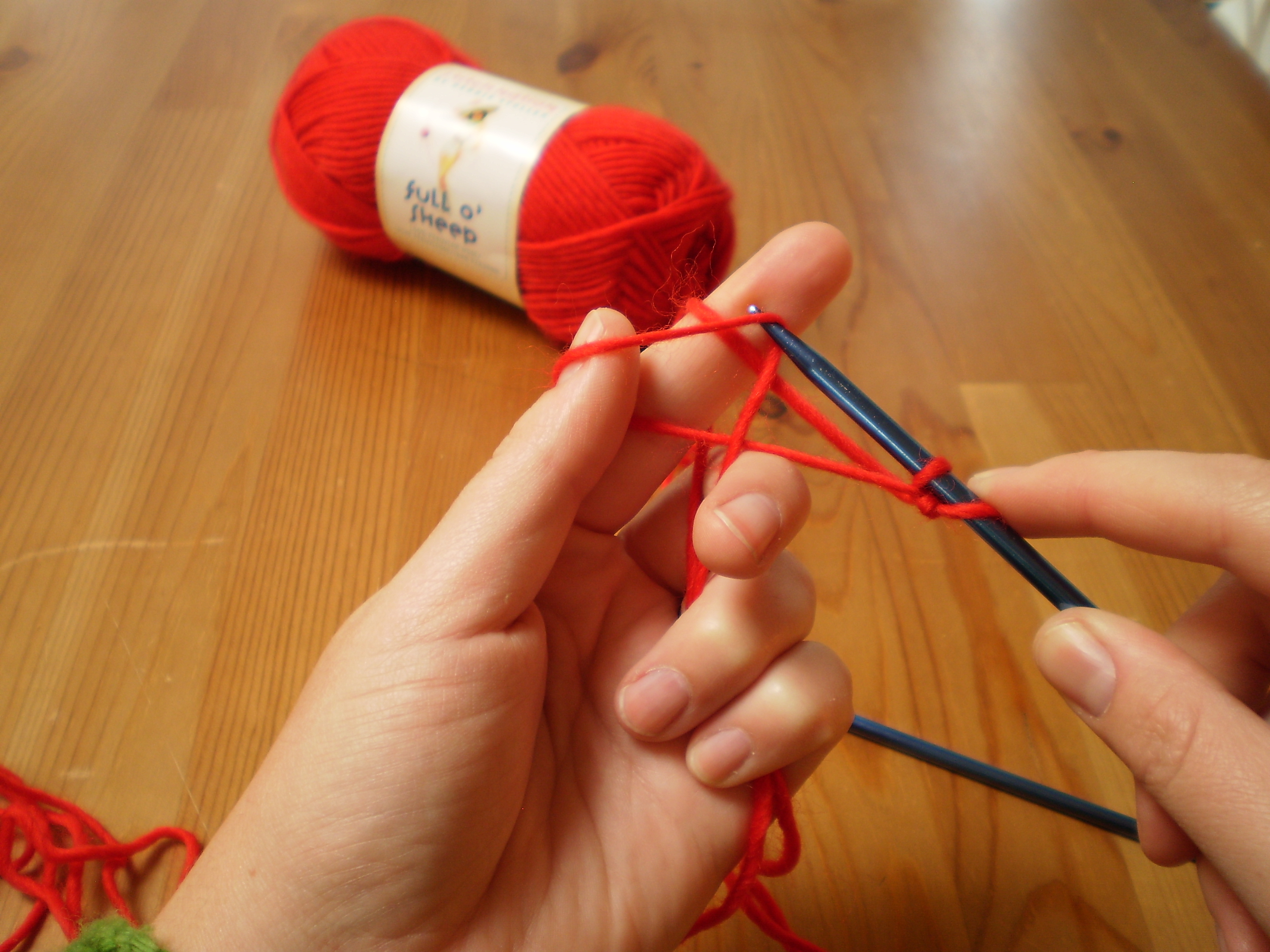
OLYMPUS DIGITAL CAMERAUse the point of the needle to slide from the bottom of your thumb to the top, picking up a loop of yarn.  Don’t let the yarn slip off your thumb.  Your pinky and ring fingers should keep tension on your yarn, which can help this.

OLYMPUS DIGITAL CAMERAOLYMPUS DIGITAL CAMERAThen, move the point of the needle over to the tip of your index finger.

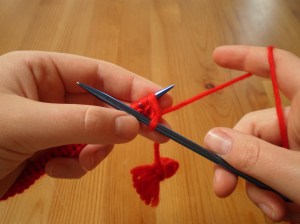
OLYMPUS DIGITAL CAMERASlide the point of the needle down your index finger, then down your thumb, too.  This will hook the loop of yarn from your index finger, and pull it through the thumb loop.
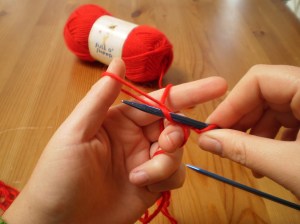
OLYMPUS DIGITAL CAMERANow, here’s the scary part.  Drop the yarn from your left hand.  I promise you won’t loose your work.OLYMPUS DIGITAL CAMERAPull on the yarn tails to snug up your new stitch.  Now you have two stitches!  Huzzah!
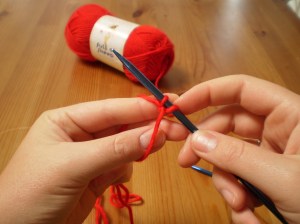
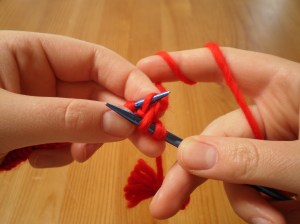
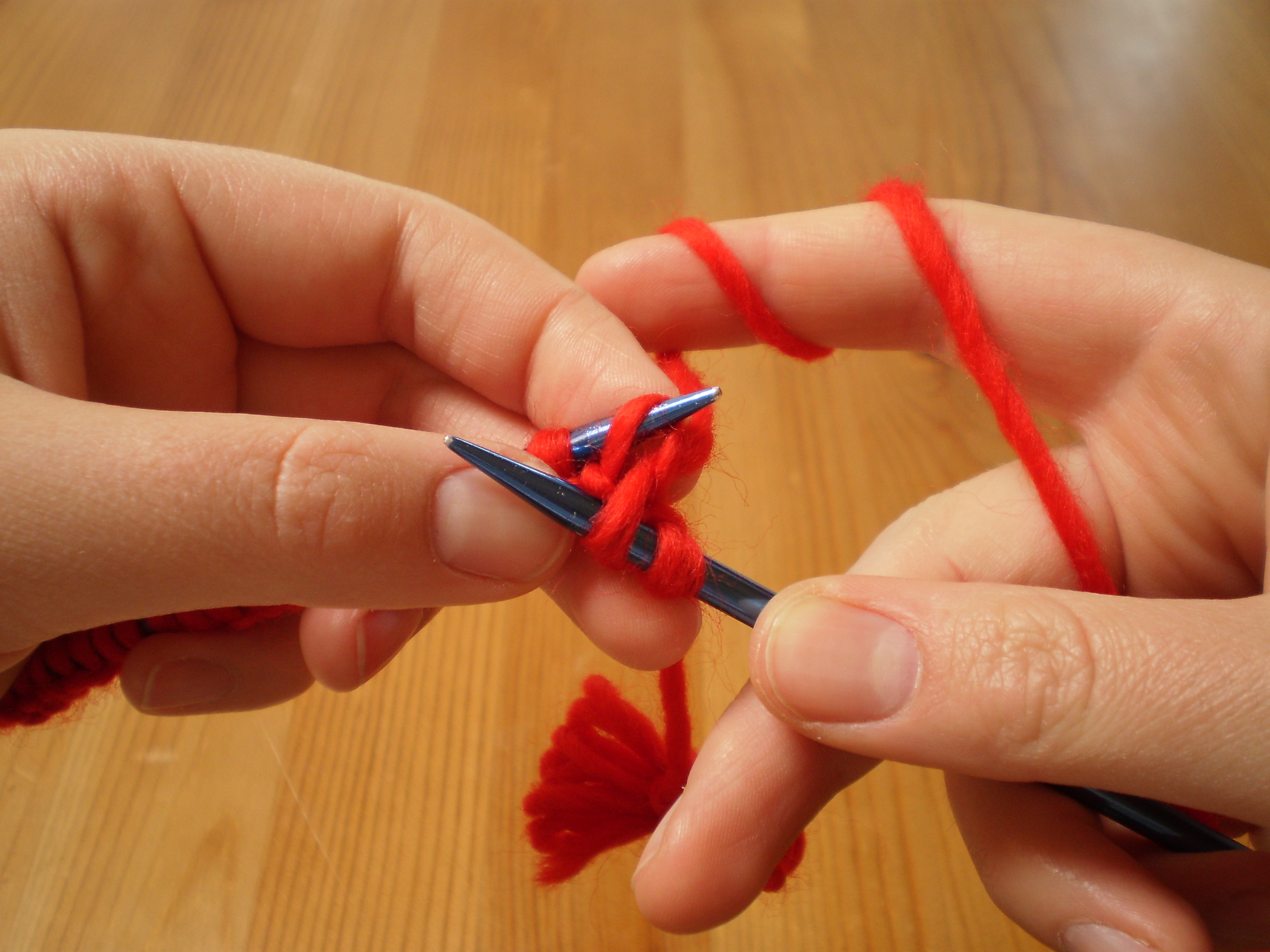
OLYMPUS DIGITAL CAMERAAnd now, you keep going.  Grab the yarn again in your non-dominant hand, with your thumb and index finger between the tail and the ball yarn.  Use the tip of the needle to slide up your thumb, over to your index finger, and back down your thumb, pulling the index finger loop through the thumb loop.
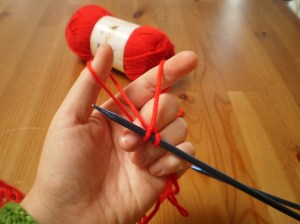
OLYMPUS DIGITAL CAMERAOLYMPUS DIGITAL CAMERAOLYMPUS DIGITAL CAMERAThen, drop the yarn, and tighten up your third stitch.
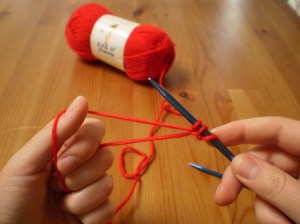
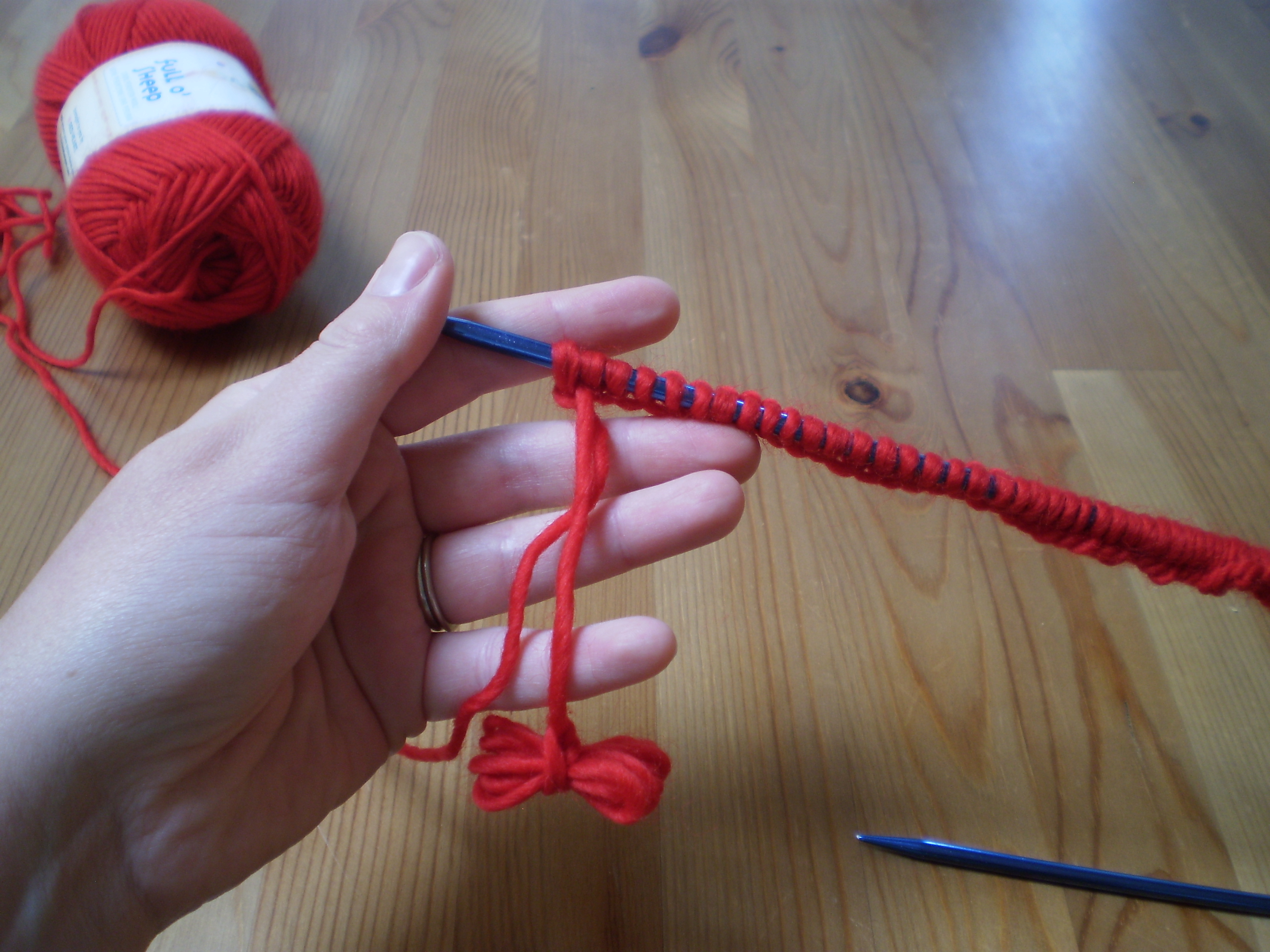
OLYMPUS DIGITAL CAMERAKeep on going, repeating these steps until you end up with 80 stitches on your needle.  (I know it seems like a lot, but practice makes perfect.  You’ll be burning through them before you know it.)  When you get all 80 stitches, tie up any remaining tail yarn into a little bundle to keep it out of your way.   You won’t do anything else with the tail until you’re done with all the knitting on this project.

OLYMPUS DIGITAL CAMERADid you get your 80 stitches all cast on?  Awesome!  Now it’s time to really start knitting.  Whenever you knit, you’re going to have the “old” stitches on your left-hand needle, and you will make the new stitches on your right-hand needle. So, that’s how we’re going to start.  Hold your needle with the stitches in your left hand, and your empty needle in your right hand.  Keep your ball of yarn on your right side.

OLYMPUS DIGITAL CAMERAAre you ready to start your first knit stitch?  Yes!

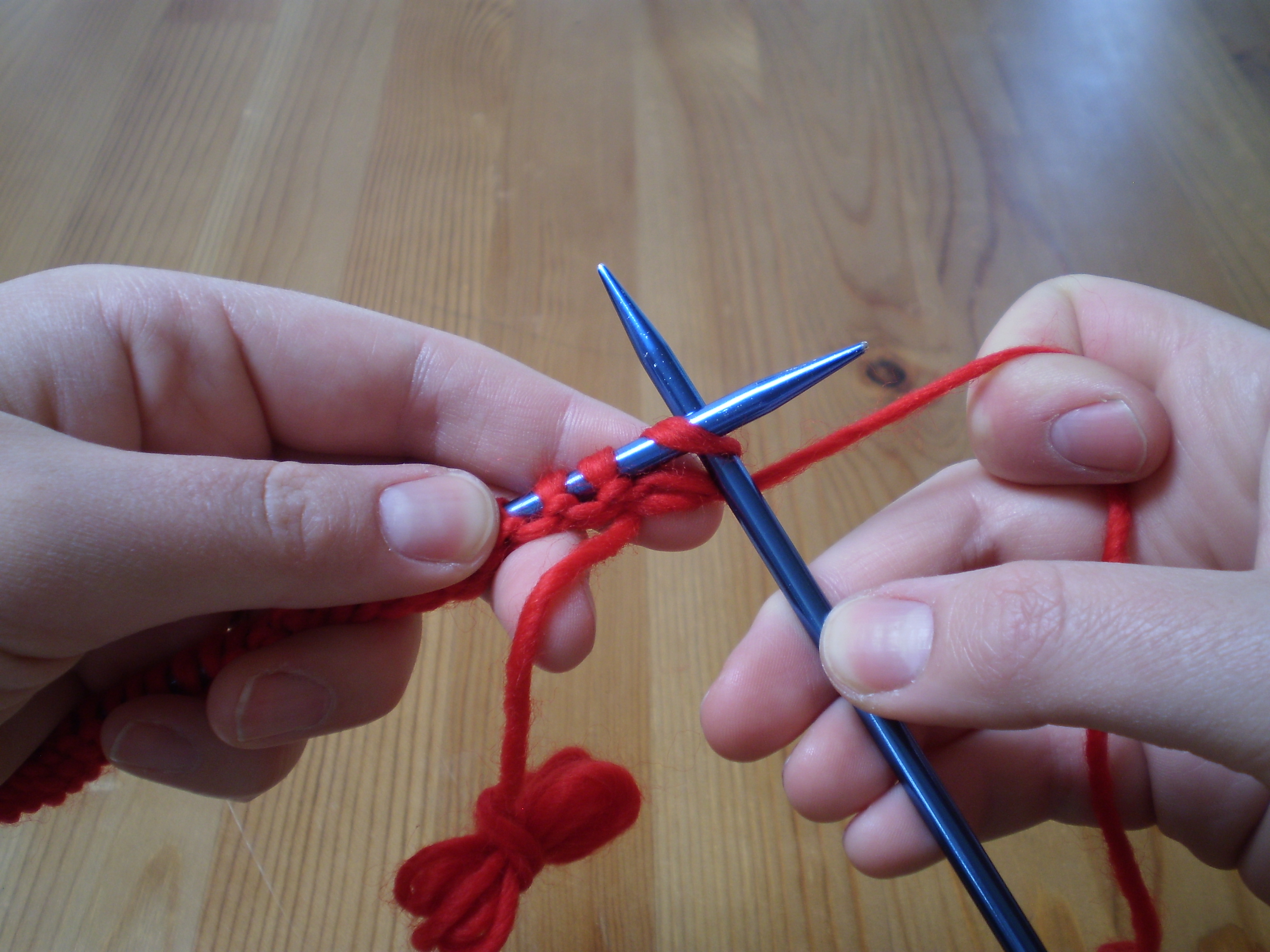
Insert the point of your right needle into the front of the first stitch, with your yarn held behind your knitting.  (The “front” of your knitting is the side that faces you as you work on it.  The “back” of your knitting is the side that faces away from you.) It should look like this:  OLYMPUS DIGITAL CAMERAThen, wrap the yarn around the tip of the right-hand needle.
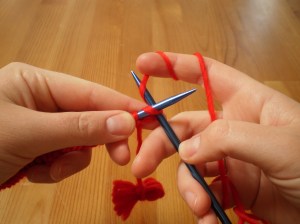
OLYMPUS DIGITAL CAMERAPull that new loop carefully through the old stitch.  This is tricky at first, so keep trying.  If you keep a little tension on your yarn, it makes it easier.  I like to wrap the yarn around my index finger to help keep tension, but if you don’t like that, try holding the yarn between your index an thumb, or wrapping it around your whole hand.  Every knitter holds their yarn a little differently. Find what feels good to you.

OLYMPUS DIGITAL CAMERAOLYMPUS DIGITAL CAMERAYou’ve made your new stitch (the loop you just made on your right-hand needle).  Now it’s time to get rid of your old stitch.  To do this, simply slip it off the end of the left-hand needle. Easy.
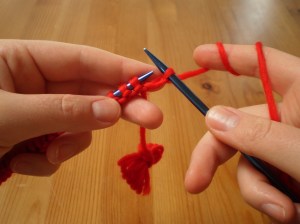
OLYMPUS DIGITAL CAMERAYou’ve finished your first stitch!  Congrats!  Now you just need to make approximately 1 billion more.  (Not really.  Although sometimes I wonder about how many stitches there are in a hat, or a sweater or something.  I’ve never actually sat down to do the math.  That would be crazy.)

Knit your second stitch:  Insert your right-hand needle into the front of the next stitch, wrap your yarn around the tip of the needle, pull the new stitch through, and then drop the old stitch off the end of the left-hand needle.
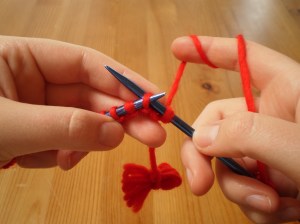
OLYMPUS DIGITAL CAMERAOLYMPUS DIGITAL CAMERAOLYMPUS DIGITAL CAMERAOLYMPUS DIGITAL CAMERATwo stitches done!  Keep going like this until you reach the end of the row.
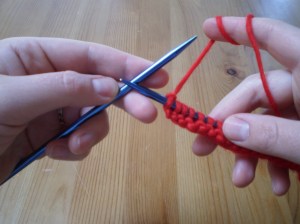
OLYMPUS DIGITAL CAMERAWhen you get to the end, swap your needles, so that your empty needle is in your right hand, and your needle with stitches on it is in your left hand.  Then, keep knitting away!
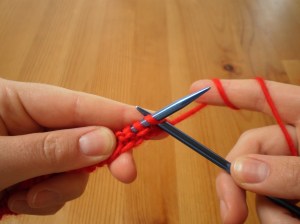
OLYMPUS DIGITAL CAMERAKeep knitting, switching your needles around at the end of each row, and soon enough you’ll see some awesome squishy fabric start growing off your needles.  (If your stitches aren’t as even as mine, that’s OK.  It adds character!  And, if you think it’s too bad to actually wear, you could frame the finished hat as a piece of modern art or something.)

OLYMPUS DIGITAL CAMERAThis pattern is called “Garter Stitch.”  It’s made when you knit every single row.  This is the brim of the hat we’re working on.  I worked my garter stitch for about 2 inches.  You can make your garter stitch brim wider or narrower by knitting more or fewer rows.

Next week, we’ll make the body of the hat, and I’ll show you how to work the purl stitch.  Happy knitting!

So Twisted

So,  you’ve got your pretty yarn all died and dry.  It’s in a big skein, but the threat of tangles still looms.  What’s a girl to do?

OLYMPUS DIGITAL CAMERA

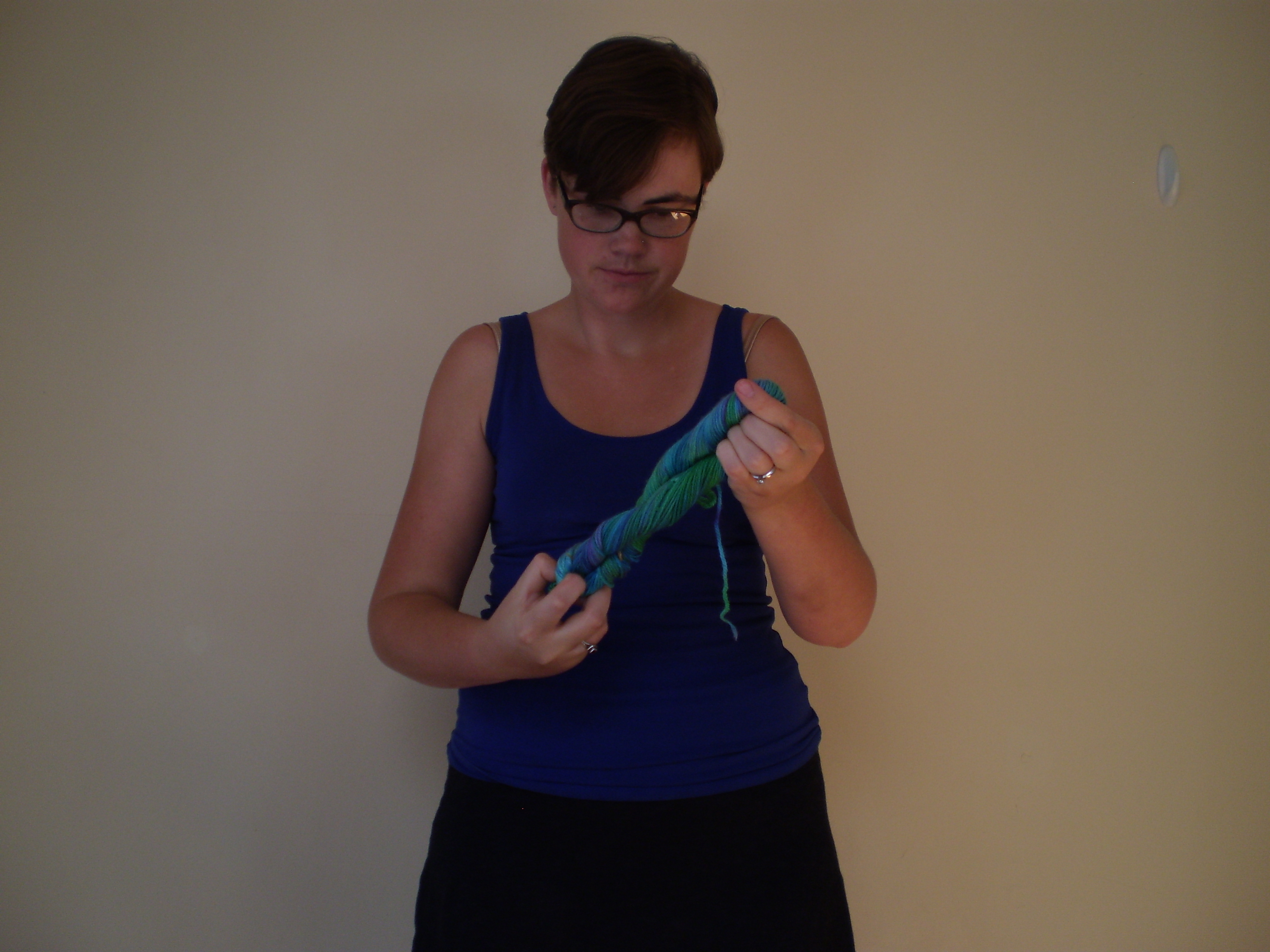
Here’s what to do to get your yarn into a pretty little twist.  It’s not terribly practical, but it’ll keep your yarn tangle-free until you get a chance to ball it up.  (Also, skeined yarn looks pretty, so if you’re giving your yarn away as a gift, this might be the way to go.)

Step 1:  Loop the yarn around your hands.OLYMPUS DIGITAL CAMERAStep 2: Twist, twist, twist.  Twist until you can’t any more.

OLYMPUS DIGITAL CAMERAStep 3: Fold the yarn in half.  I either hold the middle of the yarn in my mouth or under my chin. Don’t gag.  Ew.

OLYMPUS DIGITAL CAMERAStep 4: Tuck one end of the skein through loop at the other end.

OLYMPUS DIGITAL CAMERAStep 5: Futz with the skein to even out the twists.

OLYMPUS DIGITAL CAMERAStep 6: Success!

OLYMPUS DIGITAL CAMERA

Christmas Knitting: Gents

We can’t forget about the dudes!  Sometimes they’re a little harder to knit for, since they (typically) don’t go for fancy lace and pompoms and such.  But, here I’ve dug up some pretty neat (and manly!) projects for the guys in your life:

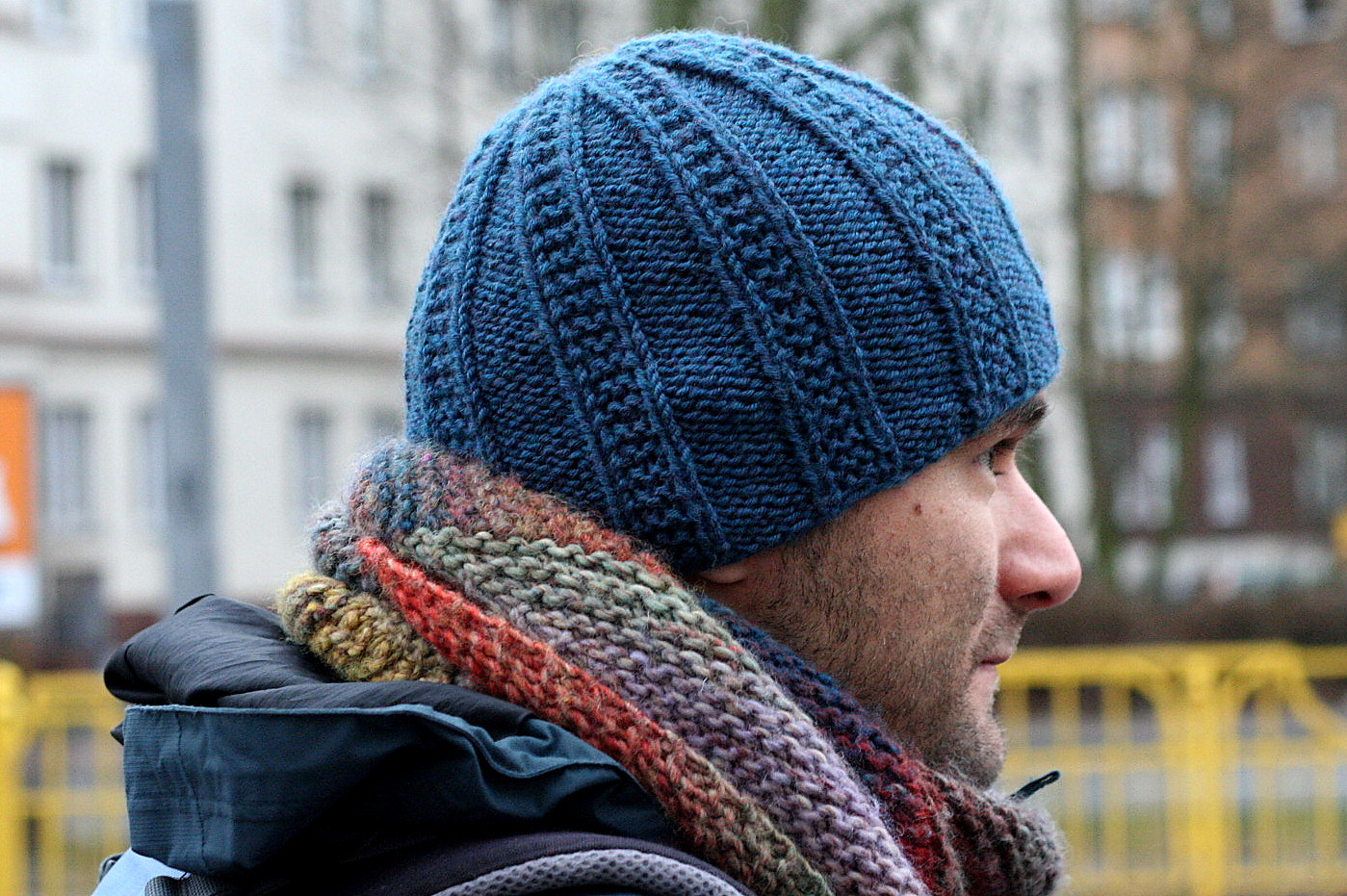
Bus Hat by Kylie McDonnell-Wade

bus hat


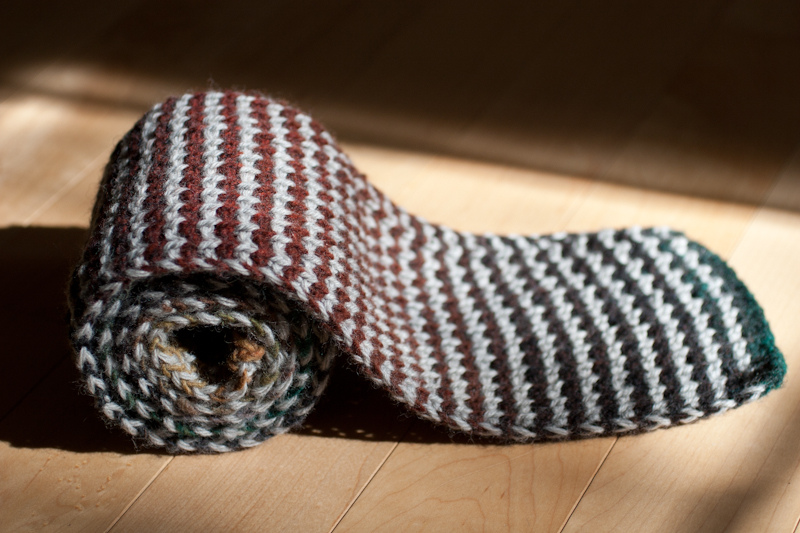
Handsome Scarf by Spilly Jane

scarf

Modified Army Gloves by Selyn Birnbaum

gloves

Socks With Pints On by Spilly Jane

beer

Christmas Knitting: Ladies

Holy crap, Christmas is coming soon!  (Even if you don’t do the whole Christmas thing, there’s always an excuse to do some gift knitting.) So, what to make?   This week, I’m trolling Ravelry for ideas for gift knitting projects.  Follow along if you’re looking for something, too.
Let’s start with knitting for the ladies in your life.  Mothers, friends, sisters, aunts, daughters, mothers-in-law, coworkers, the lady down the street that waters your plants when you go out of town.  I bet they’d all appreciate any one of these quick (and girly) projects:

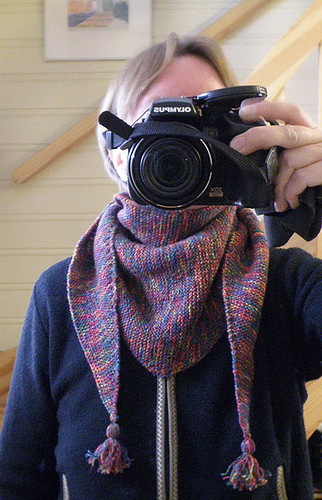
Baktus Scarf, by Strikkelise

baktus

Toast, by leslie friend

 toast

Meret, by Wooly Wormhead

Blog_Charlie_Meret_3

Persistence

Gather ’round boys and girls, and let me tell you the tale of the Green Yarn and the sweater(s) it became.  Our story begins in the year 2008…

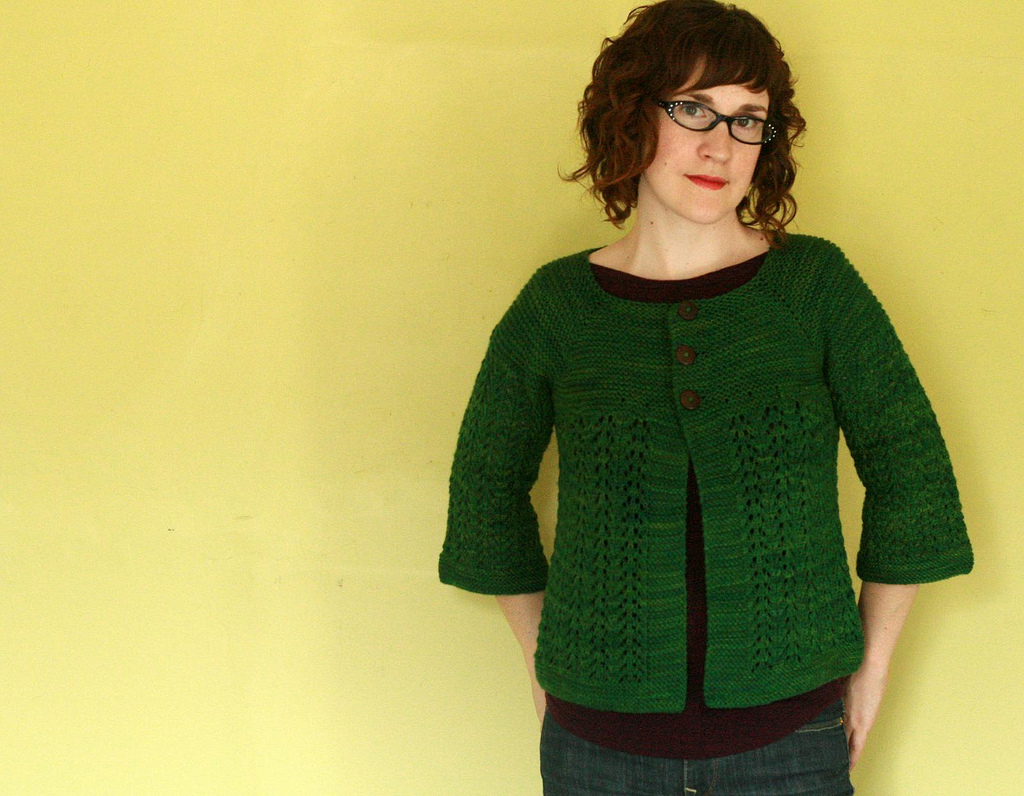
A hopeful young knitter named Allison found a beautiful pattern called the February Lady Sweater.

2557274228_d668e752a6_b

It was gorgeous… cozy, comfy, lacy, and a beautiful shade of green.  She had to have it.

As a graduate student, Allison went the cheapest route and bought a whole pile of white yarn from Knit Picks and dyed it with food coloring.  It turned out… with varying results.  Some of the skeins were greener, some were browner, and one even had bright red blotches in it.  It was odd, but it wasn’t going to defeat our knitter.  She went ahead and meticulously knit up the February Lady Sweater, carefully using each skein for only a few rows to mix the slightly different yarns throughout her sweater.  After months of work, and weaving in hundreds of ends, she was done!  She tried on the sweater and!

It. Looked. AWFUL.

It was chunky, too big, and looked like the worst, most stereotypical maternity clothes.  Allison wore it twice (out of stubbornness) and threw it to the bottom of her closet, where it was never thought of again.

Until…

In the summer of 2010, Allison got the itch to knit another sweater, and remembered that green yarn from two years ago, and went to go dig it out.  She found the terrible sweater, and tried it on again (just in case).  It was still ugly.  So, she ripped out the entire thing and balled it all up into a million golf ball sized skeins of yarn.

In the years since she had first knit the sweater, it had sat at the bottom of the closet becoming permeated with dust.  Unraveling the sweater and rolling up the balls of yarn caused both Allison and her husband to have massive allergy attacks.  So, out of spite, she hid the yarn away again, refusing to knit with something that made her sneeze like she had rolled around in a pile of cats.

Around Christmas 2012, Allison got it into her head that she wanted a new sweater.  Something plain, with nice long sleeves, and maybe a simple cable down the sleeves (because why not).

The idea rolled around for a while, until she purchased a book called “The Knitter’s Handy Book of Top-Down Sweaters” by Ann Budd.  “Perfect!” thought Allison, looking at the pattern for a basic saddle-shoulder sweater.  “I’ll make this!  It will be quick and easy, and I’ll be able to use that green yarn that’s been following me around for the past five years.”

She cast on, carefully spit-joining the ends of all her little skeins of yarn.  And, before she knew it she had the top half of a great pullover: sleeves, crew neck, shoulders, and a good 10 inches of body.  Excited, she tried it on:  the sleeves looked perfect, the neck was great, but the body of the sweater was way too big.

More determined than ever, Allison ripped out the body (again) and reknit it, this time decreasing on the sides to bring the size down.  She tried it on (again), and was dismayed to find out that the sweater looked even worse than before!  The body fit around the waist, but now there were weird puffy bits in the armpits of the sweater.  Not good!

She ripped out the body once again and reknit it, this time adding k2p2 ribbing panels on the sides.  She held her breath as she tried it on once more.

It fit!  It looked good! Hooray!

She flew through the remaining 6 inches of body and bound off as quickly as she could.  She blocked out the sweater that night, and kept coming back to look at it as it dried.

Two days later (Seattle is always slightly damp, even in summer), the sweater was cozy and dry!  Allison excitedly put on the “finished” sweater, and was heartbroken to realize that the sleeves, after blocking, were a good 4 inches too long.  After a bit of pouting, she ripped the cuffs back and reknit them in an evening.

Finally!  The sweater was done!  It had been five years since she had purchased the yarn, she had tried two patterns, and had at least 4 major froggings, but at last she had something to show for her work.

 OLYMPUS DIGITAL CAMERA

OLYMPUS DIGITAL CAMERA


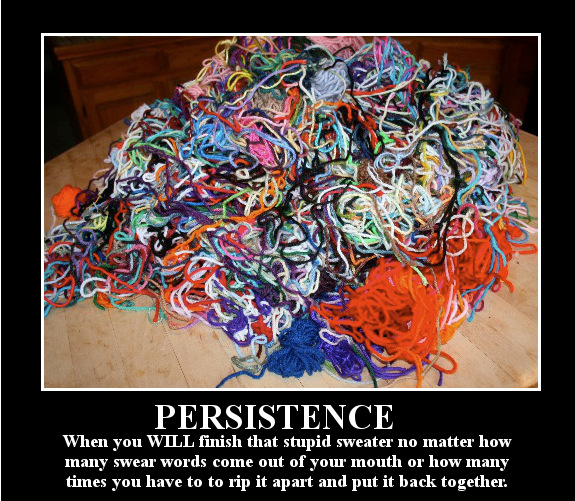
So, the moral of the story?  Never, ever, ever, give up.  That’s the great thing about knitting.  No matter how bad you mess up (unless you set your yarn on fire or something), you can always remake a pattern, fix your mistakes, or totally reknit your yarn.

persistence

I’m So Lazy…

I’m totally lazy.  I love trying to find  shortcuts and easy ways to do things.  Unfortunately with knitting, there often isn’t an easy way.  (There’s no shortcut for knitting the acres of stockinet for a sweater… you just have to do it.)

Sure, knitting is an effort-heavy process, but don’t lose all hope!  I’ve got a great little trick for making color work super easy.  Let’s imagine that you want to put a nice little fair isle border on the cuffs of your new sweater, or maybe knitting an intarsia heart on a little girl’s hat.  Your project would end up really cute, but it would be a total pain to do.  I don’t know about you, but I like just making plain old stockinet stitch garments (easy!).  So, what’s a girl to do?

That’s where the duplicate stitch comes in.  The duplicate stitch is technically an embroidery technique that you can use to decorate knitted fabric after it has already been knitted so that it looks as if the decorative pattern was worked as the project was knit up.  I like using it for projects that have only a little bit of fair isle (which can be a pain to do for only a row or two at a time), or any pattern that wants you to do intarsia in the round (which is almost impossible).

And, I’ve even made a video for you.  Enjoy, and let me know if you have questions!

The Search for the Perfect Pattern

My absolute favorite part of Ravelry is its searchable pattern database.  It’s super useful.

Imagine, if you will, that you want to knit a small stuffed animal bird.  You don’t want to pay for a pattern, and you also don’t want to have to sew any seams.  That’s a lot of things to have to search for, if you’re just Googleing for it.  Instead, let’s see what we can find using Ravelry’s advanced search tool.

Open up Ravelry, click on Patterns, then click on the “pattern browser & advanced search” button.  (Ravelry was designed by knitters, not by web designers, which is kind of obvious by its semi-terrible user interface.)

Patterns 1

This brings us to a page of ALL of the patterns currently on Ravelry.  If you really wanted to, you could just go page by page and see everything.  Sometimes it’s fun to browse the patterns, but today we’re on a mission.  We’re going to use the search bar and filters to narrow down the patterns that are available to us.  Take some time to see what filters there are available.  Some of the filters are obvious: knitting vs. crochet, free vs. paid, type of item that the pattern is for (sweaters, soft toys, tablecloths, etc.).  Some of the filters are super specific: design elements (lace, ribbing, etc.), construction details (top down, short row shaping, etc.).  Poke around and see what they’ve got.Patterns 2

Every time you click on a filter, you’ll notice that the patterns start to match your selections.  We wanted to knit a bird stuffed animal with no seams, and we wanted the pattern for free, so I clicked on the following filters:

-Free

-Knitting

-Seamless

-Softies

and I put the word “bird” in the search bar, since there isn’t a filter for “Bird.”

Look at all those seamless, free bird patterns!

Patterns 3

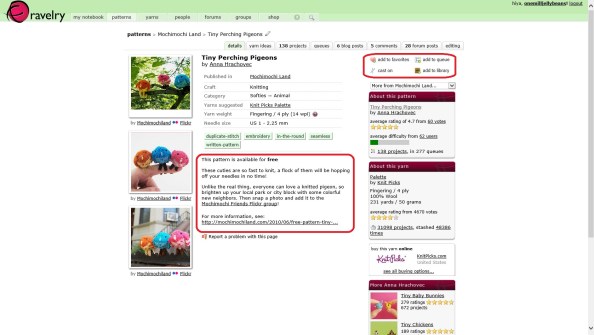
When you find one you like, you can click on the picture, and you’ll bring up the pattern page.  From there, you’ve got some options.  Ravelry will link you to where you can find the pattern (in the middle of the page).  Or you can save the pattern in your “Favorites” or your “Queue.”  OR, you could “Cast On” and start a project page for yourself right away.

Patterns 4

I hope this makes your pattern-finding quests a little easier!  Poke around the site and see what you can find.  What else do you use Ravelry for?