Category Archives: Techniques

Stellar’s Jay Sweater: Changing Plans

I’ve been hard at work on my Stellar’s Jay sweater.  The body is almost up to the armpits!

I’m following my pattern as I wrote it, except for a couple (sort-of) minor details.

First, I decided that I didn’t like doing the scallop rows the way I had planned it out, so I modified it a little.  Now, it is slightly shallower (worked over two rows, instead of three), and I think it looks much better.  I’m probably the only one who would ever notice, but I’m picky that way.

Second (and this is a larger change), my pullover had turned into a cardigan.  I don’t know what happened- I was casting on and some knitting spirit whispered in my ear that I needed a cardigan, not a pullover, and one thing led to another.  I’m still following the pattern as I designed it, but instead of working the sweater in the round, I’m knitting it flat.  When I finish up the sweater, I’ll pick up stitches along the selvedge edges and knit on some button bands.  It should look pretty good (I hope!).

OLYMPUS DIGITAL CAMERAIt’s important to remember that regardless of how much planning goes into your knitting, it’s still possible to change plans as you work.  You’re in charge of your project, and being flexible when you don’t like how something is working up will end up giving you a better finished project.

What changes have you made to projects as you knit them?

A Short Explanation of a Circuit

So, what do you think about giving this soft-circuit thing a shot? I’ve got a pretty cute (if I say so myself) pattern in the works for Monday, but in the meantime, let’s talk about circuit basics.  (WARNING: I’m so not an electronics person, so if I use the wrong words, or if I say something backwards, I apologize.  This is just what I’ve managed to figure out bumbling around on my own.)

Let’s make a little imaginary circuit.

We’ll start with an LED. I bought mine from SparkFun. They’re sold in packs of 5 for about 4 bucks. It’s tiny- about a half inch long, and less than an eighth of an inch wide, but it’s super bright when it lights up.  See on the two little holes on either end? Those are the connections to attach it into a circuit. You sew your conductive thread through those, as if you were attaching a button.

10081-02[2]We’ll also need a battery (duh).  I’m using a little coin battery (also from Sparkfun).  It’s the size of a nickel.

00338-07_replace[1]
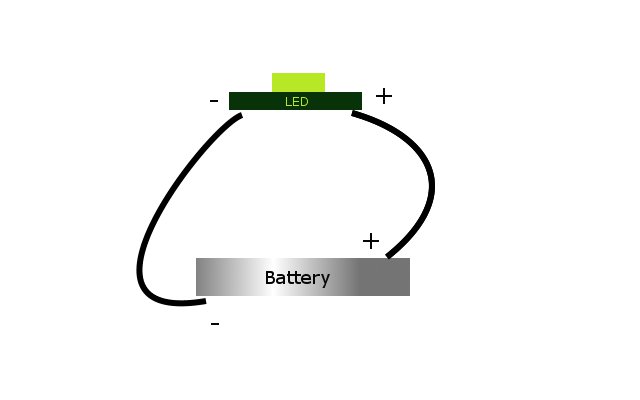
Let’s use two “wires” (pieces of conductive thread) to attach the battery to the LED, like this:Circuit 1

See how the + side of the battery is attached to the + end of the LED? And the – side of the battery is attached to the – end of the LED? That’ll make sure that the LED will light up.

Now, we could stop here. We have a lovely, bright, and shiny LED. But, where’s the fun in that? I’d like to try turning the light off and on.

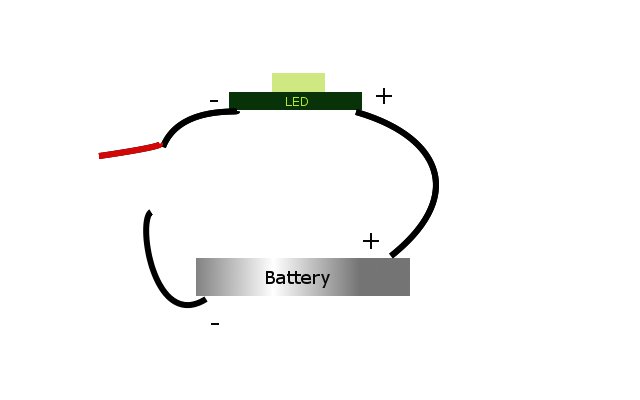
You can buy switches, buttons and other devices for turning your circuit off and on, but they all follow the same principle:  When you make a hole in one of the wires, the circuit is broken and the LED will turn off. If you patch up the hole, you complete the circuit, and the LED will turn on again.

See?  (The switch is shown in red)

OFF:Circuit 2ON:Circuit 3Easy! Frankly, the hardest part of this is making sure that your wires don’t accidentally cross and create a short circuit, but even that’s not too difficult!

Think you’re ready to try your hand at E-Textiles?

Yarn + Electricity = Winning

This weekend MakerFaire is happening in San Francisco!  I am so excited to finally get to go after years of reading about it.  MakerFaire is a super cool craft fair/creative festival that  celebrates innovation and ingenuity.  Anyone who has a cool idea is welcome to share it with other fair-goers.

You made a bicycle-powered sewing machine?  You developed a robot that tends your garden for you?  You used scrap metal to build a car?  You have a spot at MakerFaire. People at MakerFaire are especially known for taking two things that don’t usually go together, combining them and making something amazing.

Like fiber arts and electronics.

E-textiles (aka soft circuits) are a really cool way to try your hand at electronics and create some amazing projects.

The basic idea is that you use conductive thread (nylon thread, coated in a conductive metal) instead of wires to connect your electronic components (like leds, batteries, sensors and tiny computers).

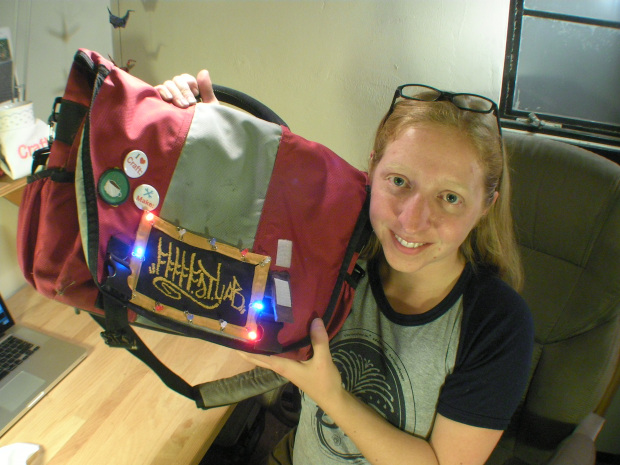
You could go super simple, and make a pair of texting gloves.  The conductive thread woven through the fingertips allows you to use a touchscreen  without removing your gloves.  (Handy in the Great White North in February.)

Teknika Gloves by Laura Nelkin

6437487283_bc44cb9a7d_z[1]Or you could get your embroidery on, and make a little sampler, including LEDs, a battery and an on/off switch.

SANYO DIGITAL CAMERAOr, if you have more tech experience than I do, you could get your hands on a LilyPad Arduino.  It’s a tiny computer that you can plug into your computer, program, and use to make LEDs blink in cool patterns.

SANYO DIGITAL CAMERAWhat would you use soft circuits for?

Wall Shawl

On Monday, I told you how I love making lace shawls.  You’ll notice that I didn’t say I love wearing lace shawls.  This is because I am a pretty big tomboy.  I love how lace shawls look, and I love making them, but I always feel like a monkey in a top-hat when I wear them.

So, I had a whole stack of gorgeous shawls that did nothing but sit in my closet, waiting for moths to show up and start munching.  Something had to be done.  How could I display them?  I tried hanging them over my closet door, but then I couldn’t open and shut the door without them falling all over the place. I tried putting one over a table lamp, but that looked like something from a palm-reader’s office (and I was paranoid about setting the whole place on fire).  And, so my lace shawls went back into the bottom of the closet again.

Until I realized something.  These lace shawls were basically great big art pieces.  And my house was full of empty walls, begging for art to be put up.

I grabbed my Panache shawl and a dowel I had laying around (because I am a pack rat and have dowels lying around, just in case.  You never know.)  I carefully sewed the flat edge of the shawl to the dowel using a little bit of matching scrap yarn, and tied a big loop from one end of the dowel to the other.  I pulled out a sticky hook, and I  had filled my wall with lacy, yarn-y goodness in no time.  (And yes, I know this is a terrible photo.  Apparently I have forgotten how to take a decent picture that isn’t a close-up…)

OLYMPUS DIGITAL CAMERAMy Panache is a medium sized shawl (about a 40 inch wingspan), but my Aeolian shawl, is a monster.  It’s at least 60 inches from point to point, so sewing it to a yard-long dowel wouldn’t fly.  I thought about it for a long time, and then the perfect solution came to me while I was doing yard work.

I cut some long (6+ feet) switches from one of the trees in my yard, and lashed them together with twine.  I added a loop of twine and hung them from a nail in my knitting studio.  Then, I looped the Aeolian shawl over the ends.  I really like how it turned out.   It’s pretty, and rustic, and if I ever want to display another shawl (or scarf, or sweater, or blanket) I can switch them out easily.

OLYMPUS DIGITAL CAMERA

Stellar Jay Sweater: Gauge and Math

It’s here! It’s here! Let’s all ooh and ahh at the beautiful yarn!

OLYMPUS DIGITAL CAMERANext step is to whip up a swatch. I have been brainstorming this sweater, and I think that plain stripes are too boring, so I’ve decided to do a little scallop design between each stripe, so I’m going to include that in my swatch, to see how it looks. Two birds. One stone.

I knit up a square of fabric about six inches by six inches. And I’ve worked my scallop pattern both right-side-up and upside down, to see which I like better.

This is the upside-down version, but I think it makes the scallops look a little rectangular.

OLYMPUS DIGITAL CAMERAThis is the right-side up version, which I like better.OLYMPUS DIGITAL CAMERA

This means that I will need to work my sweater from the bottom up, which is important to know when I start designing my pattern.

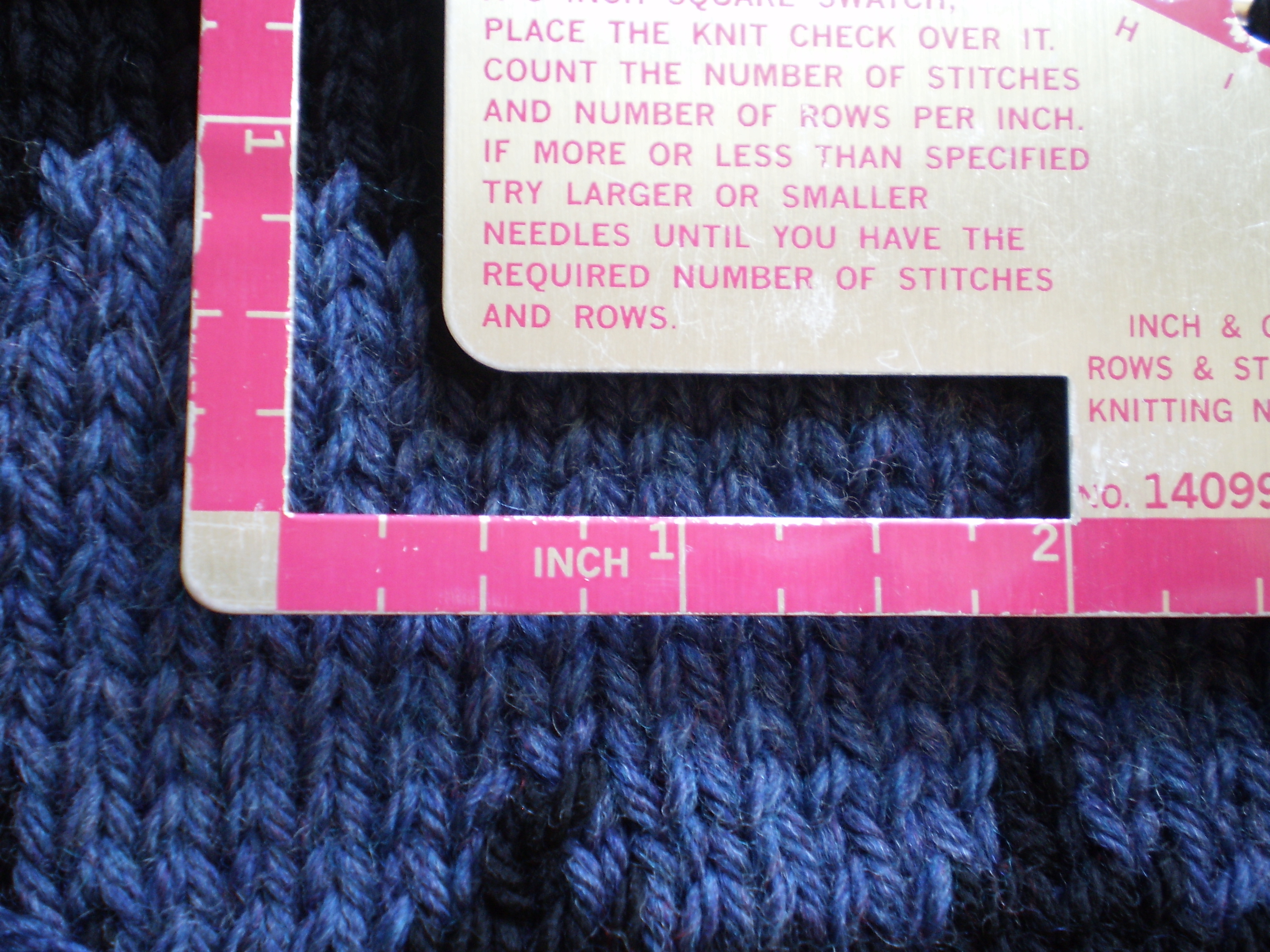
I pulled out my gauge meter (you could just use a ruler or tape measure) and measured out my gauge. I got 5 sts per inch and 7 rows per inch in stockinet stitch on size 8 needles.

OLYMPUS DIGITAL CAMERASo, now that I know my gauge, and the general design I want to use (bottom up pullover), I do a little math and sketch out my pattern. I’m basing this one on Elizabeth Zimmerman’s Percentage System, to give me the bones of the sweater, but I’m tweaking it a bit to deal with an all-over stripes pattern, instead of only a yoke pattern.

OLYMPUS DIGITAL CAMERABelieve it or not, those chicken scratches make sense to me. I usually sketch out my pattern like this (on a drawing), before I start knitting. Then, as I knit up the pattern, I’ll make notes into a notebook or on my computer in more standard knitting lingo. But, for now, this will do nicely for me.

Now I get to go cast on! Woo!

I’m Still a Baller: Winding Yarn Part 3

I want to show you one more way to wind a ball of yarn.  This one’s easier, but it takes a bit of hardware, so it may or may not be right for you.

This is a ball winder.  They cost about 45-50 bucks, depending on the brand, which is a little pricey.  If you wind a lot of yarn, it might be a worthwhile investment.  If you only go through a couple skeins of yarn a year, maybe not.  If you don’t want to invest in one for yourself, see if your local yarn store has one available for customers, sometimes they do.

OLYMPUS DIGITAL CAMERAMine screws to the edge of a bookshelf or table.  I’ve seen ones with handles that you can hold, but that seems like it would be awkward to use, since I don’t have three hands.

When you have your ball winder situated, thread your yarn through the little metal eyelet, and attach the end to the slots at the top of the winder.

OLYMPUS DIGITAL CAMERAThen start twirling the handle and watch the yarn start to wind itself into a ball.

OLYMPUS DIGITAL CAMERATurning the handle spins the  top part of the winder, which, in turn, winds the yarn into a perfect cake.  Keep going, and watch the yarn build up.  Ooh! Aah!

OLYMPUS DIGITAL CAMERAOnce you have wound all the yarn, wrap the end around the outside of the cake a couple times and tie off the end.  Pull the cake from the winder, and you’ve got yourself a perfect center-pull ball of yarn.

OLYMPUS DIGITAL CAMERA

I’m a Baller: Part 2

Two weeks ago, I talked about how to roll a ball of yarn the traditional way.  A regular old ball of yarn is plenty useful, but sometimes they can be a pain.  You could be working somewhere with a less-than-sanitary floor (at a bus stop), or somewhere where going after a runaway ball of yarn would be difficult (on an airplane), or perhaps an ill fate would befall your yarn if it left your vicinity (maybe you have a vicious house cat or sticky toddler?)

A traditionally wound ball of yarn can get itself rolling (and unraveling).  But, a center-pull ball doesn’t have that problem, and it’s almost as easy to wind as a regular ball of yarn.

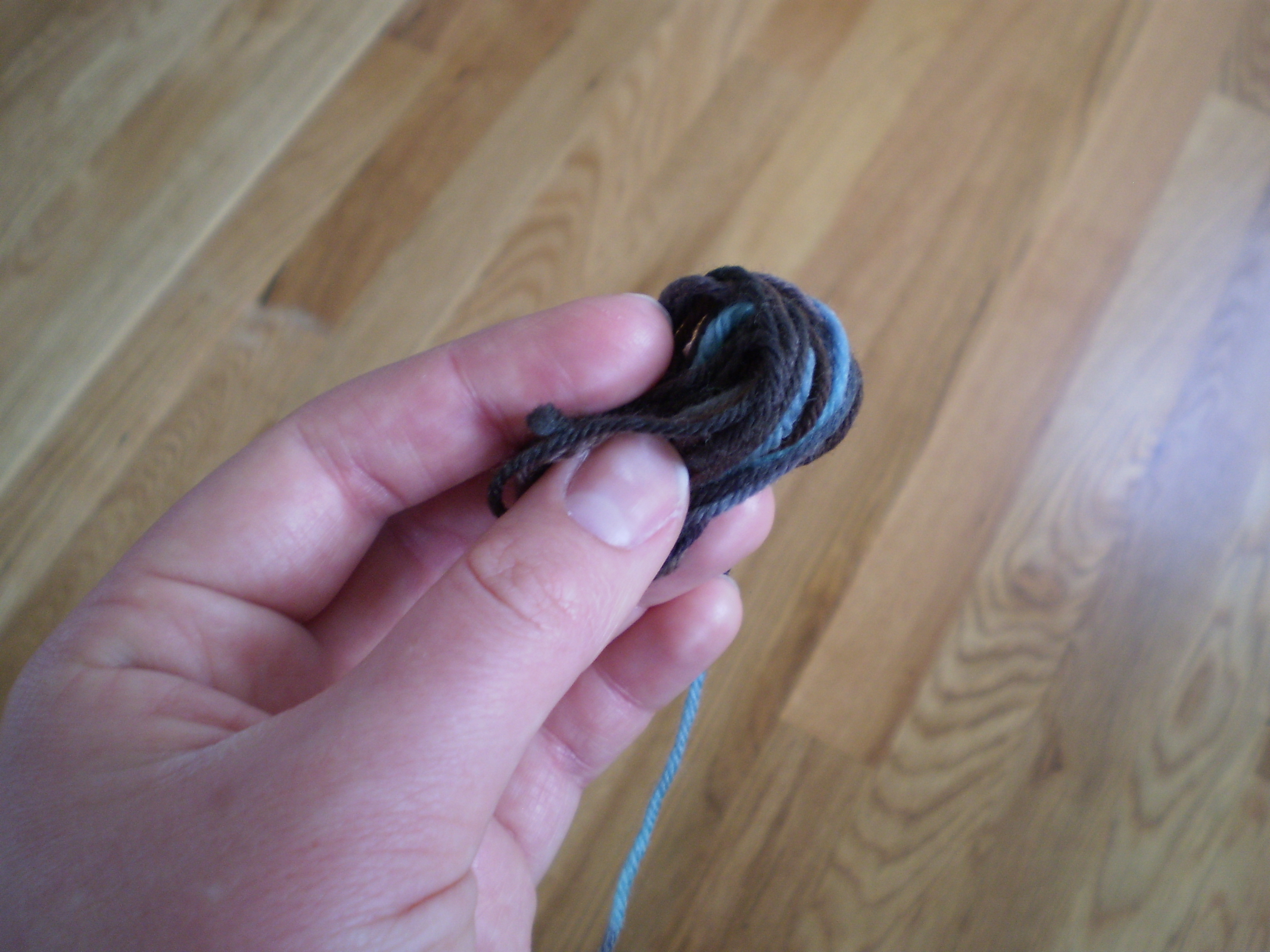
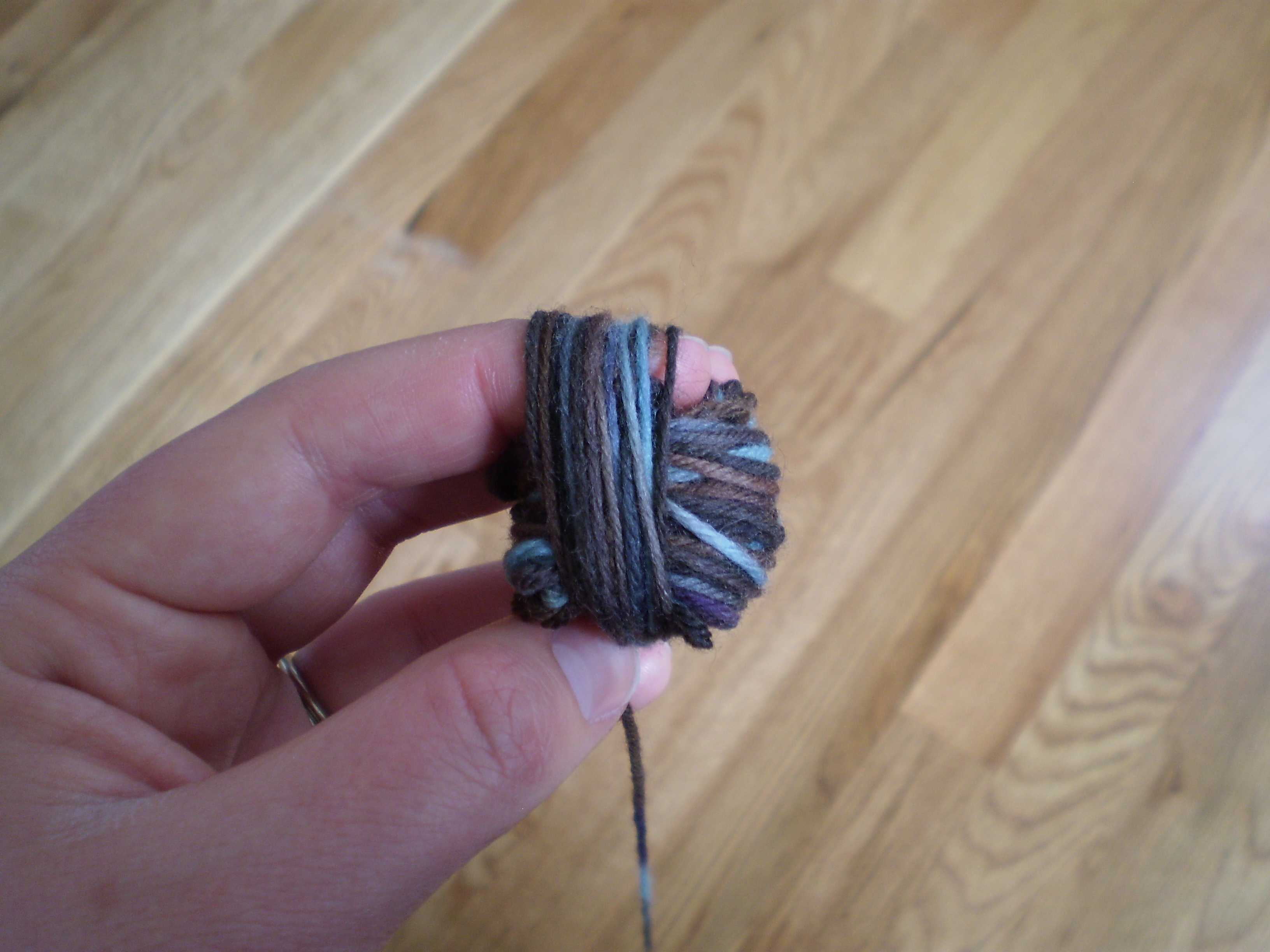
It starts exactly the same way.  Wind a good amount of yarn into a figure-8 around your thumb and forefinger.OLYMPUS DIGITAL CAMERARemove the figure-8 from your fingers and wind your yarn around one end of the figure-8 until it gets nice and puffy. OLYMPUS DIGITAL CAMERAKeep winding and turning around that initial puff of yarn, just like you did the regular ball of yarn.  Change directions every so often, and keep a finger or two caught in the loops to keep the yarn from getting too tight.   Just remember that the end of the figure-8 is poking out the top of the ball, like a strange little tuft of hair.

OLYMPUS DIGITAL CAMERAThen, when you’ve finished winding all the yarn, tuck in the end  so that it won’t unravel itself when you throw your ball in your knitting bag.  When you’re ready to start knitting, pull out the whole tuft from the top of the ball, and get to work!

OLYMPUS DIGITAL CAMERA

I’m a Baller, And You Can Be, Too!

You’ve got your skein untied and ready to go.  What’s the next step?  Rolling your yarn into a ball.

Start by wrapping the yarn in a figure 8 around your thumb and forefinger.

OLYMPUS DIGITAL CAMERAFold the figure 8 in half.  (Does that make it a figure 4?  Probably not.)

OLYMPUS DIGITAL CAMERAThen, start wrapping around the little yarn nubbin you made from your figure 8.

OLYMPUS DIGITAL CAMERAWrap it snugly, not so tight that you have to put muscle into it, and not so loosely that it’ll just fall apart.  Keep going until your proto-ball gets nice and chubby.

OLYMPUS DIGITAL CAMERAThen, turn it 90 degrees, and hold it between your thumb and forefinger.  Wrap the yarn around the ball in the new direction, catching your fingertips as you go.

OLYMPUS DIGITAL CAMERAKeep going, turning the ball  every 20 or so wraps.  Turning the ball and wrapping in different directions will give you a nice round, even ball.  Making sure that your fingers get caught every time you start wrapping in a different direction will ensure that you end up with a squishy ball of yarn.  This will stop you from wrapping the yarn too tightly, which can end up removing all the springiness from your yarn (imagine keeping a spring stored in the stretched-out position, it would eventually stick that way).

OLYMPUS DIGITAL CAMERAWhen you finish, your ball of yarn should be firm enough to hold its shape, but loose enough  that you can squeeze it like one of those foam stress balls.

OLYMPUS DIGITAL CAMERATuck the end of your yarn around the last group of wraps, and your yarn is ready to go into storage.  Or, cast on and start knitting!

And This Is How I Did It

Wednesday, I talked about a sweater I made for my grandfather, based off one that his mother made for him decades ago.

I thought it might be interesting to talk about how I combined a couple patterns, added my own details to create this customized sweater, and went from an idea to a finished product.

I started with the description my Grandfather gave me, “A brown and blue sweater with deer on it.”  From there I guessed that he meant an old-school ski sweater with some sort of color work pattern on the front and back.

235792[1]I looked at patterns for ski sweaters, and none of them were quite right.  They were either too fancy (too many colors or too fussy-looking), or more formal than I knew my grandfather would like to wear (he is a hunting, fishing, outdoors-y type).

Instead, I decided to start with a very simple pattern that I had used before, and modify it to my liking.  I picked the Weasley Sweater by Alison Hansel.  It’s a simple and easy drop-shoulder sweater that comes in a million sizes from infant to grown-up.  I’ve knit a couple sweaters from the pattern before, and they have all turned out really well.  (And the pattern is available for free!)1116161018_78043aab2b_z[1]

The only thing that I don’t care for with the Weasley Sweater is the rolled hem and collar.  Instead, I knit a k2p2 rib for the bottom, and a k2p2 crew collar.

OLYMPUS DIGITAL CAMERAAnd, instead of working the whole shebang in plain brown, I added a stripe of blue just above the cuffs and hem.  Adding a little bit of color work at cuffs and hem is a very “ski sweater” thing to do, and a stripe is the simplest color work you can do.

OLYMPUS DIGITAL CAMERAMy next problem was the deer motif that I had to put on the chest.  I looked at a lot of patterns, and finally decided to use the deer motif from the His & Hers Reindeer Jackets from Patons.  I originally planned to work the deer using the intarsia technique, but then I decided that I wasn’t insane.  (Intarsia and I don’t get along very well.)

Deer_Sweater_-_front_medium[1]Instead, I knit up the whole sweater in plain brown (except for the blue stripes at cuffs, hem, and the edges of the chest panel), and used the duplicate stitch to add the deer after once the knitting was done.  It took approximately 100 years to finish the deer (not really), but I think it was worth it.  Because the whole chest panel is knit plain, the sweater is stronger than it would have been if I had worked the deer in intarsia (and I think it looks better, too).

OLYMPUS DIGITAL CAMERASo, with a couple different patterns, some planning, a little futzing, and inspiration from the ghost of my great-grandmother, I think I managed to make exactly the sweater that my grandpa was looking for.

OLYMPUS DIGITAL CAMERA

Finishing and Felting

Finishing a project properly makes the difference between a “thing I just knit” and an “heirloom-quality hand-knit”.   If you’re knitting up something with a “right side” and a “wrong side” (like a sweater or socks) weaving in the ends is perfectly adequate.  With these garments you can just let your little ends dangle inside, and no one will know or care.  But what about when you make something without a wrong side?  For instance, a shawl or a scarf?

That’s where I deploy this little torture device:

OLYMPUS DIGITAL CAMERAIt’s my needle felter.  Look closely.  See those razor-sharp little needles with tiny little skin-ripping barbs?  Terrifying.

OLYMPUS DIGITAL CAMERAThese little puppies cost about $10 and are available at most craft stores or online.  They are used to do (duh) needle felting.  But they are awesome at dealing with knitted ends.

Hey, look!  I have an example end that I want to hide.  I wove it in like normal, and then trimmed it to about 1 inch.

OLYMPUS DIGITAL CAMERAAll you do is hold that sucker against your knitting and poke it with your needle-felting tool.  I like arranging the end in such a way that it “disappears” into the pattern.  For example, into the trough of a patch of garter stitch, or (like here) up along a column of  ribbing stitches.  Once you have the tail where you want, poke it a couple times with the needle-felting tool. (Carefully!  Don’t stab your fingers!)  Those little barbs on the needles will catch the fibers in the tail and tangle them with the fibers in the knitting.

OLYMPUS DIGITAL CAMERAAfter poking the tail a handful of times, you’ll see your tail virtually disappear!  Isn’t that cool!OLYMPUS DIGITAL CAMERA

There are two tiny caveats for this technique, though.  First, it really only works on yarns made with natural animal fibers, since it is a variation of felting.  Acrylics, cottons and linens don’t have the right fiber structure to let the felting alchemy take place.  And second, don’t felt it too much.  The more you poke the tail with the needle-felter, the more fibers get pushed out the other side of the fabric, which can leave you with a fuzzy backside.  And no one wants a fuzzy backside.