Tag Archives: finishing

Blocking!

I’ve gotten a few questions recently about blocking.  And it is kind of mysterious, so I understand the confusion.  It actually took me several years of serious knitting before I started regularly blocking my projects.  And let me tell you, it was amazing how much nicer my projects looked once I started blocking them.

OLYMPUS DIGITAL CAMERA


Think of blocking like adding a squeeze of lemon or a dusting of powdered sugar to your project.  It’s a flourishing touch that turns a good project into a great one.  Sure, your sweater will fit, even unblocked, but it will be so much better if you do.  Blocking makes your stitches more even, straightens out any little pulls and makes your knitting look more professional.  And (and this is a huge bonus), it lets you cheat a little bit on the size of your finished project.  Did the scarf turn out a little too small?  Are your sweater’s sleeves a little too long? Blocking can fix (or at least kind of fix) it.

Over the next couple weeks, I’ll talk about how I block (of course there are as many ways to block projects as there are knitters),  what you need to block a project, and what blocking can do for you.

Stay tuned!


Don’t Stop Me Now!


I’ve gotten to that point in my Persistence is Key Cardigan.  The point at which I start ignoring the laundry piling up, letting the lawn grow long, and forgetting to go to the grocery store (I managed to run out of milk without noticing last night.  I had to drink my tea black this morning.  Like a heathen!)

When I start a sweater (or other big project), I begin with gusto.  But soon enough, the dreary slog of making a big item with teensy tiny needles, stitch by stitch, begins to take over and I get less and less excited.  I still will put in a few rows’ work every day, but I won’t sit for hours, knitting away.

But then, suddenly, something clicks in my brain, and I see the light at the end of the tunnel.  I realize that if I can just put in the time, I’ll have a brand new, finished, cozy, wonderful sweater (or afghan).  And I want that finished sweater.  No.  I need that finished sweater.

The next thing I know, I’m up all hours of the night, missing meals, and letting my house fall apart around me.

And the ridiculous thing is, that I’m not even that close to finishing.  This time, the mania set in when I still had a half a sleeve, the collar, and two button bands to knit up, not to mention weaving in all my ends, sewing on buttons, and blocking the dang thing.

At least I’m making headway, and enjoying myself.   Soon (though not soon enough), I will be the proud owner of a brand new cabled sweater.

OLYMPUS DIGITAL CAMERA

Finishing and Felting

Finishing a project properly makes the difference between a “thing I just knit” and an “heirloom-quality hand-knit”.   If you’re knitting up something with a “right side” and a “wrong side” (like a sweater or socks) weaving in the ends is perfectly adequate.  With these garments you can just let your little ends dangle inside, and no one will know or care.  But what about when you make something without a wrong side?  For instance, a shawl or a scarf?

That’s where I deploy this little torture device:

OLYMPUS DIGITAL CAMERAIt’s my needle felter.  Look closely.  See those razor-sharp little needles with tiny little skin-ripping barbs?  Terrifying.

OLYMPUS DIGITAL CAMERAThese little puppies cost about $10 and are available at most craft stores or online.  They are used to do (duh) needle felting.  But they are awesome at dealing with knitted ends.

Hey, look!  I have an example end that I want to hide.  I wove it in like normal, and then trimmed it to about 1 inch.

OLYMPUS DIGITAL CAMERAAll you do is hold that sucker against your knitting and poke it with your needle-felting tool.  I like arranging the end in such a way that it “disappears” into the pattern.  For example, into the trough of a patch of garter stitch, or (like here) up along a column of  ribbing stitches.  Once you have the tail where you want, poke it a couple times with the needle-felting tool. (Carefully!  Don’t stab your fingers!)  Those little barbs on the needles will catch the fibers in the tail and tangle them with the fibers in the knitting.

OLYMPUS DIGITAL CAMERAAfter poking the tail a handful of times, you’ll see your tail virtually disappear!  Isn’t that cool!OLYMPUS DIGITAL CAMERA

There are two tiny caveats for this technique, though.  First, it really only works on yarns made with natural animal fibers, since it is a variation of felting.  Acrylics, cottons and linens don’t have the right fiber structure to let the felting alchemy take place.  And second, don’t felt it too much.  The more you poke the tail with the needle-felter, the more fibers get pushed out the other side of the fabric, which can leave you with a fuzzy backside.  And no one wants a fuzzy backside.

n00b Hat, Part 5: Finishing

You’re so close to finishing your hat, I can smell it.  (Or maybe that’s the spiced apple cider heating up on my stove…mmm, I love fall.) In fact, you are totally done with your knitting, and all that’s left is to do your finishing.  In this case, that means sewing up the seam along the back of the hat, so that it ends up… well… hat-shaped.

Start out by cutting your working yarn, leaving a good 18-inch tail on your project.  Thread this tail onto your tapestry needle.

OLYMPUS DIGITAL CAMERAThen, turn your hat over, so that you can see the purl side facing up.  Carefully use your tapestry needle to thread your tail from the left, through  the 8 remaining stitches.

OLYMPUS DIGITAL CAMERAOnce you have your last stitches safely contained on your tail, you can remove your knitting needle (So long, knitting needle!) and pull the tail snug.  This makes a nice little rosette-dealy at the top of your hat. See?

OLYMPUS DIGITAL CAMERANow, sew the two edges of your knitting together, using your yarn tail.  I like to use a mattress stitch, but feel free to use whatever you are most comfortable with (whip stitch will also work well).  Try to make your seam as neat as possible, but don’t worry too much (since the seam is worked with the same yarn as the rest of the hat, even messy stitching won’t show up too much).

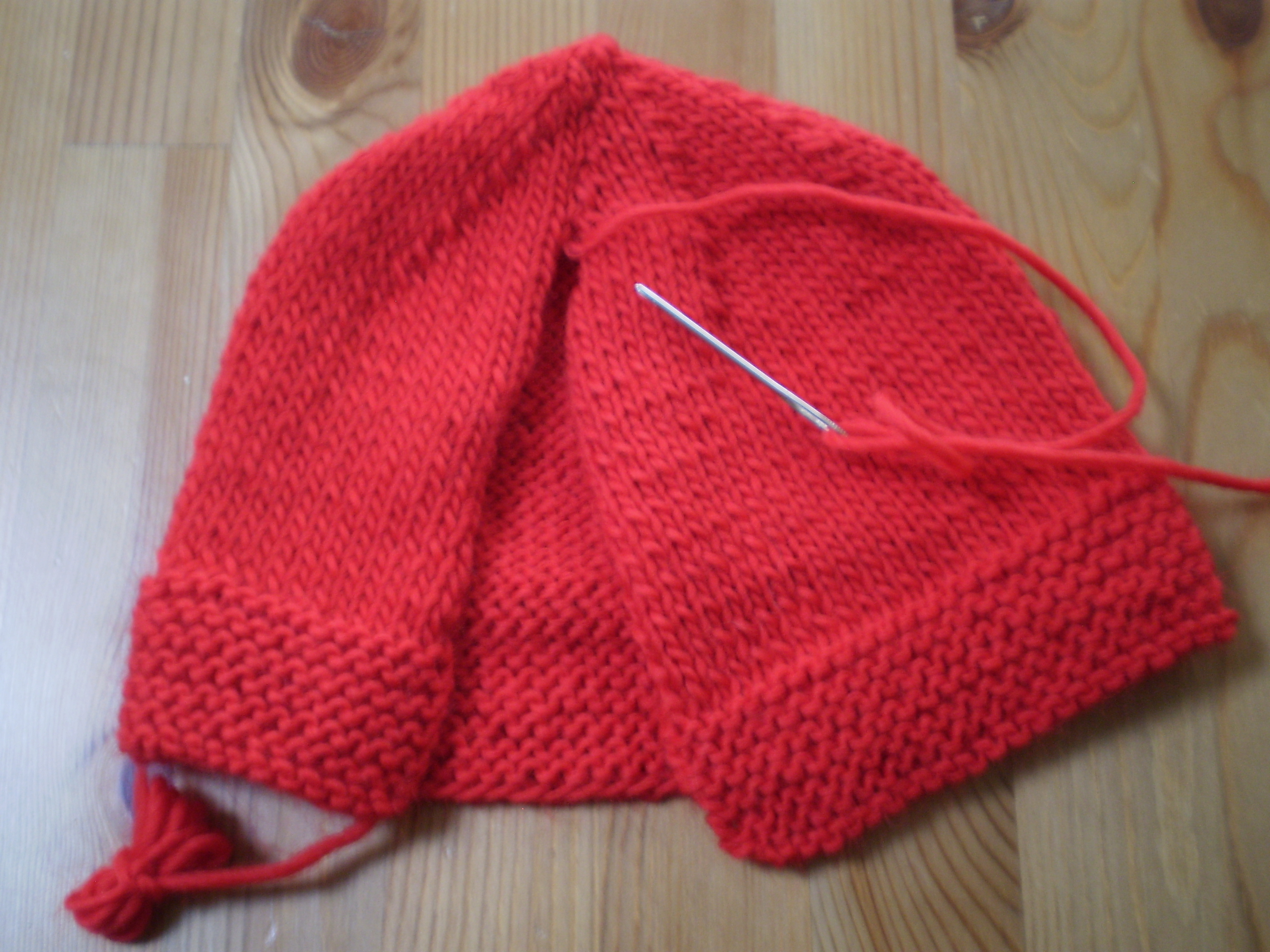
OLYMPUS DIGITAL CAMERAWhen you’ve finished sewing up the hat, it should look like this.  Very hat-like.  (Hattish? Hat-esque?)

OLYMPUS DIGITAL CAMERASee how you still have those two pesky ends?  We have to do something with them (unless you like big hunks of yarn hanging down off your hat, I suppose).  So, turn your hat inside-out.  See the seam allowance that you made by sewing the two sides of your hat together?  Sew your yarn up through that for a couple inches.  (Throw in a knot or a securing stitch, if you want.) Then, cut your tails, leaving a 1-2 inches dangling inside the hat.

OLYMPUS DIGITAL CAMERAAnd that’s it!  You’re done!  You have a great knitted cap!  Congratulations!

If you have questions, please let me know, and I’ll be happy to help!

Sock week: Sock Block Rock

There’s been a heck of a lot of sock talk around here lately.  So, I have some more!

Once you’ve finished your second sock, you could just say “Hey!  I’ve got some socks.  Yay!”

OR, you could guild the lily and go one more step and block the suckers.  Your socks will fit just fine without blocking them, so if I’m just making socks for myself, I won’t do it.  But, if I’m making the socks as a gift, I’ll block them.  Blocking just makes the toes and heels lay nicely and fixes all those little weirdnesses that happen during knitting.

Here’s what you need:

1 pair of socks.

A clean bowl (or a clean sink) filled with bathwater-warm water.

A couple clean towels

Sock blockers (optional)
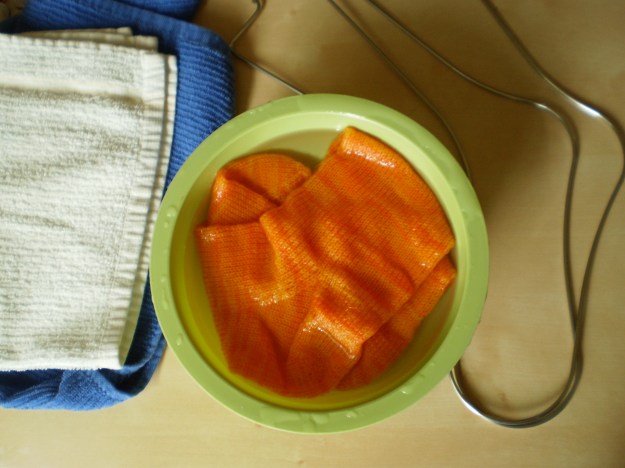
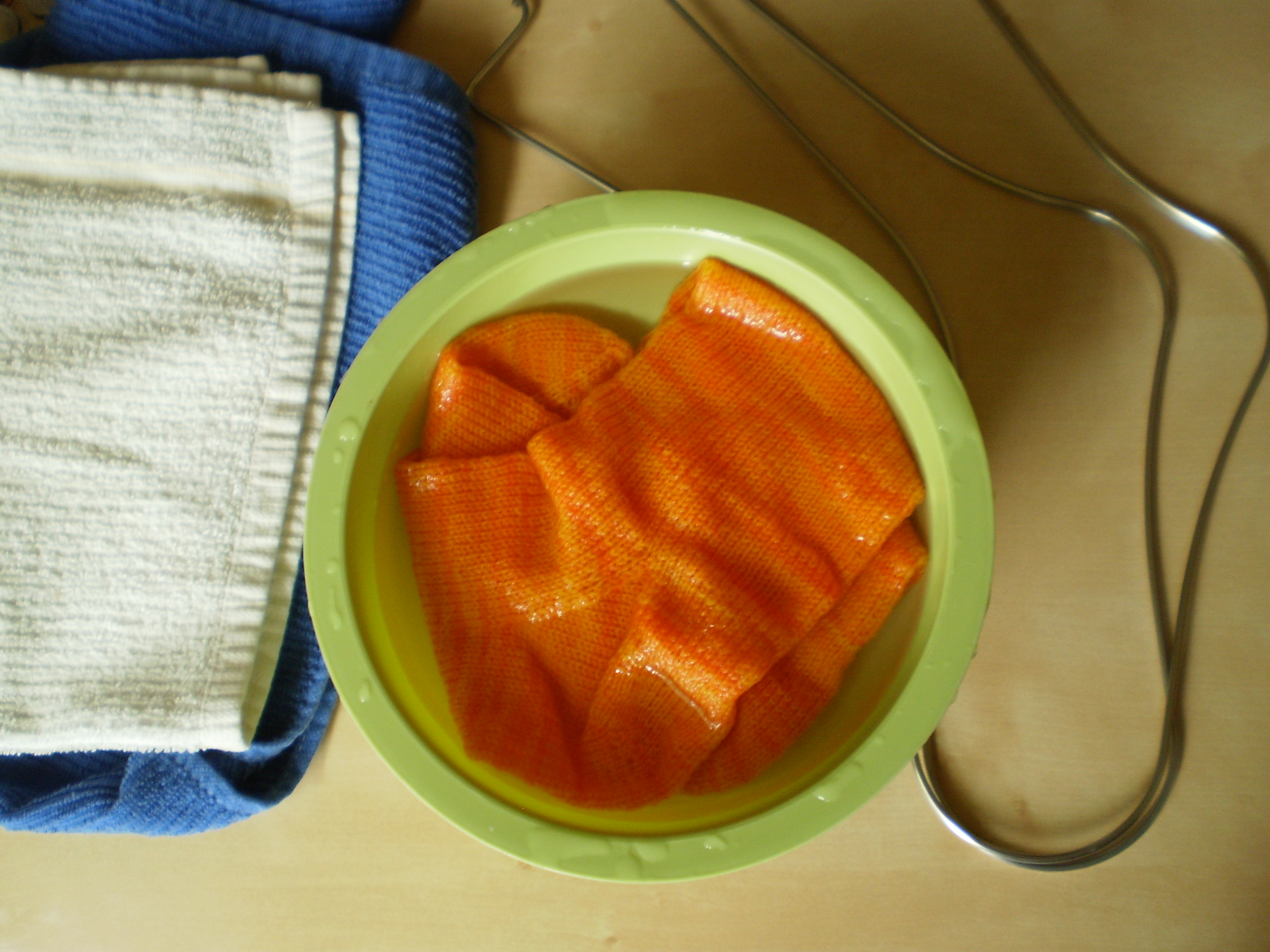
OLYMPUS DIGITAL CAMERADrop your socks into the bowl of water, and let them soak for about 20 minutes. They need to be completely saturated.  Don’t scrub or squeeze them or anything, just lay them nicely in the bowl of water.  If you mess with them too much, they’ll start to felt, which is not ideal.  You can poke them a bit until they go underwater, if you feel it’s necessary.

After your socks are thoroughly saturated, take them out of the bowl and squeeze them gently to get rid of a good portion of the water.  They should still be wet, but not drippy.

OLYMPUS DIGITAL CAMERA

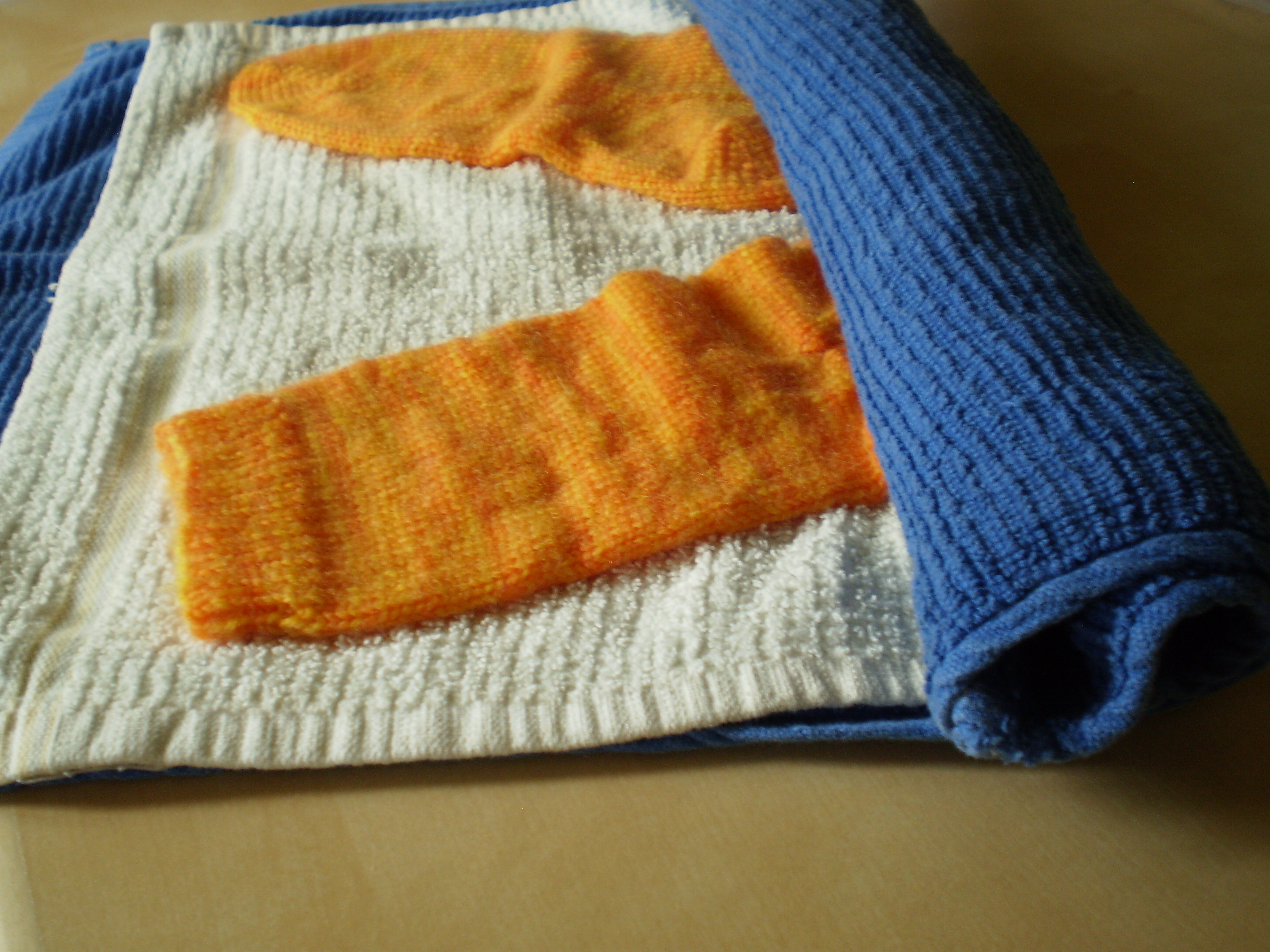
Then, lay out the towel (or towels) and arrange your socks nicely on top.  Roll the whole mess into a damp towel-and-sock burrito.  Squeeze it as much as you can, to get out most of the water.  (I know, first I tell you to get them wet, then I tell you to dry them out… I can’t make up my mind.  I’m terrible.)

OLYMPUS DIGITAL CAMERA

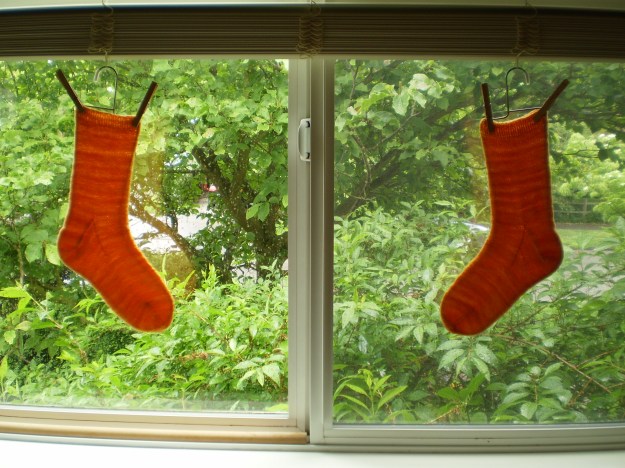
Now you have two options.  The easiest way to block socks is to use sock blockers (duh).  Sock blockers are sock-shaped forms that you put your wet socks on to dry after you’re done knitting them.  You can find them at your local knitting store, or you can buy them here.  Basically, you put the damp socks on the sock blockers, and let them hang to dry.  (My socks are a skotch too big for my blockers, so I use clothespins to keep them on the blockers.)  If you don’t own blockers, not to worry.  You can get out another clean, dry towel and lay your socks out nicely on the towel and leave them out to dry.
OLYMPUS DIGITAL CAMERA

Now, your beautiful socks are completely, totally and 100% DONE!  How exciting.  And, just in time for summer (because nothing says summer, like wool socks).

Sock Week: Second Sock Syndrome

It’s one of the most feared maladies in the fiber arts community.  It strikes suddenly and without consideration for age, experience, or the general health of the knitter.  It’s sent many a project bag to the back of the closet.  It’s the cause of countless cold feet.  It’s the one, the only,

Second Sock Syndrome-The silent killer (or rather, the cause of people getting bored with their socks and not making the second one of the pair)

Don’t fall pray to Second Sock Syndrome.  Knit your second sock, and make sure your feet get the love that they truly deserve.

Here’s my pair of socks:

OLYMPUS DIGITAL CAMERA

I made sure to follow the exact same pattern that I used to make my first sock, so that they match perfectly.  Count your rows in the leg and instep, so that one sock doesn’t end up longer or shorter than the other one.

OLYMPUS DIGITAL CAMERA

Also, in case you were wondering, I didn’t make a whole sock in two days.  I’m fast, but not that fast.

Sock Week: Closing Time

We’re in the final stretch!  All we have to do today is to close up the toe and weave in the ends.  Then you’ll have a beautiful new sock!

OK, when we left off on Friday, you had finished with needle 4 (your active yarn was at the bottom of the sole).

OLYMPUS DIGITAL CAMERA

Knit needle 1, so that your active yarn is coming from the side of the foot (by where your big toe/pinky toe would sit if you put on the sock).

OLYMPUS DIGITAL CAMERA

You’re now officially done with knitting the sock!  Yay! No more knitting.  Just grafting the toe closed.

To set up for grafting (also called the Kitchener Stitch), combine the stitches on needle 1 with the stitches on needle 4.  And, combine the stitches on needle 2 with the stitches on needle 3.  Cut your yarn, leaving a couple feet of tail, and get out your tapestry needle.  Your toe should look like this:

OLYMPUS DIGITAL CAMERA

Now, using the Kitchener Stitch, graft these stitches together.  This is a great video tutorial, if you haven’t done it before.

When you’re done, your toe should look like this:

OLYMPUS DIGITAL CAMERA

See how the knitting flows nicely from the top of the foot to the bottom of the foot?  Very pretty.

Now, all that’s left is to weave in your ends, and your sock is done!

OLYMPUS DIGITAL CAMERA

Congratulations!  You’ve now completed your first sock!

Face it

You have spent hours and hours and hours working on a teddy bear, doll or other plushie, and you are just about done, when you realize it doesn’t have a face.   While a faceless doll can be cute on occasion (although they are usually creepy), you probably at least want some eyes.  You have a couple options, but the easiest is usually an embroidered face.

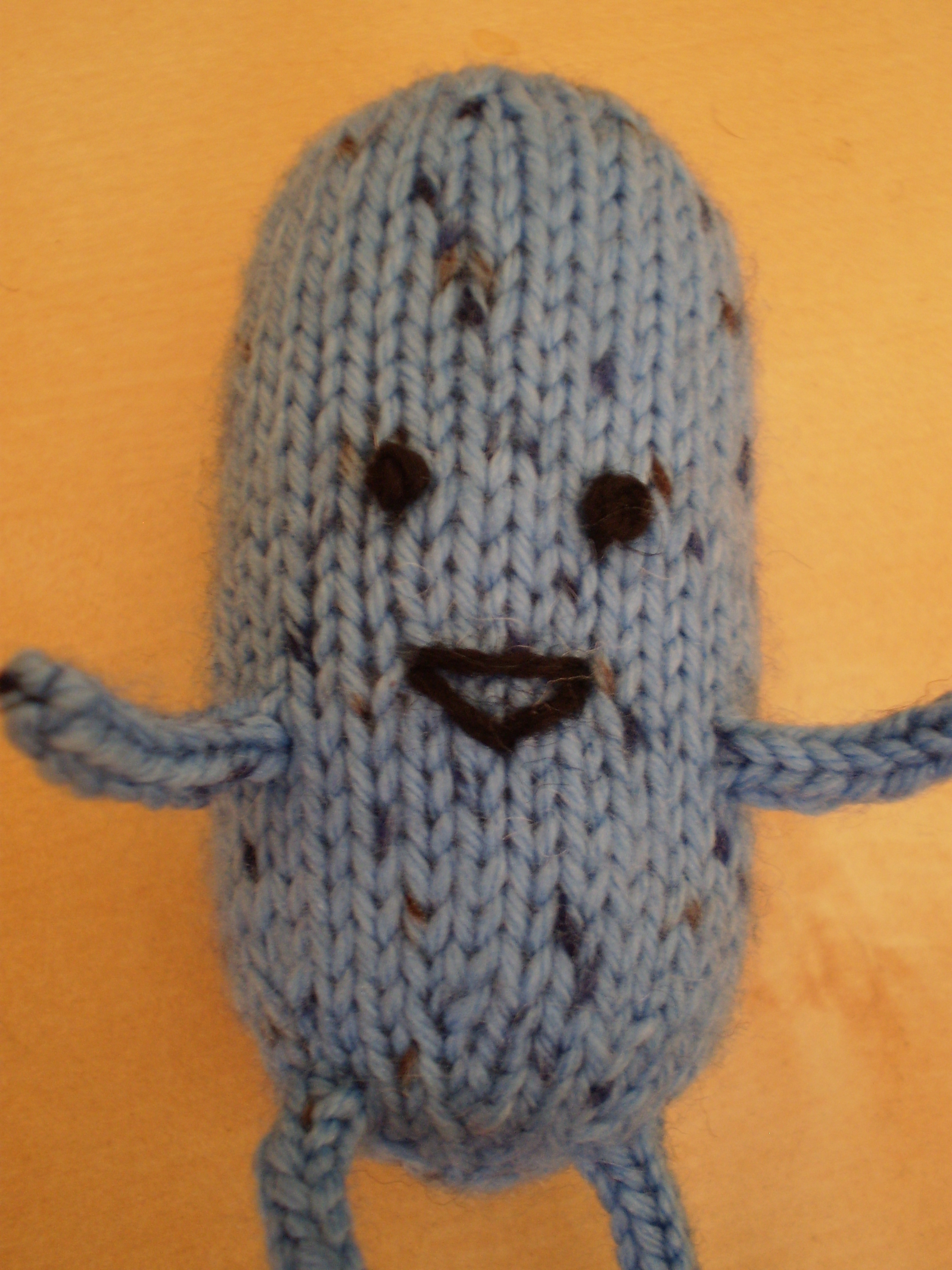
If you are making your plushie for kids under 3, animals, or particularly dumb adults, embroidered faces are best, sinc there is nothing for them to swallow or choke on.  Using an eye-colored yarn or embroidery floss, sew through the back of the head, make a stitch or two for each eye, and sew back through the back of the head.  If your doll has hair or a hat, it the ends will be hidden.  If you don’t have hair, try making a tiny little knot at the back of the head, and then burry the tail in the head, trimming off any excess yarn.  stitched eyes can be very expressive:

OLYMPUS DIGITAL CAMERA

OLYMPUS DIGITAL CAMERA

OLYMPUS DIGITAL CAMERA

OLYMPUS DIGITAL CAMERA

OLYMPUS DIGITAL CAMERA


All of these faces were made with these super simple stitches:

French Knots

Running Stitch

Now, go fourth and give things faces.  I don’t know about you, but I feel like I’m being watched or something.  Eep!

Adding Fringe

So I don’t know about you, but I am not great at learning things from out of books.  However, I do love a good tutorial video.  So, I thought, why not make a video about adding fringe?  How hard can it be?  Apparently harder than I thought.  I managed to make a video, but I don’t know how to add titles or cut scenes, or even have sound.  That’ll be my next project.  I may be good with needles and yarn, but technology still stumps me sometimes.

Anyway, here it is, my very first YouTube video!  Drum roll please!

And, since I can’t figure out how to add audio, here is what I would have said, if I had been able to conquer the computer:

Step 1: Insert the crochet hook through both the front and back layer of the scarf.

Step 2: Pick up one of your fringe pieces folded in half and use the hook to pull the middle of the fringe through both layers of the scarf.

Step 3: Using your hook again, pull the ends of your piece of fringe through the middle loop.

Step 4: Pull the ends of the fringe tight.

Step 5: Repeat the whole process over and over, so that each stitch has a piece of fringe  attached to it.  This makes a really nice, thick fringe for a scarf.

Step 6: Laugh at how terrible my YouTube video is.  I promise I’ll work hard to make my next one better. Cross my heart.