Pattern: One Row Wonder

Weee-Ahhhhh, Weee-Ahhhh!  (That’s the “New Pattern Alarm”… couldn’t you tell?)

I came up with this project on vacation, in the back of a minivan, when I was stuck with a ball of lovely blue gradient hand-spun, a pair of needles, and no pattern.  I wanted to make a shawl, but not a normal shawl.  A shawl that was easy enough to knit in the back of a minivan while sightseeing.  Something with an interesting shape, but virtually no pattern to memorize.

Thus was born the One Row Wonder.

OLYMPUS DIGITAL CAMERAThe One Row Wonder Shawl might just be the perfect pattern. With only one row to memorize, you’ll have a brand new shawl with almost no effort! It can be knit at any gauge and with any yarn. It’s a perfect way to use up leftover yarn or that extra-special skein that’s been waiting in your stash (you know the one). The finished shawl has a unique shape, which wears like a scarf, but has the look of a triangle shawl. The One Row Wonder will knit up in no time and quickly become a favorite part of your wardrobe.

OLYMPUS DIGITAL CAMERAI made mine with a lovely, chunky yarn, but now I’m itching to work one up in fingering yarn.  How cute would it be made with stripes of leftover sock yarn?

Get the pattern for free!

One Row Wonder Shawl

EDIT 9/20/2015:  Sorry for the confusion about the “Loop Increase.”  Apparently lots of places have different definitions.  This tutorial from Knit Picks outlines how I do the Loop Increase.

Design Process Series: Turning the Heel

OK, guys.  It’s time.  Time to turn the heel.

I remember my first pair of socks.  I got to the heel, took one look at the instructions, got scared and put it in the bottom of my WIP pile for about a year.

Let’s not do that.  Heels aren’t that scary.  It’s just some little short rows, and then next week, we’ll pick up some stitches.  No biggie.  (If you want a more detailed explanation, feel free to go back to my “Socks by the Numbers” series.)

This heel will be a basic short-row heel with a reinforced slip-stitch heel.  The slipped stitches will make the heel lovely and thick and squishy (which I think will fit well with the whole “warm and cozy” thing).  They’ll be perfect for wearing with your favorite pair of broken-in hiking boots. (Or while sitting on the couch with a cup of cocoa.)

Ready to start?  Great!

So far, we’ve been knitting in the round on 4 needles.  Now, we’ll be using just one needle, working back and forth as we work up the heel flap.

Join your CC and knit the next 24 (26, 28, 30) stitches onto a single needle.  You’ll have an extra needle.  Put this somewhere you won’t loose it.  We’ll need it later.  These 24 (26, 28, 30) stitches are your heel flap stitches, and we’ll only be working with these stitches today.  Turn your sock around and get ready to work back across your heel stitches.

  • Slip 1, then purl across.
  • (Slip 1, knit 1) across.

Repeat these two rows until the heel flap is 24 (26, 28, 30) rows long.  Finish with a purl row.

OLYMPUS DIGITAL CAMERA

I couldn’t find a stitch marker, but you should have one right in the middle of the blue section.

Next, we’ll shape the heel cap.  (This is the part of the heel that gets nice and round.)

  • K12 (13, 14, 15) then place marker.  Then, K2, K2tog, K 1, wrap and turn.
  • P to marker, slip marker, P2, P2tog, P1, wrap and turn.

Then:

  • K to 1 before the wrap and turn gap, k2tog, k1, wrap and turn.
  • P to 1 before the wrap and turn gap, p2tog, p1, wrap and turn.

Repeat these last two rows until you have worked all heel flap stitches.  (On the last two rows, the math might not quite work out and you might not be able to do the last k1/p1, or the last wrap and turn.  Don’t worry about it!)  End with a purl row.

OLYMPUS DIGITAL CAMERA

Break Contrast Color, and get ready to work the foot next week!

Blocking: Gear

A lot of people love shopping.  To them, there’s nothing more exciting than starting a new project and collecting all the gear they’ll need.  They enjoy dropping a couple hundred bucks on top-of-of-the line tools and professional-grade materials.

I am not one of those people.

It’s probably because I was raised in the Midwest, that most pragmatic portion of the country.

I like to get the bare minimum, and, if I can use stuff I already have around the house, all the better.  (After all, the money I save can go to buying more yarn!)

Sure, you can go buy fancy blocking wires, specialty blocking pins and expensive, nice-smelling blocking detergents.  I’m sure they’re all nice to have, but when you’re just beginning to block your knitting, do you really need these things?  No.  (And, frankly, even now, I use these materials for 90% of my projects.)

Here’s what you really need:

(And, FYI, these are all materials for wet-blocking projects.  It’s what I do for almost all my projects, and so far it’s served me well.)

1. Something to put water in.  Do you have a sink, a bowl, a bathtub?  Is it clean?  That’s all you need.  If it can hold warm water, and isn’t gross, you’re good to go.stainless-steel-bowls[1]2.  Pins.  I just use regular sewing pins.  They’re dead cheap, and you probably already have a little box of them squirreled away.  If you don’t, you can get a pack of a couple hundred for a few bucks at your local fabric store.  Some people will tell you that sewing pins will rust and discolor your knitting.  But, I haven’t seen that happen; the amount of time a pin is in contact with moisture is too short for rust to develop.  Of course, I wouldn’t use a rusty pin to block my knitting, but that’s just common sense.sewing-pins-new[1]3.  Something squishy to stick pins in.  For years, I actually used a clean towel, spread out over the Berber carpet in our attic.  The carpet held pins in place nicely, and was free.  But, our new house is unfortunately all wood and tile.  I know some folks block on a spare bed, or the back of a couch, but that’s a pain.  Instead, I went to the kids’ section of Target and got a $20 pack of foam tiles (the kind you’re supposed to put out on the floor so kids don’t crack their head when they fall).  They lock together into whatever shape you need, and work great.  You can get foam tiles that are specifically made for blocking, but they cost a bunch more.

81xrtGJjGNL._SL1500_[1]4. Your knitting.  Obviously.  FYI, wet blocking works best with animal fibers (wool, alpaca, etc.).  I have blocked some cotton things, which works a little, but blocking plant and man-made fibers never has the same amazing results.OLYMPUS DIGITAL CAMERANow that we’ve gathered the things you need from around your house (or maybe a quick trip to the store), next week we’ll start with blocking something simple!

Husband Sweater: The Sleeves

I think it’s high time that this dang sweater stops looking like a muscle shirt when my husband tries it on.  Don’t you agree?

The only problem is that he’s not a fan of the fairly over-sized sleeves that the original pattern calls for.  Ugh.  Nothing is ever simple.

So, it’s time to get out my scratch paper (or rather, the back of the pattern), my calculator and start figuring out what I need to do.

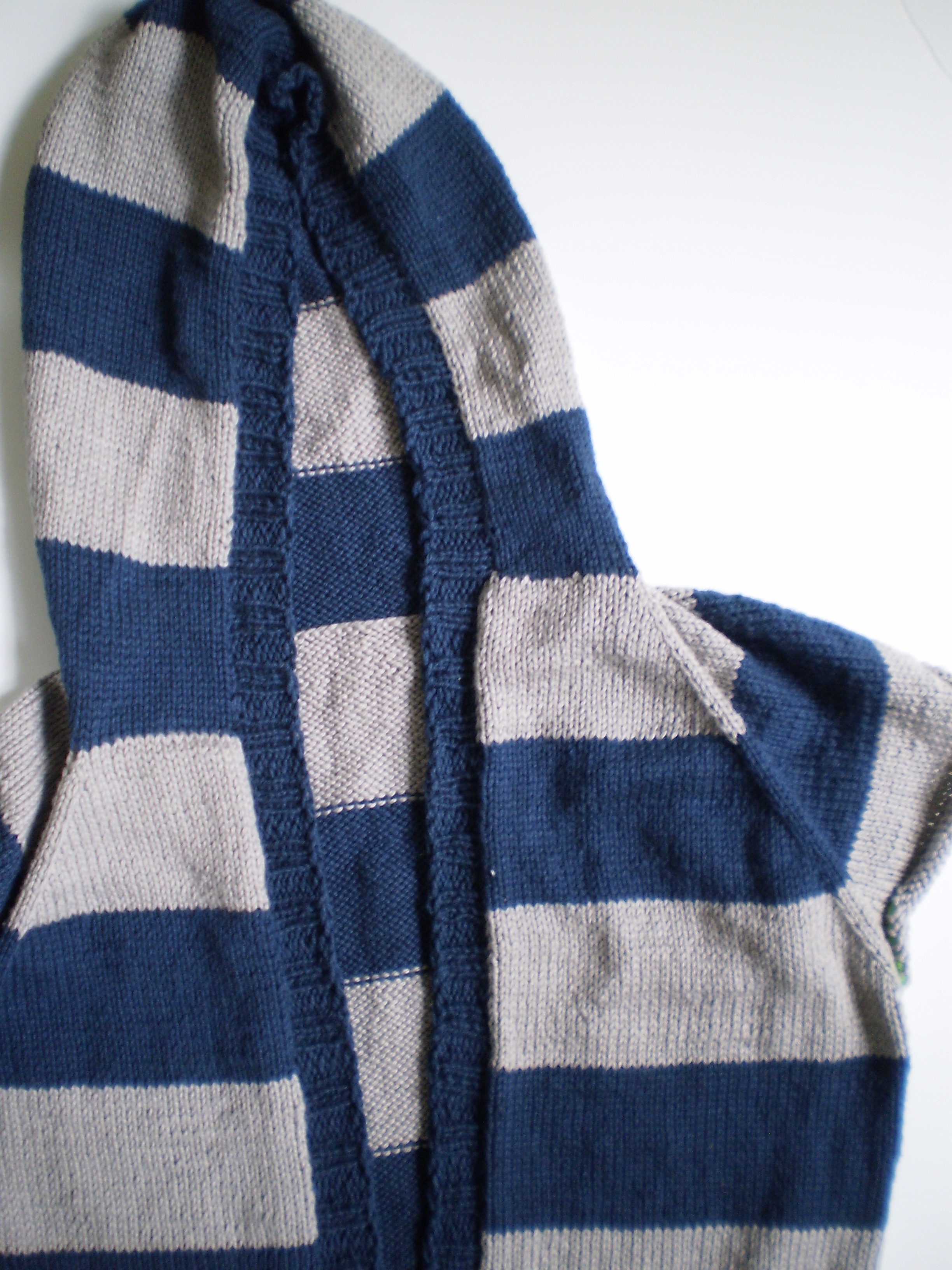
OLYMPUS DIGITAL CAMERAOK.  Before I even have to start doing math I know a few things:

1.  I have 82 stitches (about 20 inches) at the top of the sleeve, set aside from when I split the body for sleeves.

2.  I need to get down to about 40 stitches (about 10 inches) at the top of the cuff.

3.  My sleeve needs to be about 15 inches (about 105 rows) from where I’ll pick up my stitches to the top of the cuff.  (I based this on my husband’s arm length, and the length of the sleeves of his favorite sweater.)

Now it’s math time.

If I need to go from 82 to 40 stitches, I need to do 42 decreases somewhere on the sleeve.

(82 sts at the shoulder-40 sts at the cuff=42 decreases)

I’ll do two decreases per decrease row, so I’ll need to do 21 decrease rows.

(42 decreases/2 decreases per row=21 decrease rows)

And, I want to space those decreases out evenly over 105 rows, so I’ll work a decrease row every 5th row.

(105 rows/21 decrease rows=5 rows per decrease row)

OLYMPUS DIGITAL CAMERASo that means, I’ll knit four rows evenly (while still making sure the stripe pattern matches up with the body), then I’ll work a decrease row (knitting all stitches, except for working two decreases at the underarm).  Easy!

Hopefully, this’ll look good.  It’s a more extreme decrease than I usually use for sleeves, but it might work.  Luckily, I’ll be able to finish one sleeve, have the husband try it on, and get his approval for the next sleeve (or, heaven forbid, find out I have to redo the sleeve!  Cross your fingers for me).OLYMPUS DIGITAL CAMERAHave you ever had to rejigger part of a pattern?  How did it turn out for you?

Design Series: Let’s go!

Guys.  It’s time.  Finally!

It’s time to cast on for our socks!

Just to recap, we decided to make simple, warm and cozy socks with a basic design.  We picked light gray and indigo blue for the colors, and we wanted them to be regular socks, not slipper socks.

Luckily, I had some lovely indigo blue and light gray sock yarn in my stash!

Knit Picks Stroll Sock yarn in Sapphire Heather and Dove Heather, about one skein of each.  (Which should hopefully be enough to make it through a whole pair of socks!)

24590[1] 25023[1]Pretty, right?  Of course, you’re more than welcome to use any color (or brand of yarn) that makes you happy, but I’ll be using this yarn.

Since we’re going for a nice warm and cozy design, I thought that using a lovely, squishy 2×2 rib would look really good.  (Not to mention that ribbed socks are super comfy.)

I’m going to be working this design in four sizes: Women’s Small (Medium, Large, Extra Large). (Don’t feel bad if you have to use the Extra-Large Size.  That’s the size I have to make for myself.  I have big man-feet.)

So, let’s start!

  • Materials:
  • 5 US2 double-pointed needles
  • Yarn needle
  • Scissors
  • 1 skein each, Gray (MC) and Blue (CC) sock yarn, such as Knit Picks Stroll Sock in Dove Heather and Indigo Heather.

Directions:

  • Using MC, cast on 48 (52, 56, 60) stitches using your favorite method.  Distribute the stitches evenly across 4 needles (12 (13, 14, 15) sts per needle) and join to work in the round.
  • Work around in a K2P2 rib for 15 rounds.  Break yarn and join CC.
  • Continue in ribbing for 10 rounds.  Break yarn and join MC.
  • Continue in ribbing for 10 rounds.  Break yarn and join CC.
  • Continue in ribbing for 10 rounds.  Break yarn and join MC.
  • Continue in ribbing for 30 rounds.
  • Work 1 round, knitting all stitches.
  • Knit 36 ( 39, 42, 45).  Break yarn and get ready to make the heel flap!

OLYMPUS DIGITAL CAMERANext time, we’ll turn the heel!  Woo Hoo!

Inspiration: Talavera Tile

Before I moved to Seattle, I lived for a few years in Texas.  I love Seattle, but Texas was super fun, too (in a barbecue and rednecks kind of way).  I know this makes me kind of dorky, but one of the things I liked most about living down there was seeing the traditional Mexican/Southwestern influences mixed in with all the modern buildings.  And, my favorite part of that were the amazing talavera tiles everywhere.  (If I ever have to do a remodel on our house, I’m definitely going to suggest adding in some talavera tiles, even if they don’t really “go” in Seattle.)

til086[1]1411768119-Nine-Tile-View[1] til047[1]Totally gorgeous, right?  (By the way, these tiles are all available for sale here.  Not that I’ve been window shopping or anything.)

I love the vivid colors, the delicate details, and the fantastic organic patterns.

I wonder if I could translate that into knitting?  Of course I can!

This gorgeous sweater would look fantastic in creamy-white, burnt umber and forest green.

Oranje by Ann Weaver

oranjeBACK_medium2[1]And this hat is the absolute cutest!  Look at those earflaps!

Talavera Ear Flap Hat by Elizabeth Murphy

IMG_0855_medium[1]And this gorgeous hat already looks like it’s been tiled!

The Inga Hat by Sheila Macdonald

Inga_medium2[1]I guess I’ll just have to get my talavera fix through my knitting for now…  oh well…

Blocking!

I’ve gotten a few questions recently about blocking.  And it is kind of mysterious, so I understand the confusion.  It actually took me several years of serious knitting before I started regularly blocking my projects.  And let me tell you, it was amazing how much nicer my projects looked once I started blocking them.

OLYMPUS DIGITAL CAMERA


Think of blocking like adding a squeeze of lemon or a dusting of powdered sugar to your project.  It’s a flourishing touch that turns a good project into a great one.  Sure, your sweater will fit, even unblocked, but it will be so much better if you do.  Blocking makes your stitches more even, straightens out any little pulls and makes your knitting look more professional.  And (and this is a huge bonus), it lets you cheat a little bit on the size of your finished project.  Did the scarf turn out a little too small?  Are your sweater’s sleeves a little too long? Blocking can fix (or at least kind of fix) it.

Over the next couple weeks, I’ll talk about how I block (of course there are as many ways to block projects as there are knitters),  what you need to block a project, and what blocking can do for you.

Stay tuned!


Pattern Spotlight: Human Beans Sweater

Just when I thought that my Human Beans couldn’t get any cuter, the folks over at Knit Picks had to go and do this:sweater_girl1[1]I mean, seriously?  How cute is that?  A tiny, pink cabled sweater on a tiny doll with red shoes, sitting on a tiny wicker chair.  Honestly.

They modified this free pattern, changing the shoulders slightly, since the Human Beans don’t really have shoulders.

51077220

This pretty pink sweater was worked up for a middle-sized doll, but you could totally modify it for the larger or smaller dolls, simply by changing the gauge.

sweater_girl2[1]Thanks, Knit Picks folks!  You’ve totally made my day with this ridiculous little sweater.

Husband Sweater: Button (er- Zipper) Band

I feel like it’s been a hot minute since I gave you an update on the sweater I’m working on for my husband.  Oof- actually it’s been almost a month.  (Sorry, husband!  Hopefully I’ll have it finished by August at this rate!)

Anyway, this time, I knit up the button band (or rather, the zipper band).  Instead of using the pattern, I used my own standard button band (mostly because I lost my paper copy of the pattern).

OLYMPUS DIGITAL CAMERA

My button bands actually start when I’m knitting up the sweater body.  I always slip the first stitch of each row.  This creates a nice, neat edge that makes it easy to pick up stitches evenly all the way around.  And I’ve found that picking up one stitch for every two rows makes a button band with just the right tension.  This way, you don’t even have to count, except for making sure you have an even number of stitches to make your ribbing come out right.

OLYMPUS DIGITAL CAMERA

I worked the button band on this sweater for about an inch, in a 2×2 rib.  This is a little narrower than my usual button bands, but that’s because I’ll be using a zipper, not buttons.  If you use buttons, the button bands will overlap, so you’ll need a wider band.  If you use a zipper, the bands don’t overlap, so you need a narrower one.

Next up-I’ll start working on the sleeves!

And The Winner Is…

Woo!  Hello new folks!  And hello not-so-new folks!  Thanks for entering the  drawing for a copy of “Cute, Cuter, Cutest: Knit Toys to Love in 3 Sizes.”  I loved reading about your favorite childhood toys.  Such sweet stories and lovely memories!  If you haven’t read everyone’s comments on last Friday’s post, you should definitely take a look.

But, enough sentimentality!  You’re all here for the giveaway!32673[1]More than fifty people entered, but only one can win.  I wrote down everyone’s names, and picked one at random.

*Drum roll*

And, Jan!  You’re the big winner!  Congratulations!  I’ll be emailing you later this afternoon.

32673101[1]And, if you’re not Jan, you still want the book, right? (Of course you do.  Because it’s stupidly cute.)  Head on over to Knit Picks and pick up a copy for yourself.