Flying with Yarn

It’s summertime, and that means traveling!  I just got back from a lovely weekend trip to Pennsylvania to visit my husband’s family.  It’s about a six hour flight from one coast to the other, so I had plenty of time to indulge two of my favorite pastimes:  knitting and reading SkyMall.

WP_20130609_021

When you’re traveling with your knitting, it’s important to keep three factors in mind.  Or, at least these are the three things I keep in mind:

1.  What will the fuzz (the po-po, the man, the 5-O) let you take on the plane?  TSA regulations can be found here.  But basically, the only thing you (as a knitter) need to worry about is that your scissors need to have blades that are less than 4 inches long.  Needles/crochet hooks are allowed.  Now, if you bring a pair of super-sharp 15 inch-long size 10s, they might have a problem with it.  But, I’ve never had an issue with bringing my needles on a plane.

2.  What can I carry?  I like knitting small projects on vacation, so I’m not lugging a great big sweater around with me.  Socks are great, because they don’t take a lot of thinking, and you can pick them up and put them down without worrying you’ll loose your place.  Lacework is fun, too, since you can work on a pretty big project, but it crunches up into a tiny little ball when you’re not working on it.

3.  What will prevent the folks in my row from hating me?  If I didn’t get to knit during a flight, I would probably go insane from boredom.  I have to keep busy.  It’s sort of a nervous tick.  But, when you’re stuck in such a small space with other people, it’s important not to piss them off.  So I like to pick a project that doesn’t take a lot of room to work on.  So, no big, long straight needles that poke my seatmates, no blankets or anything that will take up more than my allotted personal bubble space, and no projects that use multiple balls of yarn that could roll around and get in people’s way.

So, safe travels!  And may the TSA never confiscate your knitting!  (And, if you are thinking of getting me a present for early Christmas, I’m a huge fan of the swamp zombie statue from SkyMall.)WP_20130609_028

I’m turning 50!

Actually, I’m not turning 50… not even close.  But this is my 50th post!  How exciting!

It seems like I just started this blog yesterday.  Is it too early for me to repost some of my earlier posts?  Probably, but I’ll do it anyway.

My first pattern, the Lace-Edged Shawl, is still by far my most favorited/knit pattern.  Here’s the link to Ravelry.

OLYMPUS DIGITAL CAMERA

People also seem to like my Call the Midwife posts (but that’s probably due more to the show being awesome, than me writing anything particularly genius).

blanket 2


People also seem to like my Call the Midwife posts (but that’s probably due more to the show being awesome, than me writing anything particularly genius).


MIDWIFE%202_l

Although, my most liked post so far was my critique of Clueless:

clueless_l

But despite all those, I think the series of posts I’m most proud of (wether or not you guys are into them, I’m not so sure), is my Sock Week posts.

OLYMPUS DIGITAL CAMERA

So, thanks for reading!  And here’s to 50 more posts.

It’s too pretty out for a real post

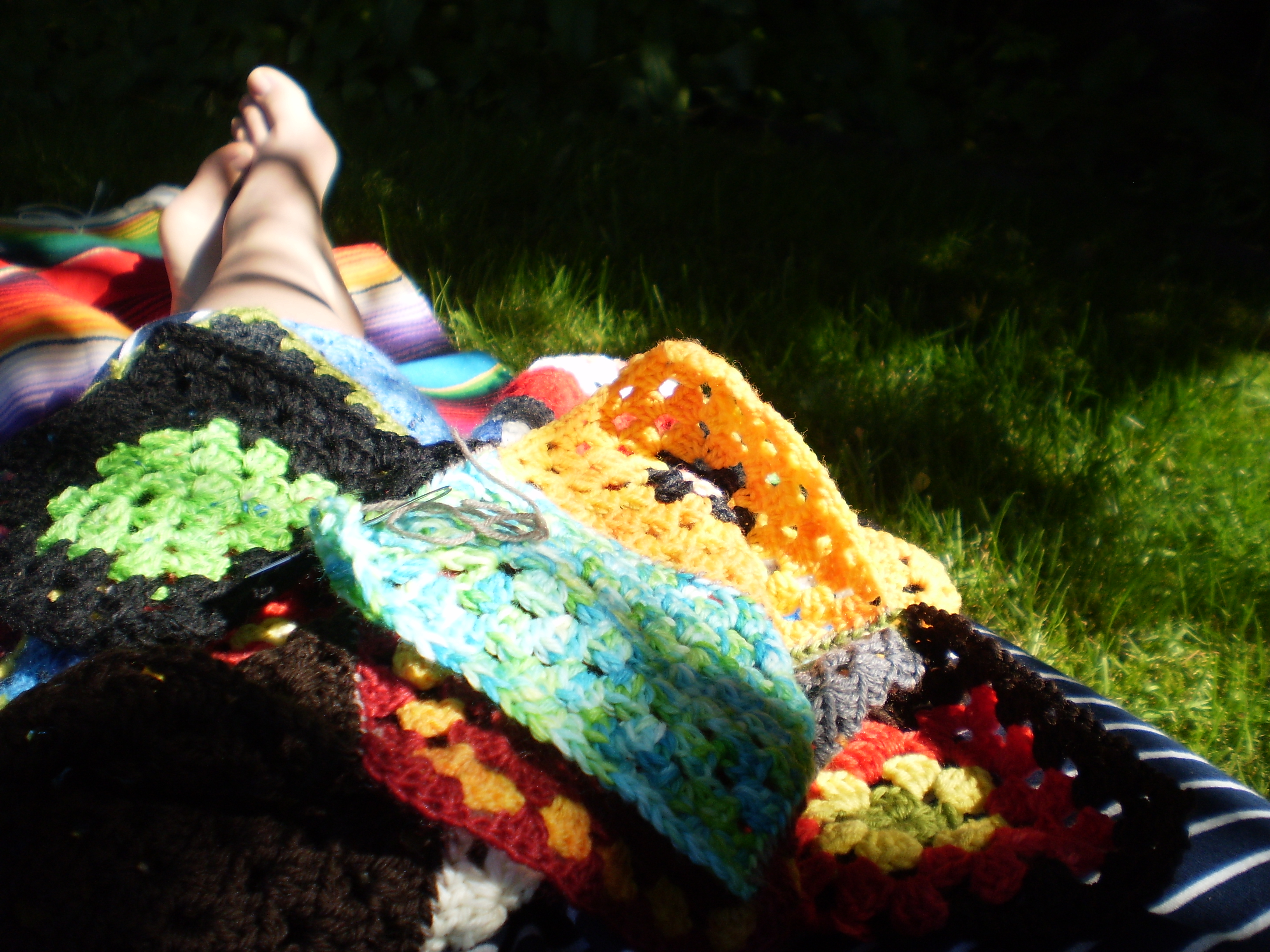
If the sun’s out in Seattle, you’re pretty much required by law to spend your day outside.  So, I decided to sit out in the yard with a nice iced coffee and a pile of granny squares and sew them together.  Not a bad afternoon.OLYMPUS DIGITAL CAMERA

After an hour or two of work and a few chapters of my most recent audiobook…

OLYMPUS DIGITAL CAMERA

And I’ve whip-stitched my squares together:

OLYMPUS DIGITAL CAMERA

They’re nowhere near an entire blanket yet, but they’re a start.  It’s going to end up being possibly the tackiest blanket ever (since I’m using up all my sock leftovers from over the years, and I tend to knit brightly colored socks), but I’m kind of OK with that.  It’ll be a nice project to work on a little at a time, whenever my bowl of sock yarn leftovers gets too full.

Granny Squares

Want to make your own blanket like Chummy’s?  It’s super easy (and satisfying) to make granny squares from your scrap yarn.

I made you a video!  (I even figured out how to and sound and a title!  I’m still not sure about editing and stuff yet.  Next time, I’m thinking special effects, background music and unicorns.   Some day, I will become the Steven Spielberg of knitting/crochet videos.)

Inspiration: Chummy’s Afghan

Now, if you’ve read any of this blog, you know that I have a major thing for costume dramas.  I don’t know why, but I think they’re just great.  And “Call the Midwives” is one of my favorites.  The stories are great, the costumes and sets are beautiful, and I want to be friends with all of the characters.

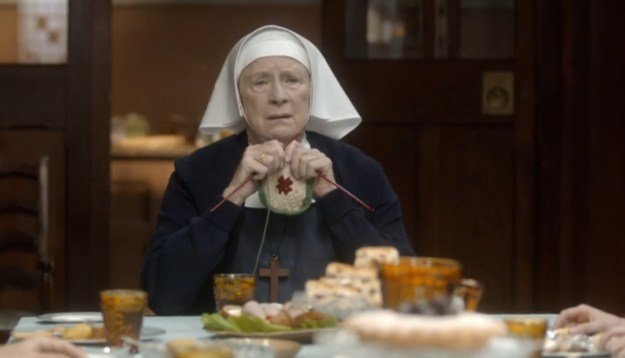
Also (and possibly most importantly…just kidding) the characters are all involved in “handicrafts,” and are always making things.  Chummy sews, the nuns knit toys for charity, etc.   The makers of the show (the director?  the producer? I don’t know about these things) are really good at making sure that the actors know what they’re doing.  For example, when the character knits, the actor doesn’t just wave her needles around like someone in a cartoon.

I was very excited when the creation of an afghan was a major plot point of the Season 2 finale.  Until I saw this:

blanket 1

And this:

blanket 9

Holy anachronism, Batman!  If you’ve done any fiber arts, you can probably recognize that the blanket squares the ladies are making are Granny Squares.  These are super-traditional, basic building blocks of many afghans.  And the number 1 thing about them, is that they are CROCHETED.  Not knitted.

You can’t just go to the store and buy Granny Squares.  So, the props department for the show must have gone through the trouble of crocheting all the squares, then decided that it would look better on camera if they were stuck on knitting needles in the show.  Blows my mind.  (But maybe that’s why I’m not a props director.)

Anyway.  I’ll get off my soap box now.   *Deep breath*

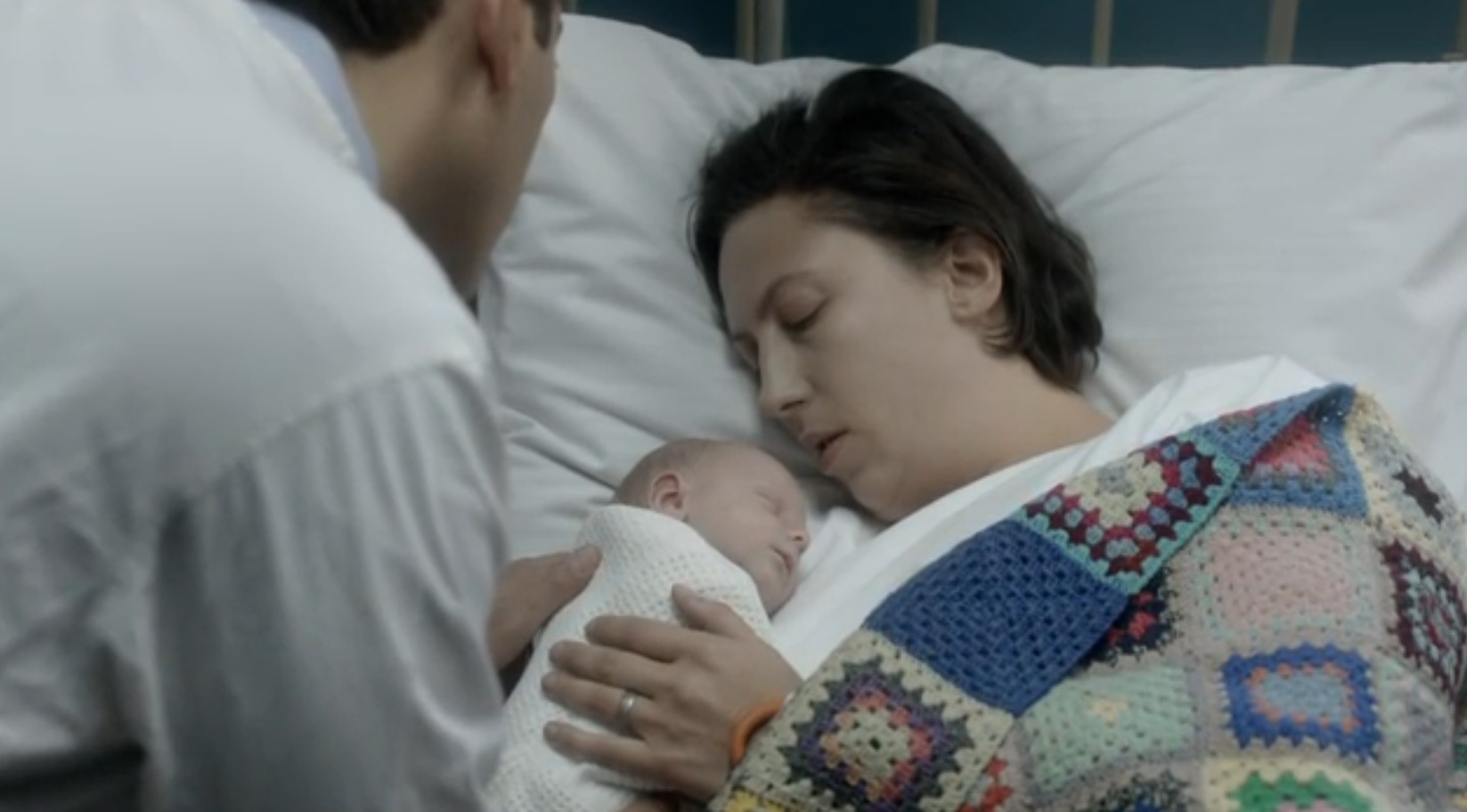
Despite the clear issues with the knitting vs. crochet  thing, the story that accompanied the blanket was just beautiful.  (If you missed it, Chummy ends up in the hospital, and all the women of Nonatus House band together and put together the blanket for her.)

blanket 2

Jenny and Sister Juliene deliver the blanket, and through the magic of love (doesn’t that sound like something the narrator would say?), Chummy wakes up and everyone is happy and healthy again.  Awww.

blanket 3

Sock week: Sock Block Rock

There’s been a heck of a lot of sock talk around here lately.  So, I have some more!

Once you’ve finished your second sock, you could just say “Hey!  I’ve got some socks.  Yay!”

OR, you could guild the lily and go one more step and block the suckers.  Your socks will fit just fine without blocking them, so if I’m just making socks for myself, I won’t do it.  But, if I’m making the socks as a gift, I’ll block them.  Blocking just makes the toes and heels lay nicely and fixes all those little weirdnesses that happen during knitting.

Here’s what you need:

1 pair of socks.

A clean bowl (or a clean sink) filled with bathwater-warm water.

A couple clean towels

Sock blockers (optional)

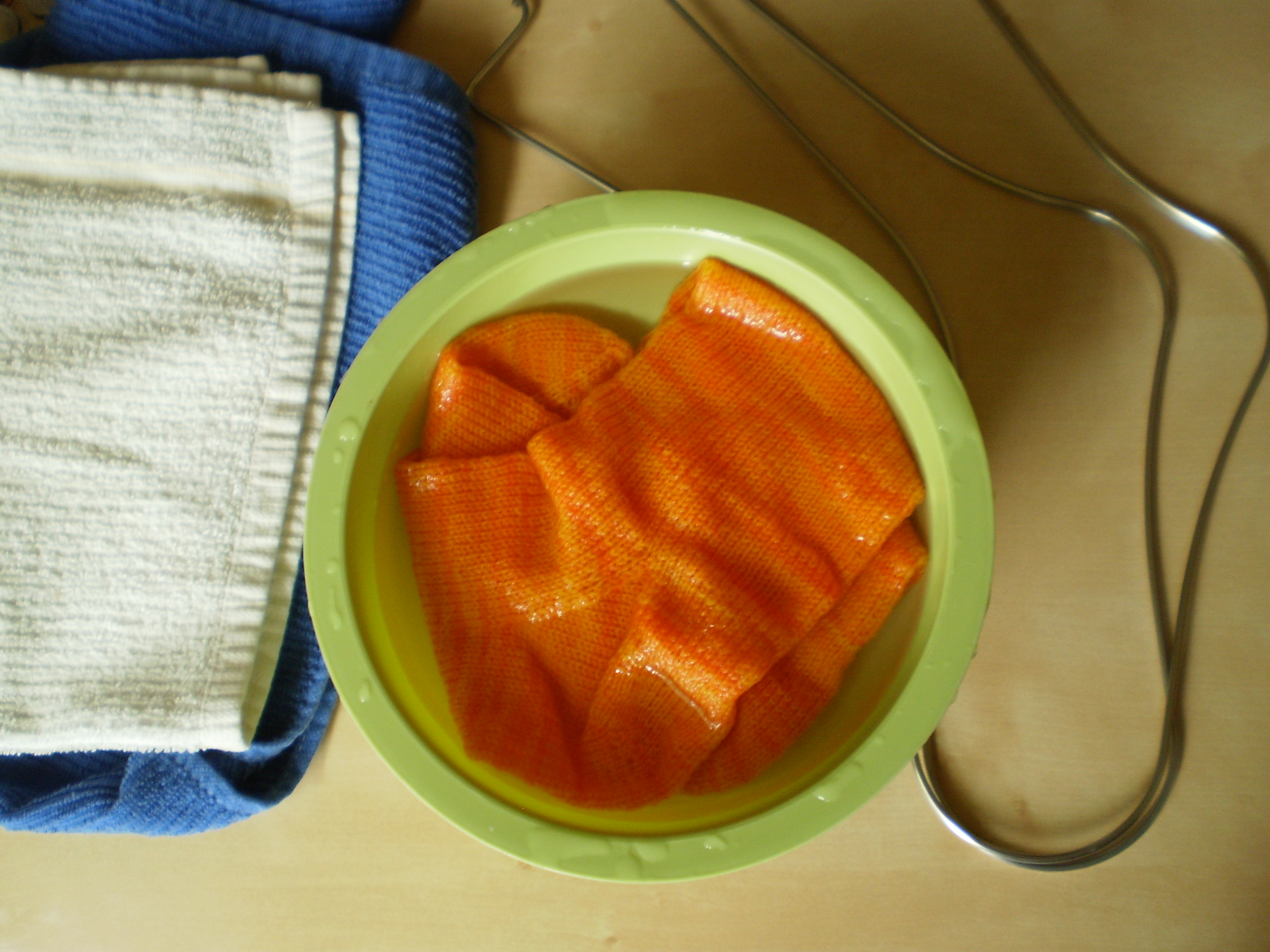
OLYMPUS DIGITAL CAMERADrop your socks into the bowl of water, and let them soak for about 20 minutes. They need to be completely saturated.  Don’t scrub or squeeze them or anything, just lay them nicely in the bowl of water.  If you mess with them too much, they’ll start to felt, which is not ideal.  You can poke them a bit until they go underwater, if you feel it’s necessary.

After your socks are thoroughly saturated, take them out of the bowl and squeeze them gently to get rid of a good portion of the water.  They should still be wet, but not drippy.

OLYMPUS DIGITAL CAMERA

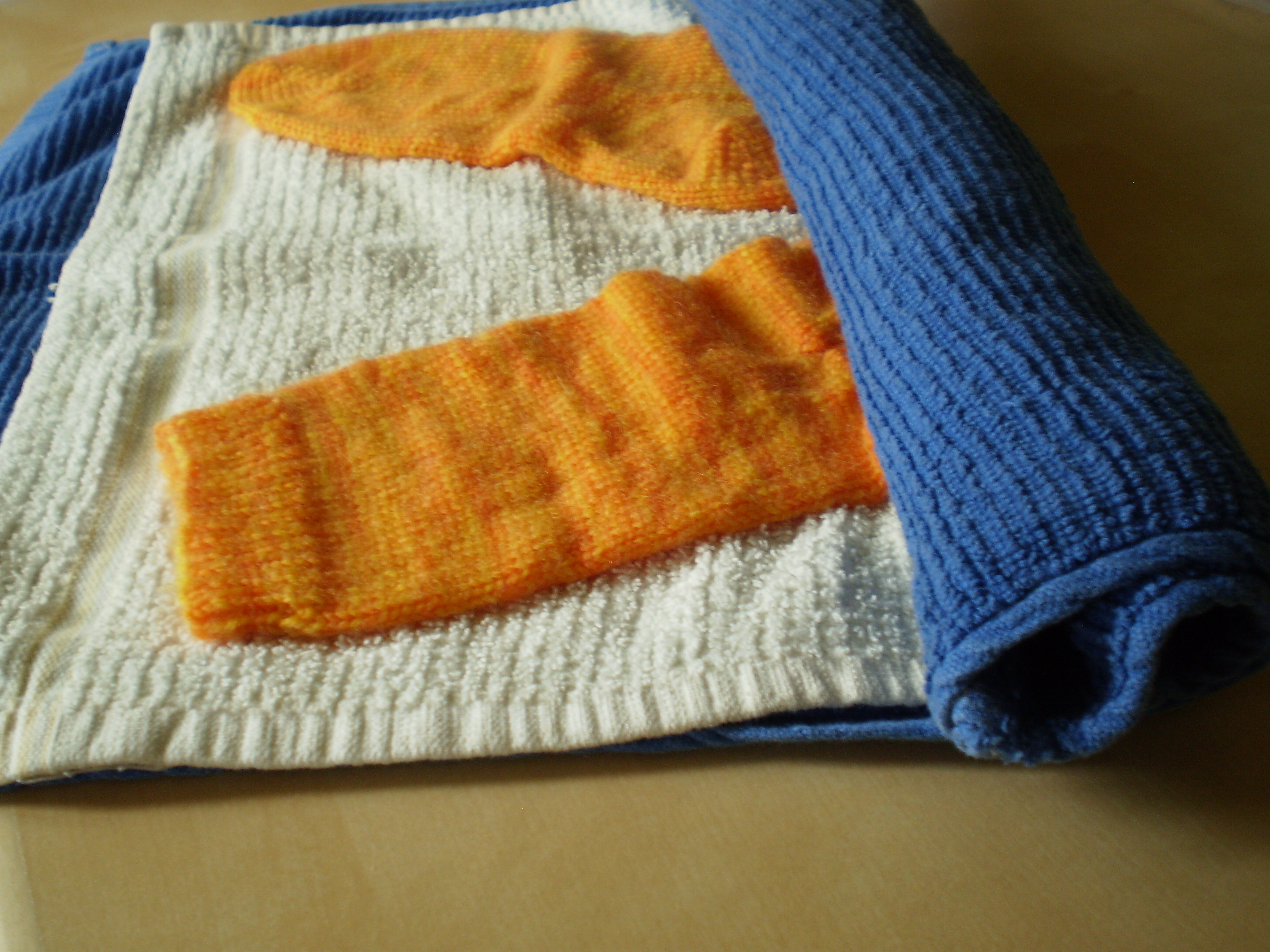
Then, lay out the towel (or towels) and arrange your socks nicely on top.  Roll the whole mess into a damp towel-and-sock burrito.  Squeeze it as much as you can, to get out most of the water.  (I know, first I tell you to get them wet, then I tell you to dry them out… I can’t make up my mind.  I’m terrible.)

OLYMPUS DIGITAL CAMERA

Now you have two options.  The easiest way to block socks is to use sock blockers (duh).  Sock blockers are sock-shaped forms that you put your wet socks on to dry after you’re done knitting them.  You can find them at your local knitting store, or you can buy them here.  Basically, you put the damp socks on the sock blockers, and let them hang to dry.  (My socks are a skotch too big for my blockers, so I use clothespins to keep them on the blockers.)  If you don’t own blockers, not to worry.  You can get out another clean, dry towel and lay your socks out nicely on the towel and leave them out to dry.

OLYMPUS DIGITAL CAMERA

Now, your beautiful socks are completely, totally and 100% DONE!  How exciting.  And, just in time for summer (because nothing says summer, like wool socks).

Sock Week: Second Sock Syndrome

It’s one of the most feared maladies in the fiber arts community.  It strikes suddenly and without consideration for age, experience, or the general health of the knitter.  It’s sent many a project bag to the back of the closet.  It’s the cause of countless cold feet.  It’s the one, the only,

Second Sock Syndrome-The silent killer (or rather, the cause of people getting bored with their socks and not making the second one of the pair)

Don’t fall pray to Second Sock Syndrome.  Knit your second sock, and make sure your feet get the love that they truly deserve.

Here’s my pair of socks:

OLYMPUS DIGITAL CAMERA

I made sure to follow the exact same pattern that I used to make my first sock, so that they match perfectly.  Count your rows in the leg and instep, so that one sock doesn’t end up longer or shorter than the other one.

OLYMPUS DIGITAL CAMERA

Also, in case you were wondering, I didn’t make a whole sock in two days.  I’m fast, but not that fast.

Sock Week: Closing Time

We’re in the final stretch!  All we have to do today is to close up the toe and weave in the ends.  Then you’ll have a beautiful new sock!

OK, when we left off on Friday, you had finished with needle 4 (your active yarn was at the bottom of the sole).

OLYMPUS DIGITAL CAMERA

Knit needle 1, so that your active yarn is coming from the side of the foot (by where your big toe/pinky toe would sit if you put on the sock).

OLYMPUS DIGITAL CAMERA

You’re now officially done with knitting the sock!  Yay! No more knitting.  Just grafting the toe closed.

To set up for grafting (also called the Kitchener Stitch), combine the stitches on needle 1 with the stitches on needle 4.  And, combine the stitches on needle 2 with the stitches on needle 3.  Cut your yarn, leaving a couple feet of tail, and get out your tapestry needle.  Your toe should look like this:

OLYMPUS DIGITAL CAMERA

Now, using the Kitchener Stitch, graft these stitches together.  This is a great video tutorial, if you haven’t done it before.

When you’re done, your toe should look like this:

OLYMPUS DIGITAL CAMERA

See how the knitting flows nicely from the top of the foot to the bottom of the foot?  Very pretty.

Now, all that’s left is to weave in your ends, and your sock is done!

OLYMPUS DIGITAL CAMERA

Congratulations!  You’ve now completed your first sock!

Sock Week: Tootsies

We’re so close, I can taste it!  Only a few short rows until you get to be done!  (And then you get to make another one… unless you’re an amputee.  In which case I’m jealous that you don’t have to make two socks, but I’m also sorry for your loss.)

So, there are a bunch of ways to do toes, just like there are a bunch of ways to do heels.  You’re welcome to use whatever method you like, but here’s what I do.  It’s easy, and gives me a nice result.

Starting at the middle of the sole of the foot (between needles 4 and 1), work the toe in the round by repeating the following two rows:

Row 1:  Needle 1: knit to 2 stitches before the end of the needle.  K2tog (right leaning decrease).  Needle 2: ssk (left leaning decrease), then knit to the end of the needle.  Needle 3: knit to 2 stitches before the end, k2tog.  Needle 4: ssk, knit to end of needle.

Row 2: Knit evenly (no decreases).

Repeat these two rows until you only have 5 stitches left on each needle, finishing with Row 1.  (Note: if you’re using this recipe to make tiny kids’ socks or doll socks, you’ll want to keep decreasing until there are 2 or 3 stitches left on each needle.)  You should have 20 stitches total.

Here’s what your toe should look like.  See how the decreases end up lining up nicely?

OLYMPUS DIGITAL CAMERA

Have a fantastic weekend!  We’ll finish the sock on Monday!!

Sock Week: Instep

So, I’m kind of running out of funny ideas for sock post titles.  Also, I now realize that this has taken WAAAY more than a week.  So perhaps I should have called it Sock Month.

But, I suppose it’s too late for all that.

Anyway.  Today’s step is stupid easy.  We’re going to make this “instep” of the sock.  The folks that write books about knitting call this the instep.  But I think it should more accurately be called the “foot-part.”  Basically, it’s the part of the sock between the gusset and the toe decreases.  And it’s really simple to do.

You knit.   That’s all.  No fancy decreases or increases, no picking up stitches, no dropping stitches, no short rows, no ribbing (unless you really want to for decorative reasons) or anything else.  Just knit a tube until your sock is 1 1/2 inches shorter than you want your finished sock to be.

How long do you want your sock to be?  As long as your foot (see, I told you this step was easy).  Measure your foot from the back of your heel to the tip of your big toe (or whatever toe is longest).  Subtract 1 1/2 inches.  Knit your sock instep until the sock measures that length from the back of the heel to the needles.  For example, my bare foot is 10 1/2 inches long.  So I knit my instep until the sock measured 9 inches long from needles to the back of the heel when laid out flat.  In my opinion, it’s better to err on the side of making your sock a smidge too big.  No one wants socks that are too small.

OLYMPUS DIGITAL CAMERA

See?  I realize I forgot to include a ruler in this photo, so you’ll have to take my word on the length of my sock.

If you don’t have a ruler hanging around, just keep trying on your sock until only 1 1/2 inches of toe poke out the end.  If you’re knitting socks for someone whose feet you don’t have access to, this website has some good sizing charts.

And, because I feel like this is a rather short post today, and because I’m getting a little sock-crazy, here’s a weird video I found on the internet today.  You’re welcome.

(Warning.  He swears a tiny bit, so don’t watch if you’re not into that.)

http://www.youtube.com/watch?v=r_A71jVpGSQ