Lazy Susan Beanie

OLYMPUS DIGITAL CAMERA

I love knitting stripes.  Changing colors back and forth keeps my interest, even when making a super simple project like this beanie.  But, as you know, I am utterly lazy.  I absolutely detest stopping my flow of knitting to attach and reattach new balls of yarn.  And weaving in all those thousands of tiny ends at the end of a project is pretty much the worst.    The Lazy Susan Beanie avoids both of these issues by working both colors at the same time, knitting them in a spiral pattern that ends up looking like perfect one-row stripes (get it?  Lazy Susan?  Because it spins and is for lazy people… like me).

Also, this pattern is a great way to experiment with color and dying your own yarn.  I knit the sample with a turquoise variegated yarn and a dark purple/black semi-solid which I dyed using food coloring.  (You can read my posts for more information about dying yarn with food coloring.)  Try using different color combos for different results!

You can get the Lazy Susan Beanie pattern here:

Lazy Susan Beanie

Oh, so that’s who you are

It’s been a week since I put up the post with my demographic questions, and the results are in!

Now, only about 10 people responded, but still!  Very exciting.  That means at least 10 people read my blog (and care enough to fill out a poll), which is about 9 more than I expected.

Anyway, according to the results, you guys (or should I say gals) are all female.   About half of you are in your fifties, but the other half of you are spread out in age from teenagers on up.

Most of you learned to knit in your teens/early adulthood, some earlier, some later.  And a couple of you don’t know how to knit (yet!)!  This surprised me.  We will have to fix that!  (I have a great project for absolute beginner knitters in the works for the next couple weeks.)

Apart from knitting, you guys are a very busy group!  Crochet and sewing are the most popular crafts, but you also enjoy embroidery, quilting, fine art, and spinning.

Very cool!  Thanks to everyone who completed my poll.  I thought it was interesting to see what you guys are up to.alpaca-health-6

(I didn’t know what photo to include for this post, so here are some ridiculously cute alpacas.  You’re welcome)


(Oh, you want me to fill out the poll too?  OK… I’m Female, in my 20s, and I learned to knit when my mom taught me as an itty bitty kid (in second or third grade).   I crochet, sew clothes, love cross stitch, spin my own yarn from time to time and have a quilt I’ve been working on for the past 5 years.)

Lots of Lots

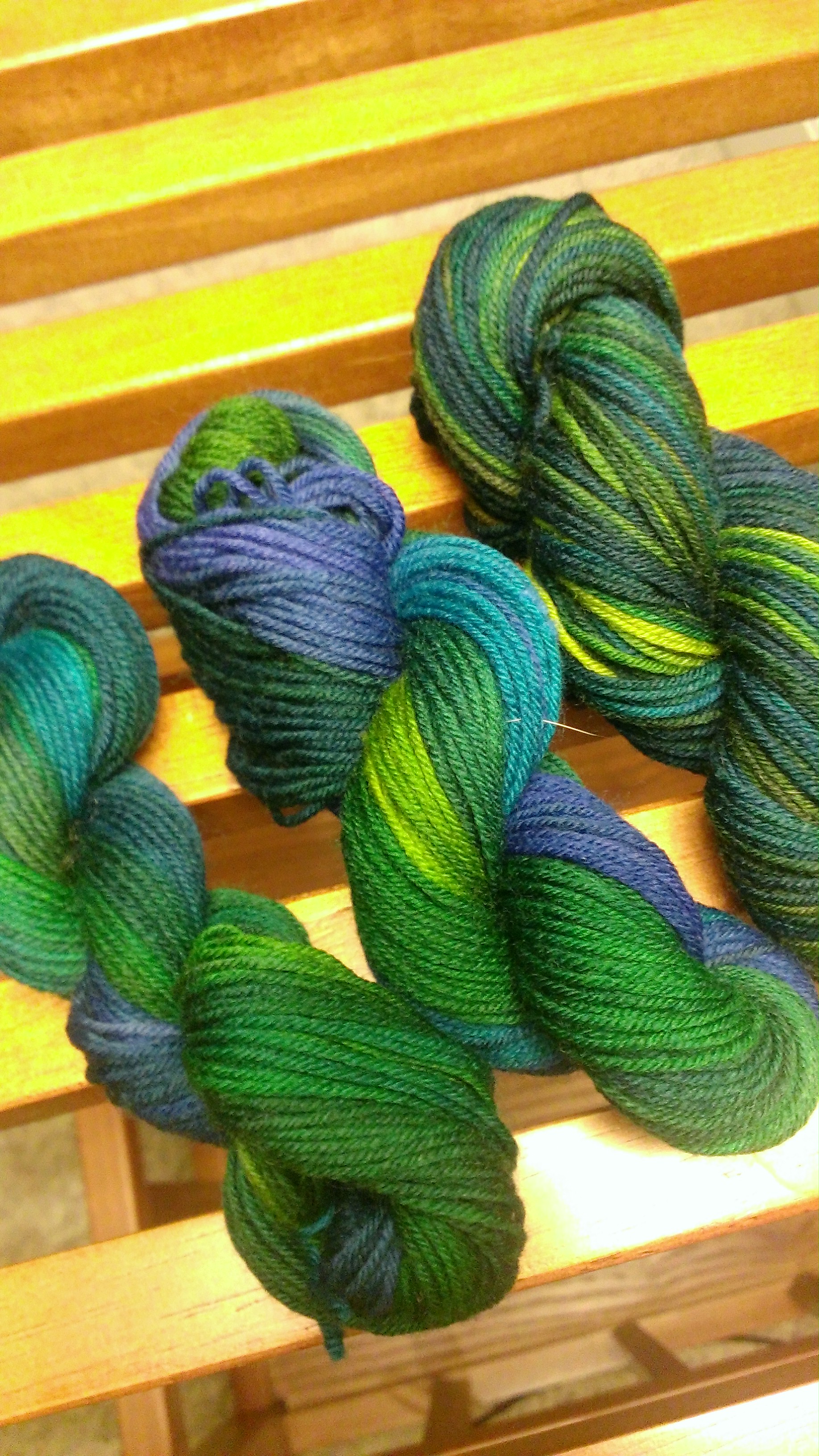
Like I mentioned in my dying posts, it’s really really ridiculously hard to dye two skeins of yarn separately and end up with the same color finished product.  Even for companies who do nothing but dye yarn all day.  Point in case:

WP_20130802_009(Pardon the cell phone pic.  I had to start knitting, so there wasn’t time for finding my camera…waiting for the sun to come out.  Don’t judge me.  I know I have a problem.)

I actually bought these three nano-skeins as a single mini skein. They were the ends of a couple different batches (aka. dye lots) of yarn, supposedly dyed the same way.  See how the one on the right is more olive-y?  See how the left one is greener?  And the one in the middle has a lot more blue in it?  When you buy hand-dyed yarn, you have to expect there will be a bit of variation in dye pattern between dye lots.  (Even mass-produced yarn has some variation between dye lots.)  Sometimes it’s subtle, but sometimes it’s super obvious.

How do you avoid this?  You’ve got two options:

Option 1:  Buy all your yarn from the same dye lot.  Look on the label, and you’ll see information about the color.  The colorway (the color the yarn is supposed to be) will be indicated.  Usually the colorway has a descriptive name (like Heather Gray, or Sunshine Yellow, or whatever), but sometimes it’s a serial number.  It depends on the company.  The dye lot will be indicated by a number.  It’ll be written “Lot:###” or “Dye Lot:###.”  Usually yarn stores will stock mostly one dye lot at a time, but check anyway, just to be sure.

If you can’t find enough skeins of yarn from the same dye lot, you can move on to Option 2:

Stripes.  Lots of stripes.  If you mix your yarn together (changing the yarn you work with every row or two), changes between the dye lots will blend together and become unnoticeable.  If you’re working in the round, think about using my spiral technique from Friday.

This option takes approximately another metric ton of extra work, but if you’re talking about the difference between making a sweater that you will wear for the next ten years, or a sweater you’ll leave sitting in the bottom of your closet, it might be worth it.  Just sayin’.


You spin me right ’round

I love stripes, and I adore knitting stripes especially.  The whole “knitting with two colors at the same time” is pretty much the best.  But I do not love weaving in all the ends at the end of a project.  It’s like the world’s worst knitting practical joke.  “Oh, you think your sweater’s done?  HAHA NO!  You get to spend the next six hours weaving in ends. Sucker!”  Not fun.

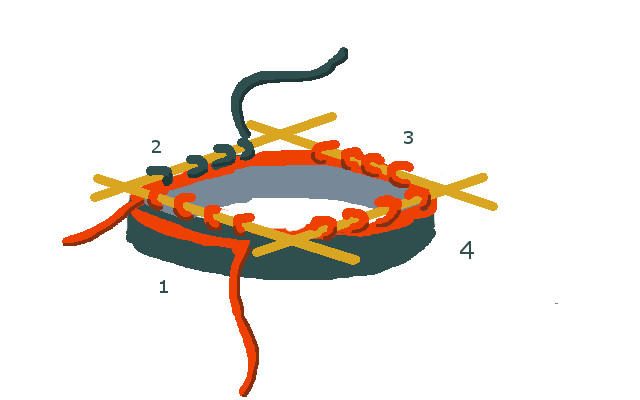
So, here’s a trick that I like to use when I want to make something in the round with itty bitty stripes.  Essentially, I’m working both colors at the same time, spiraling them together.  This way, it looks like I have perfect jogless stripes, AND I don’t have to worry about a million little ends to weave in at the end.  (Also, despite my poor description, it’s actually quite easy.)

Please forgive the messy drawings… I’m still figuring out the whole “graphics” thing.

1.  Cast on with your first color, and join in the round using a set of 5 dpns (4 to hold your knitting, and one to use).  Knit a few rows (it can get too fiddly if you don’t have a good solid base before adding the second color).

Swirl 12. At the beginning of the round, start knitting with the second color, but don’t cut the first color.  Knit needles 1, 2, and 3 with the second color.

Swirl 23. Stop knitting with the second color, but don’t cut the yarn.  Pick up the first color and start knitting where you left off.  This time, only knit two needles (needles 1 and 2).
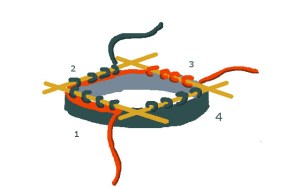
Swirl 3

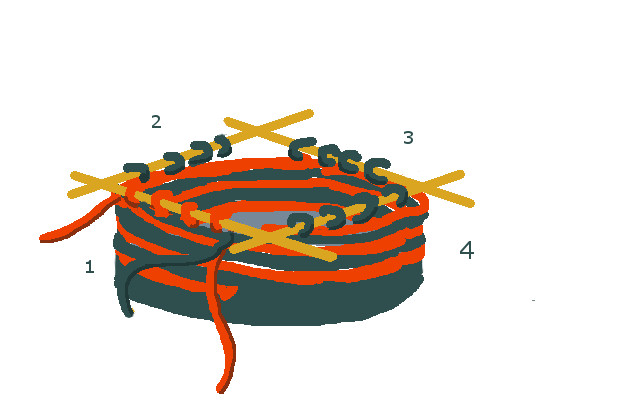
4.  Pick up the second color again, and knit two needles (in this case, needles 4 and 1)

Swirl 45.  Keep going in pattern, picking up the first color and knitting two needles (needles 3 and 4).

Swirl 56. See how the pattern is going?  You knit two needles of the first color, then two needles of the second color.  This way you keep building up a spiral of stripes, until you end up with a great big long spirally/striped scarf/hat/mitten etc.

Swirl 6When your project gets long enough, knit until your secondary color is back at the beginning of the row, then cut it.  Do a couple more rows in the first color, and bind of as usual.

Easy!

So… Who are you?

We’ve been doing this blog thing for a while now, and I think it’s time for us to get to know each other a little bit more.  Also, I just figured out how to add polls, so I had to give it a try.

So, just out of curiosity, if you would answer a couple quick questions for me, I would love to hear from you!  And feel free to add anything you think is missing in the comments section.

Please Stand By…

technical

So, I don’t know what I did to my camera, but it’s doing something weird, and I’m having trouble getting photos off of it.  I’m also completely exhausted from this weekend (in a good way), so it’s possible that my camera is fine, and it’s me who’s having the issues.

Anyway, please bear with me while I get it figured out.  And we should be back to our regular scheduled program by Wednesday!

Inspiration: PAX

As you’re reading this, I’m probably at PAX Prime!  PAX is an annual gaming convention here in Seattle, and it’s absolutely a blast!  Thousands of people getting together to play and discuss games of all sorts.  Video games, board games, tabletop games… anyone who’s even remotely interested in gaming would have a fantastic time there.   I’m not even a hard core video gamer, but I enjoy myself there thoroughly. (They have rooms filled with board games for you to check out and try.  It’s pretty much the best.)

PAX-Prime-Logo

Anyway, in honor of PAX Prime this week, let’s get our geek on and look at some super cool videogame inspired knits:

From Zelda:

The Legend of Baby Link, by Joanna Rankin

1Finley_as_Robin_Hood_medium[1]From Minecraft:

Cute Creeper, by Krista Sodt

image

From Portal:

Knitted Companion Cube, by Wren Montgomery

6279582438_0e038740f6_bFrom Space Invaders:

bmp, bu Aija Goto

407924933_d28c695624_z[1]

Chummy’s Afghan Redux

This is a totally selfish post, with really very little value to you as a reader.  But I’m very excited about finishing my Call The Midwife-inspired afghan! (If you don’t remember what I am talking about, you can catch up here, here and here.)

OLYMPUS DIGITAL CAMERA

I used up almost all my leftover yarn from my many years of making socks.  It’s nothing more than a simple granny square blanket, whip stitched together.  I added a tiny single crochet edging to give the blanket a little more strength, since I plan on using it all the time as soon as the temperature drops out of the 60s (the 60s are “Summer Weather” out here in Seattle.  I was wearing shorts the other day, and my husband and I were going out to do some errands when he asked if I needed a jacket or something.  I said “No, I’m good.  It’s still plenty warm. It’s not supposed to get below 65 today.”  This is still weird to me, coming most recently from Austin, where if the temperature dropped to the 60s, you broke out the sweaters.  But I digress.)

Anyhoo, the blanket is kind of hideous, but I love it.  It’s mostly wool, so it’s really cozy, despite being fairly thin.  It’s just about the right size to fit over your lap when you’re sitting on the couch watching TV.  And I think it’s pretty delightful.

OLYMPUS DIGITAL CAMERA

The Long and the Short of It

Just a quick post today, with a really awkward photo.  Because that’s how I roll.

When you do a long-tail cast-on, like this, sometimes it’s yard to figure out how long to make your tail.  If the tail is too long, you end up wasting yarn.  If the tail is too short, you have to rip out your cast-on, and try again (which is a very inauspicious way to start a project).

So, here’s my rule of thumb:  Estimate the length of your finished knit object, and multiply that by four.  So, for example, imagine you’re making a wash cloth.  You want the wash cloth to be 9 inches across.  So, you multiply 9 inches x4, to get 36 inches.  So, you want a 36 inch tail for your long-tail cast-on.  Easy!

Or, if you want to do it the slacker way (which I totally do), just estimate.  If I’m making a hat, I’ll just wrap the yarn around my head a few times.

Here’s the awkward picture:

OLYMPUS DIGITAL CAMERA

You’re welcome.