Tag Archives: stripes

And This Is How I Did It

Wednesday, I talked about a sweater I made for my grandfather, based off one that his mother made for him decades ago.

I thought it might be interesting to talk about how I combined a couple patterns, added my own details to create this customized sweater, and went from an idea to a finished product.

I started with the description my Grandfather gave me, “A brown and blue sweater with deer on it.”  From there I guessed that he meant an old-school ski sweater with some sort of color work pattern on the front and back.

235792[1]I looked at patterns for ski sweaters, and none of them were quite right.  They were either too fancy (too many colors or too fussy-looking), or more formal than I knew my grandfather would like to wear (he is a hunting, fishing, outdoors-y type).

Instead, I decided to start with a very simple pattern that I had used before, and modify it to my liking.  I picked the Weasley Sweater by Alison Hansel.  It’s a simple and easy drop-shoulder sweater that comes in a million sizes from infant to grown-up.  I’ve knit a couple sweaters from the pattern before, and they have all turned out really well.  (And the pattern is available for free!)1116161018_78043aab2b_z[1]

The only thing that I don’t care for with the Weasley Sweater is the rolled hem and collar.  Instead, I knit a k2p2 rib for the bottom, and a k2p2 crew collar.

OLYMPUS DIGITAL CAMERAAnd, instead of working the whole shebang in plain brown, I added a stripe of blue just above the cuffs and hem.  Adding a little bit of color work at cuffs and hem is a very “ski sweater” thing to do, and a stripe is the simplest color work you can do.

OLYMPUS DIGITAL CAMERAMy next problem was the deer motif that I had to put on the chest.  I looked at a lot of patterns, and finally decided to use the deer motif from the His & Hers Reindeer Jackets from Patons.  I originally planned to work the deer using the intarsia technique, but then I decided that I wasn’t insane.  (Intarsia and I don’t get along very well.)

Deer_Sweater_-_front_medium[1]Instead, I knit up the whole sweater in plain brown (except for the blue stripes at cuffs, hem, and the edges of the chest panel), and used the duplicate stitch to add the deer after once the knitting was done.  It took approximately 100 years to finish the deer (not really), but I think it was worth it.  Because the whole chest panel is knit plain, the sweater is stronger than it would have been if I had worked the deer in intarsia (and I think it looks better, too).

OLYMPUS DIGITAL CAMERASo, with a couple different patterns, some planning, a little futzing, and inspiration from the ghost of my great-grandmother, I think I managed to make exactly the sweater that my grandpa was looking for.

OLYMPUS DIGITAL CAMERA

Lazy Susan Beanie

OLYMPUS DIGITAL CAMERA

I love knitting stripes.  Changing colors back and forth keeps my interest, even when making a super simple project like this beanie.  But, as you know, I am utterly lazy.  I absolutely detest stopping my flow of knitting to attach and reattach new balls of yarn.  And weaving in all those thousands of tiny ends at the end of a project is pretty much the worst.    The Lazy Susan Beanie avoids both of these issues by working both colors at the same time, knitting them in a spiral pattern that ends up looking like perfect one-row stripes (get it?  Lazy Susan?  Because it spins and is for lazy people… like me).

Also, this pattern is a great way to experiment with color and dying your own yarn.  I knit the sample with a turquoise variegated yarn and a dark purple/black semi-solid which I dyed using food coloring.  (You can read my posts for more information about dying yarn with food coloring.)  Try using different color combos for different results!

You can get the Lazy Susan Beanie pattern here:

Lazy Susan Beanie

You spin me right ’round

I love stripes, and I adore knitting stripes especially.  The whole “knitting with two colors at the same time” is pretty much the best.  But I do not love weaving in all the ends at the end of a project.  It’s like the world’s worst knitting practical joke.  “Oh, you think your sweater’s done?  HAHA NO!  You get to spend the next six hours weaving in ends. Sucker!”  Not fun.

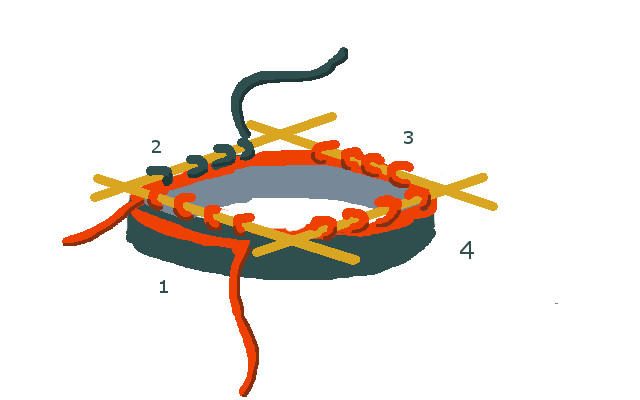
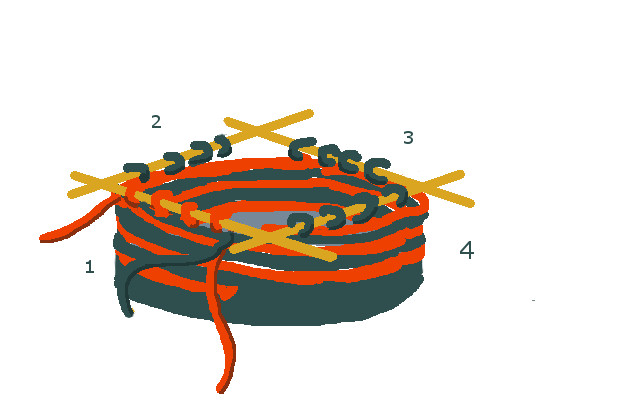
So, here’s a trick that I like to use when I want to make something in the round with itty bitty stripes.  Essentially, I’m working both colors at the same time, spiraling them together.  This way, it looks like I have perfect jogless stripes, AND I don’t have to worry about a million little ends to weave in at the end.  (Also, despite my poor description, it’s actually quite easy.)

Please forgive the messy drawings… I’m still figuring out the whole “graphics” thing.

1.  Cast on with your first color, and join in the round using a set of 5 dpns (4 to hold your knitting, and one to use).  Knit a few rows (it can get too fiddly if you don’t have a good solid base before adding the second color).

Swirl 12. At the beginning of the round, start knitting with the second color, but don’t cut the first color.  Knit needles 1, 2, and 3 with the second color.

Swirl 23. Stop knitting with the second color, but don’t cut the yarn.  Pick up the first color and start knitting where you left off.  This time, only knit two needles (needles 1 and 2).

Swirl 3

4.  Pick up the second color again, and knit two needles (in this case, needles 4 and 1)

Swirl 45.  Keep going in pattern, picking up the first color and knitting two needles (needles 3 and 4).

Swirl 56. See how the pattern is going?  You knit two needles of the first color, then two needles of the second color.  This way you keep building up a spiral of stripes, until you end up with a great big long spirally/striped scarf/hat/mitten etc.

Swirl 6When your project gets long enough, knit until your secondary color is back at the beginning of the row, then cut it.  Do a couple more rows in the first color, and bind of as usual.

Easy!

Yikes! Stripes!

I don’t know about you, but I’ve still got socks on the brain.  They are possibly my favorite project to work on when I’m looking for something easy, portable and fun.  But, sometimes having a million plain socks gets boring, so sometimes I mix it up, and use self-striping sock yarn.  Lots of brands carry self-striping sock yarn, and when you buy it, it just looks like regular variegated sock yarn (except that the label will have the word “stripe” on it…duh):

But, when you knit your socks, you magically end up with beautifully striped socks with absolutely no effort on your part!

OLYMPUS DIGITAL CAMERA

Pretty awesome, right?

So, how do they do it?  Basically the yarn company figures out how much yarn the average knitter uses for every row when she makes her socks.  Then, they dye the yarn in row-long increments, so that each row is a different color.  So, for example, if it takes 1 yard of yarn to knit 1 row, they might dye the yarn sow that 5 yards are blue, then 5 yards are green.  This means that in the finished sock, you will end up with a 5 row stripe of blue followed by a 5 row stripe of green.  Pretty clever!

A Recipe for Anarchy

This recipe is for a basic yarn bombing piece.  I’ve purposefully neglected to give you yarn requirements, gauge measurements, sizes and other specifics.  Because, well, this is graffiti, and should be sort of free form.  And rules are for squares.  So, feel free to change, modify, add to, and alter to your heart’s content.  Change is good!  Anarchy!  Down with the Man!

OLYMPUS DIGITAL CAMERA

Materials:

Yarn-As much or as little as you like.  Don’t use anything expensive, since it’ll get gross out in the rain, and may be torn down quickly.  Odds and ends that you have laying around will work fine.  I used some Red Heart that I had laying around, waiting to be used.

Needles- To match your yarn.  I recommend a large gauge, so that your knitting goes quickly and you can cover a larger area.  I used 10 1/2.

Crochet hook (optional)- In a gauge to match your needles.

Buttons (optional)-Again, nothing fancy or expensive.  If you have some laying around that you don’t mind parting with, feel free to use them.  Or, you can make your own buttons using an old plastic container (like a milk jug or other food container).  Cut out circles about an inch around, and use a hole punch (or a knitting needle) to poke two holes in each button.  They won’t be pretty, but, they’ll do the job.

Scissors and tapestry needle.

Instructions:

1. Cast on any number of stitches.  This should be easy and free-flowing, so don’t worry about gauge or where the knitting is going to end up.   I’ll just make something, and then find somewhere to put it.  However, if you have a particularly sad tree or something that you think needs a little knitted excitement, feel free to measure the circumference of the tree, make a gauge swatch, and figure out the number of stitches you’ll need to go around it.

2. Knit for a while.  Let your creativity take over!  Change colors, mix patterns together, do things that you wouldn’t usually do.  Think of this as an opportunity to “sketch” with your needles.  Here are some ideas that you might want to include:

  • Stripes
  • Ribbing
  • Lace patterns (How cool would a tree look covered in gigantic lace?  I just thought of this… and I might go try this soon.)
  • Cables
  • Intarsia, Fair Isle, or other Color work
  • Adding beads or other unconventional materials

3.  When your piece is finished, cast off loosely.

4. Optional-Use the crochet hook to edge the whole piece with a single crochet edge.  You can use this to burry any yarn tails that you may have, so you don’t have to actually sew them in.OLYMPUS DIGITAL CAMERA

5. Optional- Add buttons and button holes.  You can skip this step if you want to sew your piece directly onto your tree/light pole/sign post. If you want buttons, attach them to one side of your piece (mine are on the right in the above picture).  On the opposite side of the piece, make some button loops.  You have two options:

  • Use the crochet hook to make loops in the edging.  Make another row of single crochet along the edge.  When you reach a spot where you want a button hole, chain 3 stitches, then continue doing the single crochet edging.
  • Using your tapestry needle and a length of yarn, you can add simple button loops as follows:  Sew in one end of the yarn.  Wrap the yarn around your non-dominant thumb, right down by your knitting.  Sew other end of the yarn.  You’ll end up with a 1” loop of yarn hanging off the side of your knitting.  This loop will act as your buttonhole.

OLYMPUS DIGITAL CAMERA

6. Sew in any ends that haven’t been sewn in already.

7. Install your work.  This is the sneaky part.  I recommend doing it under cover of darkness.  But it’s up to you.  Find where you want to put your knitting.  Trees in parks are good, or maybe there is a bike rack near your house that needs a little perking up.  Look for something with a circumference that is roughly equal to the width of your knitting.  When you have found a good spot for you knitting, install your graffiti!

  • If you have buttons:  Button the piece to your tree/pole etc.  Easy!
  • If you didn’t put on buttons: Using a long piece of yarn, sew the piece into place.  A simple whip stitch works well.  Work quickly!

8. Run away!

9. Come back the next day to appreciate your work.  Take pictures.  Pretend to just be a passer-by who is tickled by the cool knitting.

OLYMPUS DIGITAL CAMERA