Tag Archives: sweater

Stellar’s Jay Sweater: Changing Plans

I’ve been hard at work on my Stellar’s Jay sweater.  The body is almost up to the armpits!

I’m following my pattern as I wrote it, except for a couple (sort-of) minor details.

First, I decided that I didn’t like doing the scallop rows the way I had planned it out, so I modified it a little.  Now, it is slightly shallower (worked over two rows, instead of three), and I think it looks much better.  I’m probably the only one who would ever notice, but I’m picky that way.

Second (and this is a larger change), my pullover had turned into a cardigan.  I don’t know what happened- I was casting on and some knitting spirit whispered in my ear that I needed a cardigan, not a pullover, and one thing led to another.  I’m still following the pattern as I designed it, but instead of working the sweater in the round, I’m knitting it flat.  When I finish up the sweater, I’ll pick up stitches along the selvedge edges and knit on some button bands.  It should look pretty good (I hope!).

OLYMPUS DIGITAL CAMERAIt’s important to remember that regardless of how much planning goes into your knitting, it’s still possible to change plans as you work.  You’re in charge of your project, and being flexible when you don’t like how something is working up will end up giving you a better finished project.

What changes have you made to projects as you knit them?
Inspiration: Mr. Roger’s Mom

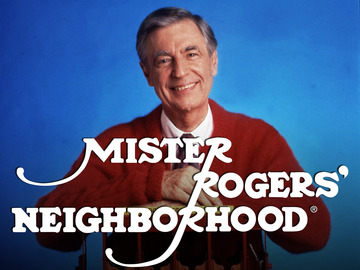
Everyone (at least in the US), knows Mr. Rogers, and his beautiful kids’ TV show, Mr. Rogers’ Neighborhood.

Each episode begins with Mr. Rogers entering his house, changing his shoes and zipping up (or buttoning up) a cardigan sweater while singing “Won’t You Be My Neighbor?”  (I still know all the words more than 20 years after I last saw the show.)Copyright © 1995 - 2008 Public Broadcasting Service (PBS). All Rights ReservedBut, did you know that all (or at least, nearly all) his sweaters were knit by hand by his mother, Nancy Rogers?  How wonderful is that?   It totally makes sense.  Of course Mr. Rogers wore sweaters knit by his mother!25988[1]One of her sweaters has even ended up in the Smithsonian.   You can visit it in D. C. next time you’re there to pay respects to Mrs. Rogers.

mr-rogers-sweater-smithsonian-640x480[1]

And, one of the most famous Mr. Rogers quotes (at least it pops up on my Facebook feed most frequently) is about his mother:

“When I was a boy and I would see scary things in the news, my mother would say to me, ‘Look for the helpers. You will always find people who are helping.” — Mister Rogers

Mr. Rogers’ mother must have been a pretty amazing lady.  So let’s raise our knitting needles to Nancy Rogers (and all the other amazing mothers) this Sunday while we celebrate Mothers’ Day!


(And Happy Mothers’ day to all you mothers out there on the internet!  Especially Mom, Grandma, and Kris (my Mother-in-Law)!)

Stellar Jay Sweater: Gauge and Math

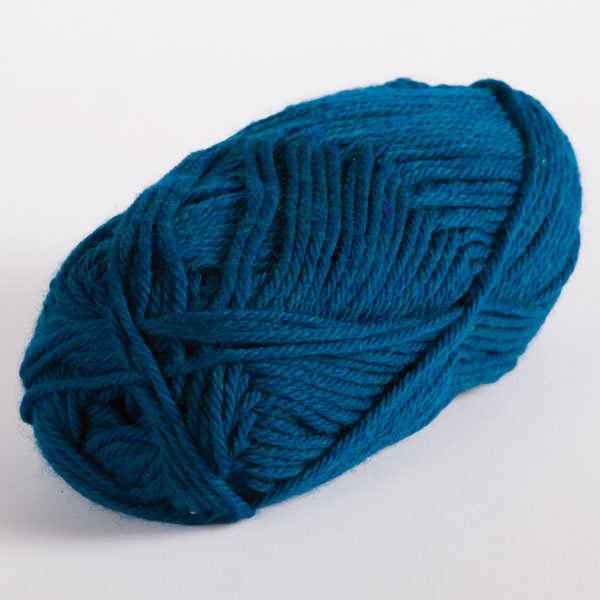
It’s here! It’s here! Let’s all ooh and ahh at the beautiful yarn!

OLYMPUS DIGITAL CAMERANext step is to whip up a swatch. I have been brainstorming this sweater, and I think that plain stripes are too boring, so I’ve decided to do a little scallop design between each stripe, so I’m going to include that in my swatch, to see how it looks. Two birds. One stone.

I knit up a square of fabric about six inches by six inches. And I’ve worked my scallop pattern both right-side-up and upside down, to see which I like better.

This is the upside-down version, but I think it makes the scallops look a little rectangular.

OLYMPUS DIGITAL CAMERAThis is the right-side up version, which I like better.OLYMPUS DIGITAL CAMERA

This means that I will need to work my sweater from the bottom up, which is important to know when I start designing my pattern.

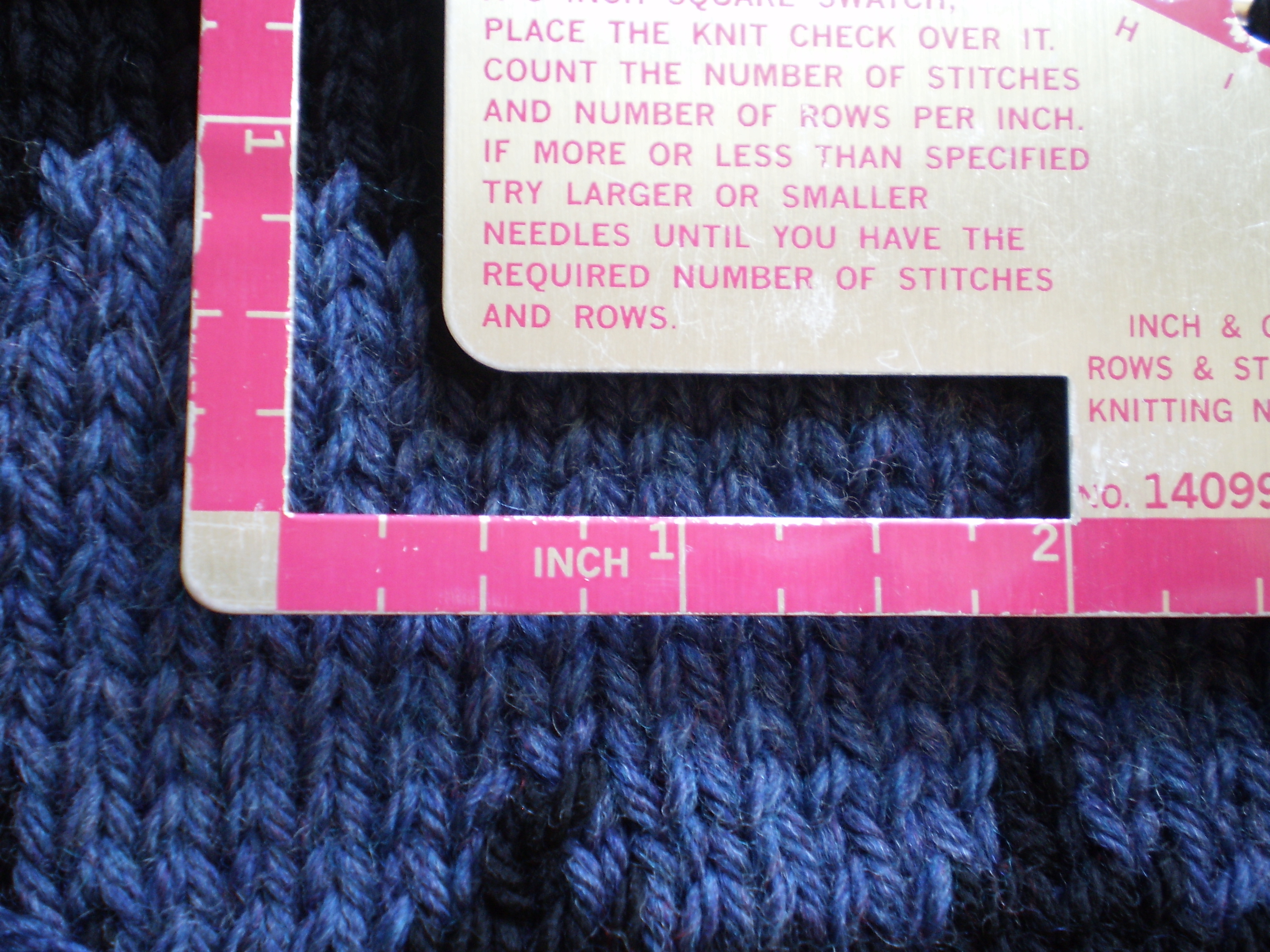
I pulled out my gauge meter (you could just use a ruler or tape measure) and measured out my gauge. I got 5 sts per inch and 7 rows per inch in stockinet stitch on size 8 needles.

OLYMPUS DIGITAL CAMERASo, now that I know my gauge, and the general design I want to use (bottom up pullover), I do a little math and sketch out my pattern. I’m basing this one on Elizabeth Zimmerman’s Percentage System, to give me the bones of the sweater, but I’m tweaking it a bit to deal with an all-over stripes pattern, instead of only a yoke pattern.

OLYMPUS DIGITAL CAMERABelieve it or not, those chicken scratches make sense to me. I usually sketch out my pattern like this (on a drawing), before I start knitting. Then, as I knit up the pattern, I’ll make notes into a notebook or on my computer in more standard knitting lingo. But, for now, this will do nicely for me.

Now I get to go cast on! Woo!

Stellar’s Jay Sweater: Planning

In case you haven’t picked up on it yet, I am essentially an 80 year old woman in a 28-year-old’s body.  I love drinking tea, watching procedural cop dramas, puttering around in my garden, and obviously, knitting.  When I was in college, I tried to deny it, but I have given up.  I’m an old lady, and I’m A-OK with it.

As an old lady, I spend an inordinate amount of time watching the birds that are hang around my bird feeders on the back porch.  We get house finches, juncos, chickadees, and squirrels (who have already destroyed two bird feeders).  But my favorite birds by far are the Stellar’s Jays that live in the great big cedar tree in the corner of our garden.stellers_jay[1]I’d never seen these birds until we moved to the PNW.  They are incredibly striking, slightly bigger than a Blue Jay, and their colors are spectacular.   They’re a super dark, rich, black on their top half, and a bright cerulean blue on their bottom half.  They have a great big crest of feathers on the top of their head, which looks like a particularly sassy mohawk.  I love watching them hang out on our porch.

In honor of my favorite bird-feeder visitor, I thought I would make a sweater inspired by their gorgeous plumage.  And, I am going to bring you along on the design and knitting process.

My plan is for a pullover worked with a bold blue-to-black gradient inspired by the Stellar’s Jay plumage.  The design is still a little hazy in my brain right now, but I know it will solidify once I start playing with the yarn.

I’ll start by ordering some of my favorite sweater yarn: Knit Pick’s Swish Worsted.   It’s a super-wash merino wool, so it’s both durable and super cuddly soft.  It comes in about 40 colors and is pretty reasonably priced.

I picked out two skeins of each color:

Black (duh)

23876Delft Heather

24095Dusk25150

Marine Heather24094Gulfstream25137Very Stellar, no?

When my order gets here, I’ll work up some swatches and start playing with math.  But for now, I think I need to go refill my bird feeder.  Stupid squirrels.


Pattern Spotlight: Baby Sophisticate

A few years ago, it seemed like everyone I knew was getting married (including me, so I don’t really have any room to complain).  For some reason I decided that the perfect wedding gift was a hand knit or crocheted blanket.  I soon began to hate that decision.  When you have one wedding a year, it’s fine.  However, when you start having three weddings every month, that’s a lot of late nights.

Now, as the song goes, first comes love, then comes marriage, then comes…  a whole passel of babies (what’s a group of babies called?  A herd? A pod?  A holler?).

But this time, I am being smart about what hand knits I give out.  Babies get sweaters. Not great big blankets.  Maybe a little stuffed animal or a matching pair of bootees, if I’m feeling generous.  I’m a big fan of EZ’s Baby Surprise Jacket, but sometimes knitting even a tiny sweater in sock yarn is more than I’m up for.  When I learned that a friend was expecting twins, and invited me to a baby shower in a week, I knew that even I couldn’t bang out two BSJ’s in time.

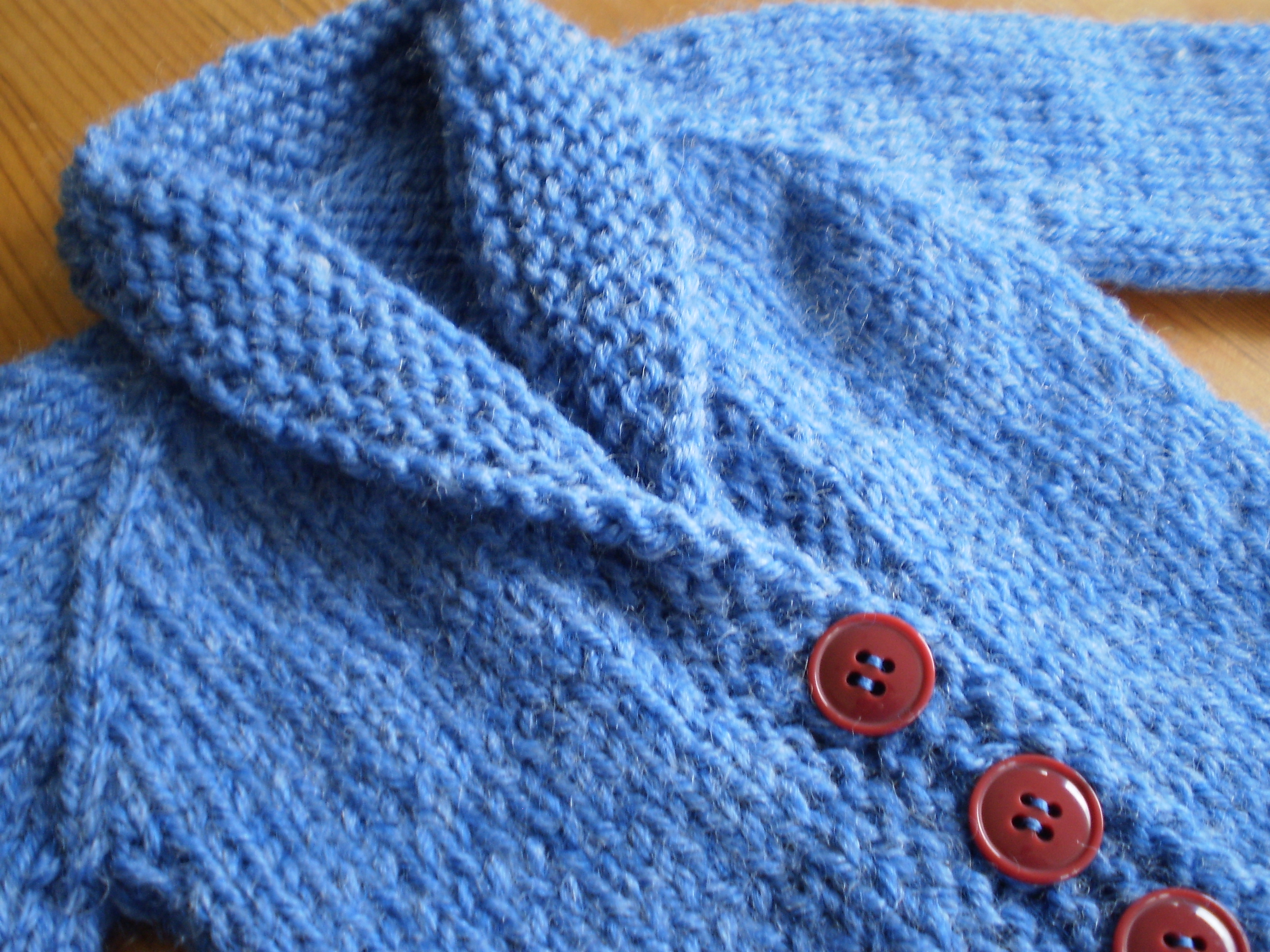
I went to Ravelry and started poking around for an alternative, and I found the perfect baby sweater.  It’s the Baby Sophisticate by Linden Down.  It’s a free download and comes in two sizes, 0-3 months and 6-12 months.  It’s knit up on size 8 needles and Aran yarn (although I used worsted, which worked fine). OLYMPUS DIGITAL CAMERAIt’s an absolutely adorable pattern.  It’s well-written and easy to follow.  The garter-stitch shawl collar makes the sweater look fancy, but it’s completely easy to do.  And, since it’s knit at a larger gauge, I managed to knit up two sweaters in about a week.

OLYMPUS DIGITAL CAMERASo, if you have a skein or two of something superwash, and you know of someone (or six people) in the family way, keep the Baby Sophisticate in mind.

Getting the Fit

I’ve only got time for a quick little post today. (It’s sunny!  SoI have to take this opportunity to do yard work without sinking up to my knees into mud.  Seattle is just the best.)

So, this is a tip that sounds totally obvious, and when I heard it, I totally kicked myself for not coming up with it myself:

When you’re picking the size for a new sweater, find a sweater or shirt in your closet that fits well, and is a similar style (in other words, if you are making a baggy sweater, go find a baggy sweater in your closet, if you’re making a tight-fitting sweater, find a tight-fitting sweater in your closet).

Lay the sweater flat and measure across the chest, just under the armpits.  Multiply that measurement by 2.  This is the finished chest/bust circumference.

Measure under the armpitsThen, look at your pattern, and pick the size that has the closest finished bust circumference to your finished sweater.

Why is this better than measuring your body?  Frankly, it’s easier to measure something flat on the floor, than something all bumpy and three-dimensional, like your body.  There’s less math.  You don’t have to worry about calculating ease for a sweater if you already have a finished garment with the perfect amount of ease.  And, it’s a great way to be sneaky about knitting a sweater for someone else.  Your kid/husband/friend/neighbor/dude-you-just-met-on-the-street will know something’s up if you ask to measure their chest, but if you sneak off to a quiet corner of the house with one of their sweaters, you can measure away to your heart’s content!

Inspiration: Spring!

It’s official!  As of last Thursday, it’s spring!  And here in the PNW, it’s just gorgeous!  (Sorry to those of you in the Great White North still dealing with snow and cold.  You might want to skip this post.  I don’t want to make you jealous.)

The flowers here are just starting to bloom and we’re getting some beautiful warm spring days.  I’m having a great time exploring our new garden (we moved to a new house in the fall) and finding gorgeous spring flowers as they make their appearance.

In honor of these flowers, I thought we could do some spring flower-inspired knitting.

Tiny little snowdrops were the first to bloom:

OLYMPUS DIGITAL CAMERASnowdrop Beret by Marya Speton

3440218173_2e11349f2c_z[1]Hellebore are subtle and gorgeous.  They remind me of an old, overgrown forest.

OLYMPUS DIGITAL CAMERA151-30 Hellebore – Jacket in seed st in Andes and Fabel by DROPS design

30-2_medium2[1]We have a handful of daffodils just starting to open:

OLYMPUS DIGITAL CAMERADaffodil by Martin Storey

Daffodil_back_medium2[1]And camellia bushes are covered with fluffy, cheerful flowers:

OLYMPUS DIGITAL CAMERACamellia by Meg Myers

6305-cover_medium2[1]Our cherry tree (which I’m sure I will be cursing come fall when I have to clean up all the dropped cherries) is just beautiful and smells even better.

OLYMPUS DIGITAL CAMERABaby Cherry Blossom by Sarah Franklin

sweater_baby_cherry_blossom_medium[1]What’s spring look like in your neck of the woods?

And This Is How I Did It

Wednesday, I talked about a sweater I made for my grandfather, based off one that his mother made for him decades ago.

I thought it might be interesting to talk about how I combined a couple patterns, added my own details to create this customized sweater, and went from an idea to a finished product.

I started with the description my Grandfather gave me, “A brown and blue sweater with deer on it.”  From there I guessed that he meant an old-school ski sweater with some sort of color work pattern on the front and back.

235792[1]I looked at patterns for ski sweaters, and none of them were quite right.  They were either too fancy (too many colors or too fussy-looking), or more formal than I knew my grandfather would like to wear (he is a hunting, fishing, outdoors-y type).

Instead, I decided to start with a very simple pattern that I had used before, and modify it to my liking.  I picked the Weasley Sweater by Alison Hansel.  It’s a simple and easy drop-shoulder sweater that comes in a million sizes from infant to grown-up.  I’ve knit a couple sweaters from the pattern before, and they have all turned out really well.  (And the pattern is available for free!)1116161018_78043aab2b_z[1]

The only thing that I don’t care for with the Weasley Sweater is the rolled hem and collar.  Instead, I knit a k2p2 rib for the bottom, and a k2p2 crew collar.

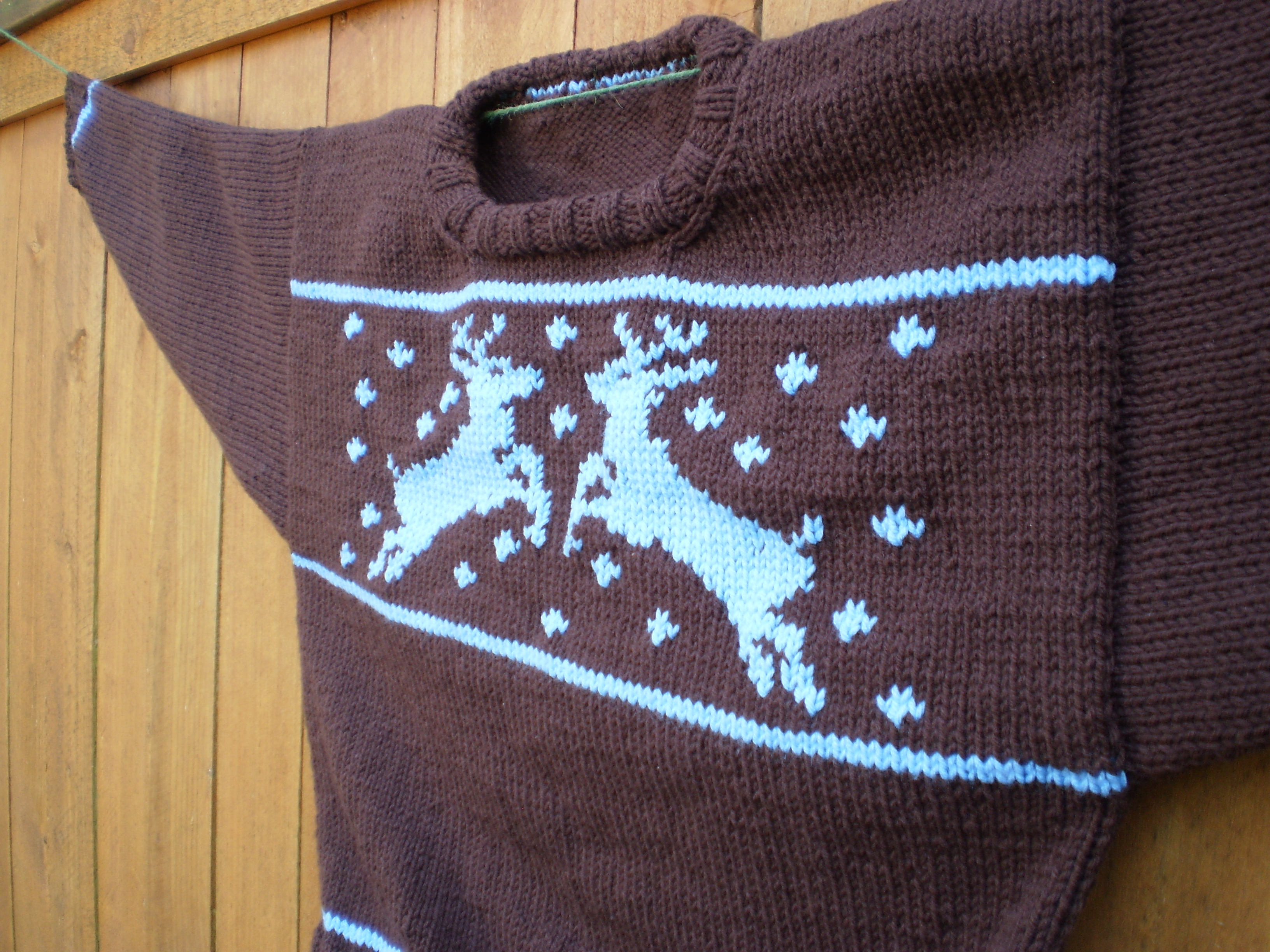
OLYMPUS DIGITAL CAMERAAnd, instead of working the whole shebang in plain brown, I added a stripe of blue just above the cuffs and hem.  Adding a little bit of color work at cuffs and hem is a very “ski sweater” thing to do, and a stripe is the simplest color work you can do.

OLYMPUS DIGITAL CAMERAMy next problem was the deer motif that I had to put on the chest.  I looked at a lot of patterns, and finally decided to use the deer motif from the His & Hers Reindeer Jackets from Patons.  I originally planned to work the deer using the intarsia technique, but then I decided that I wasn’t insane.  (Intarsia and I don’t get along very well.)

Deer_Sweater_-_front_medium[1]Instead, I knit up the whole sweater in plain brown (except for the blue stripes at cuffs, hem, and the edges of the chest panel), and used the duplicate stitch to add the deer after once the knitting was done.  It took approximately 100 years to finish the deer (not really), but I think it was worth it.  Because the whole chest panel is knit plain, the sweater is stronger than it would have been if I had worked the deer in intarsia (and I think it looks better, too).

OLYMPUS DIGITAL CAMERASo, with a couple different patterns, some planning, a little futzing, and inspiration from the ghost of my great-grandmother, I think I managed to make exactly the sweater that my grandpa was looking for.

OLYMPUS DIGITAL CAMERA

Inter-generational Knitting

Over Christmas, I got to visit my grandparents in The Great White North (aka, Wisconsin).  In between blizzards, I chatted with my grandfather, and we started talking about his mother (my grandmother).  She was an amazing woman and an extremely accomplished knitter.  She was actually buried with her blue ribbon that she won at the Wisconsin State Fair. Pretty impressive, right?

In the process of our conversation, my grandfather mentioned that his mother made him a sweater when he was younger.  He had loved it, but it had somehow gotten lost over the last 50+ years.  She had designed it especially for him, in brown and blue, and had put deer on the front and back, since he is an avid deer hunter.

The conversation stuck with me (since I am apparently very sentimental), and the more I thought about it, the more I thought it was sad that the sweater had been lost.  It kept bugging me until I decided that I had to try and recreate the lost sweater.

I don’t have a photograph of the original sweater, but I knew that it was a sweater made for my grandpa in the fifties (or so).  I imagined it would have been a sort of traditional Norwegian ski sweater, the kind that you see on vintage postcards from Colorado.   And, I knew that it was blue and brown.

So I just guessed the rest of the way and came up with this:OLYMPUS DIGITAL CAMERA

I’m sure it’s not an exact replica, but I think it turned out pretty well.   My grandpa loves it, and that’s what matters.  I hope I did my great-grandmother proud.

Inspiration: Aran Knitting

It’s St. Patrick’s Day, and instead of drinking (virtual) green beer and wearing obnoxious glittery green shamrock jewelry, let’s talk about something that’s more traditionally Irish (and way less racist).

partypatty[1]Aran Sweaters are gorgeous and so cozy.  They are traditionally made on the Aran Islands, located off the west coast of Ireland.  And with most traditional crafts, they live in a fog of tradition and old wives’ tales.   Supposedly, they were supposedly knitted in untreated wool for fishermen by their wives.  They left the lanolin on the wool to add an extra water-proofing layer.  (I suppose this makes sense, but can you imagine the stink of a fishing boat full of people in unwashed wool sweaters?  Ugh!)

Some people say that families (or individual knitters) each had traditional motifs that they would use on each sweater.  I’m sure there’s some truth to this.  Everyone has patterns they gravitate to and patterns they can’t stomach.  But, as a knitter who gets bored when she has to make a second sock, I can’t imagine that someone would tie them self to making sweaters with the same pattern over and over forever.

My favorite piece of lore surrounding the Aran sweater is the idea that each motif has a symbolic meaning.  I don’t know how true it is, but it’s a great thought.  The traditional honeycomb pattern  means “hard work”, cables mean “safety,” and diamonds mean “prosperity.”  It’s like the sweater is a good luck charm for your family member to wear, which is an idea I really like.

Want to try your hand at Aran knitting?  Here are a couple (more or less traditional) patterns:

Staghorn Aran Second Edition by Janet Szabo

5280327608_aa0025b2ac_z[1]Baby Poonam by Norah Gaughan

baby_poonan_lg_medium[1]Aran Felted Hot Water Bottle by Ann Budd

ep1172_small[1]