Tag Archives: knitting

Winner, Winner, Chicken Dinner

Oh man, you guys.  It’s time!  Time to give away those free copies of Twist & Tweed!  I’m so excited!

75206DBut, before that, I just wanted to say that you’re all making me very wistful for autumn.  I can’t wait to do all the apple-picking, cider-sipping, forest-hiking and sweater-wearing that everyone has been talking about.  It’s just about killing me that it’s going to be in the 80s again today.  Oh well, I suppose we’ll get back to lovely rainy autumn days soon enough…  but patience was never my strong suit.

In the meantime, let’s get the drawing underway!

As of right now, 72 people entered the drawing, and I’ve got 2 copies of Twist & Tweed to give away– one e-book and one paper book.

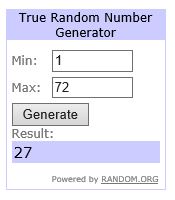
Let’s go to the random number generator:

For the e-book:Capture 1Kristen!  You’ve won the e-book!  You can look at it while your apple pie is baking in the oven!


And for the paper book:

Capture 2Lana!  You’ve won a copy of the paper book!  You can take your book up north to your favorite apple farm and read it while sipping hot cider!

Congrats, ladies!  Keep an eye out for an email from me with the details!

If you want a copy of your own, head over to the Knit Picks website here!

Free! Free! Free!

So, you know my new pattern (the Ballard Pullover)?  It’s not being published on it’s own.  It’s part of a fantastic collection of gorgeous, autumnal knits.  Twist and Tweed!  Here’s what you’ll find inside:

Amazing cables! Cables! Cables!

75206D120[1]Tweed and heathers!

75206D110[1]And more (freaking amazing) cables!75206D115[1]Holy cow, are my fingers itching to start knitting up these projects.  Do you think I could finish that dress by the time fall rolls around if I start now and skip stuff like going to work and sleeping?   Maybe.

Are your fingers itching to cast on, too?  Well, today’s your lucky day!  I’m giving away two (count ’em, two!) copies of Twist and Tweed– one e-book and one paper book– to two lucky readers!

Want to enter? Just comment below with your favorite autumnal activity!  I can’t wait to read all about apple picking and cozy blankets and imagine that I’m back in autumn!

Stoichiometry and Knitting

calculator[1]I don’t get to use my college degrees very often (they’re in a couple fairly impressive-sounding branches of biology and chemistry), but sometimes I get to use a technique I learned in school.  It always makes me happy to use to use things my professors never would have expected.

For example:  Stoichiometry.

Never heard of it?  Not a problem.  Stoichiometry is a fancy chemistry word for a really useful way to do conversions.

If you’ve ever figured out how many stitches there are an inch of sweater or how many rows you need to knit to make a  foot of scarf, you’ve probably done stoichiometry without even knowing it.

Here’s the idea:

You know how if you divide a number by itself, it equals 1?  (Like:  2/2=1)  Stoichiometry tells you that you can do the same thing with words, units, and variables (remember x from high school algebra?).

So what does that mean?  Let’s take a really simple example:

1We can cancel out the “sts” from the top and bottom, so the answer (1) doesn’t have any units.

Now, that example is kind of useless to us, right?  So let’s use stoichiometry to do something that really is useful.  Figuring out how many rows we need to knit to get a 7 inch-tall sock.

Start by making a list of everything you know:

  • Our gauge is 12 rows/inch.
  • We want a 7 inch sock.

You could probably figure this one out in your head (or just on a calculator), but let’s do it the long way for example’s sake.

Start with the number that has a single unit (in this case the “7 inch” finished length) then, build your equation, multiplying across, and making sure that you cancel out your units as you go:
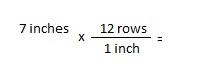
4 We can cross out the units that appear on the top and on the bottom (in this case, the “inches”).

Then we just multiply across, and the answer to the problem gets whatever unit is left (in this case, “rows”)3
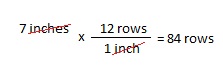
So, in this example, if you have a 12 row/inch gauge and you want to knit a 7 inch sock, you have to work 84 rows.

Does that make sense?  Want to do one more (slightly complicated) example?

OK:  Imagine you’re designing a sweater pattern.  You want the front to be covered with fair-isle patterned stripes that are 8 rows tall.  You want to calculate how many stripes you will need to work to cover the front.

Here’s what we know about your sweater:

  • Gauge: 6 rows/inch
  • Sweater length from hem to shoulder: 22 inches
  • Stripe width: 8 rows/stripe

So, let’s set up the formula (starting with the sweater length- remember, begin your calculation with the number with the single unit.)

5(See how I flipped the 8 rows/stripe upside down, so it’s 1 stripe/8 rows?  That’s totally OK!  And, actually really important.  Flip any/all of your numbers, if it makes the units cancel out correctly.  Just remember, if you flip your the number, make sure you flip your units, too.)

Once everything is lined up correctly, start crossing out units that cancel:

6Then multiply across:7And then divide the top by the bottom.8So, in this example, you’d need to work 16.5 Fair Isle stripes to cover the entire front of your sweater.

Cool right?  (Or maybe that’s just me being a math nerd.)

Of course, you don’t have to use stoichiometry to work these things out, but it’s a great tool to have in your pocket- you never know when it will come in handy.

Do you think you’d ever use this technique to calculate bits of your pattern?  Do you have a different technique for calculating things?  Or do you avoid math completely?

A Short Pause

I love being busy.  To me “a day with nothing to do” means “a day I can work on extra projects.  I  could work on my yard, knit up a sweater, write out a new pattern, make some peach sorbet, or get a jump on my blog writing.

But, it seems like this summer it’s been a little too busy.

I’ve been keeping up with the blog, of course, and working my two day jobs.  I’ve been working on several super-secret freelance design projects (stay tuned for more details!).  Plus, I have a puppy to take care of, a house to keep clean and dandelions to battle in the yard.  And, we keep having visitors stop by.

I love all of these things-  Our house guests have been fantastic, my jobs are great and I couldn’t be happier with how my patterns are turning out.

But there are only so many hours in the day, and I’m starting to get a little frazzled.

Luckily, today is a magical, amazing, special day.  A day when I don’t actually have to go into work!  It’s 9:30, and I’m still in bed.

Sure, I’ve already put in a good hour and a half of knitting time and I’m writing today’s blog post from my laptop, but it’s so much more pleasant to “work” from bed with music playing and a cup of coffee, my pup curled up at the foot of my bed.

My goal today is to knit as much as possible.  And that’s it!  It’s kind of great to only have one thing to do today.

So, I’ll sip my coffee, listen to my music, and knit another row.  (And then another, and another.)

Sometimes that’s all you need to refresh your brain.

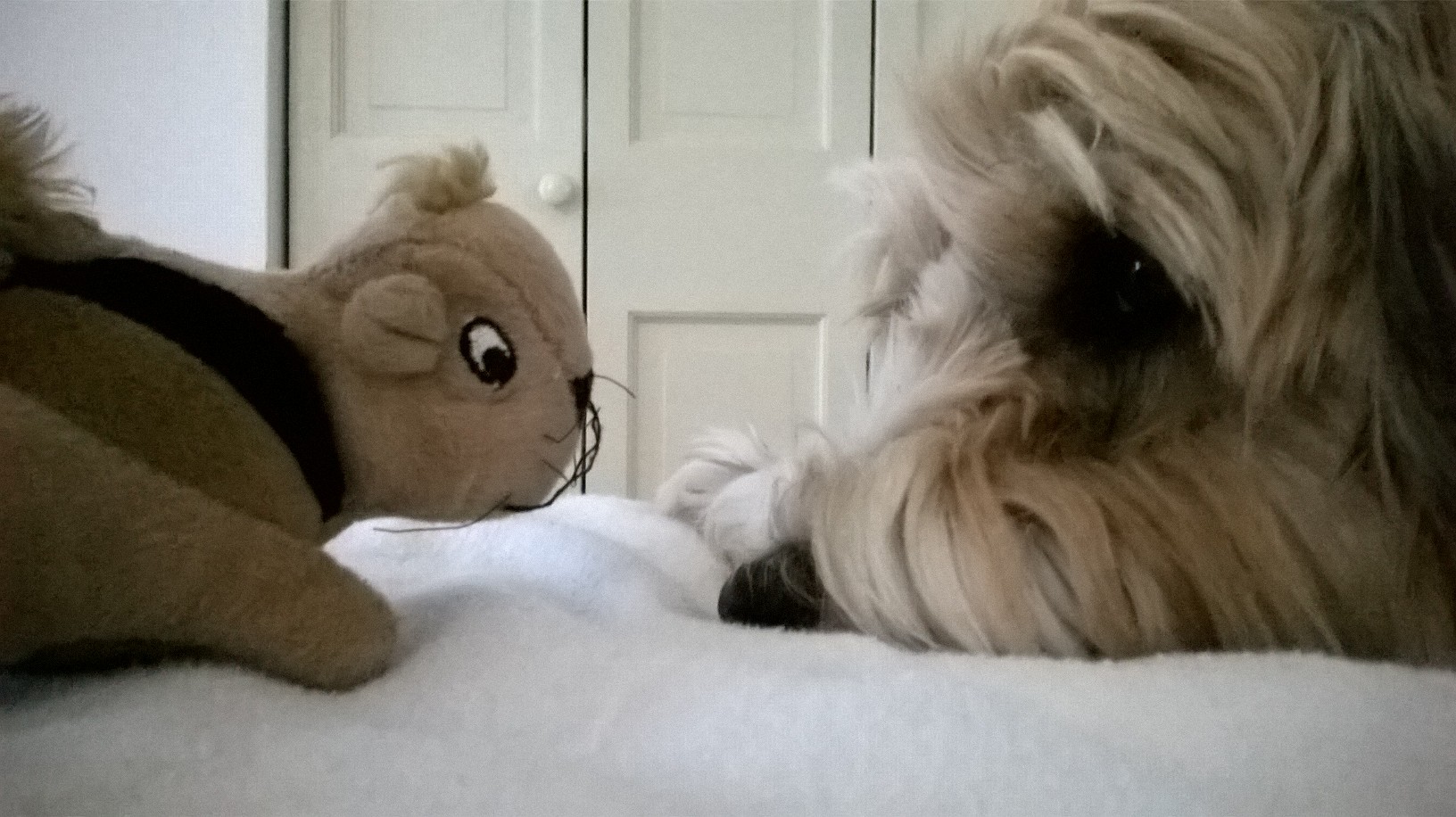
And now, a picture of my dog having a very important conversation with his squirrel toy:

WP_20150702_003

Blocking: Lace

Nothing makes me happier than finishing a big lace project- a shawl, a scarf, or a fancy-pants sweater, and stretching it out across my blocking boards.  There’s something alchemical and transformative about blocking lace.  It’s kind of magical.

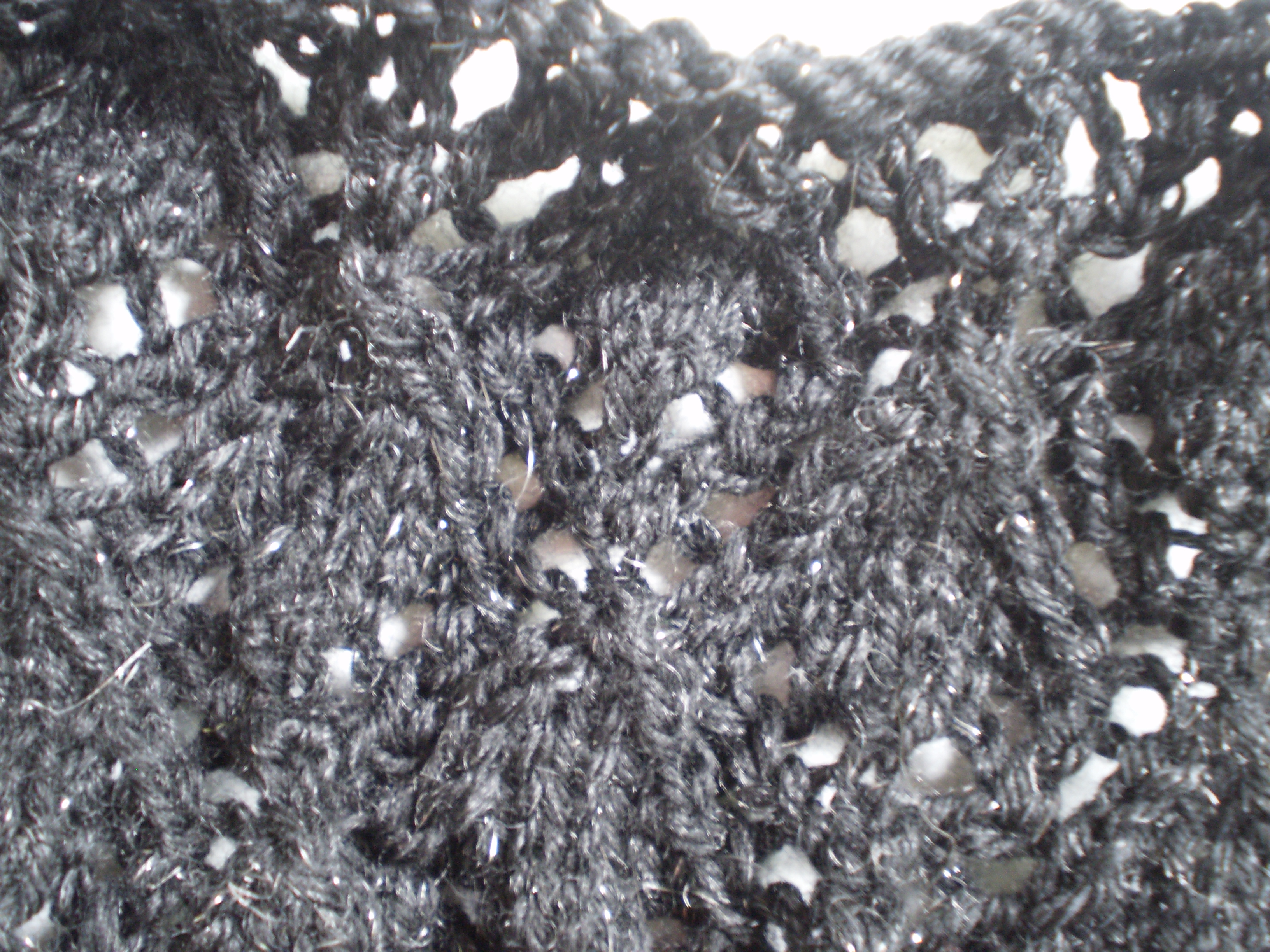
You start with a little blob of knits, purls and yarn overs, and toss it in some water to soak.

OLYMPUS DIGITAL CAMERA

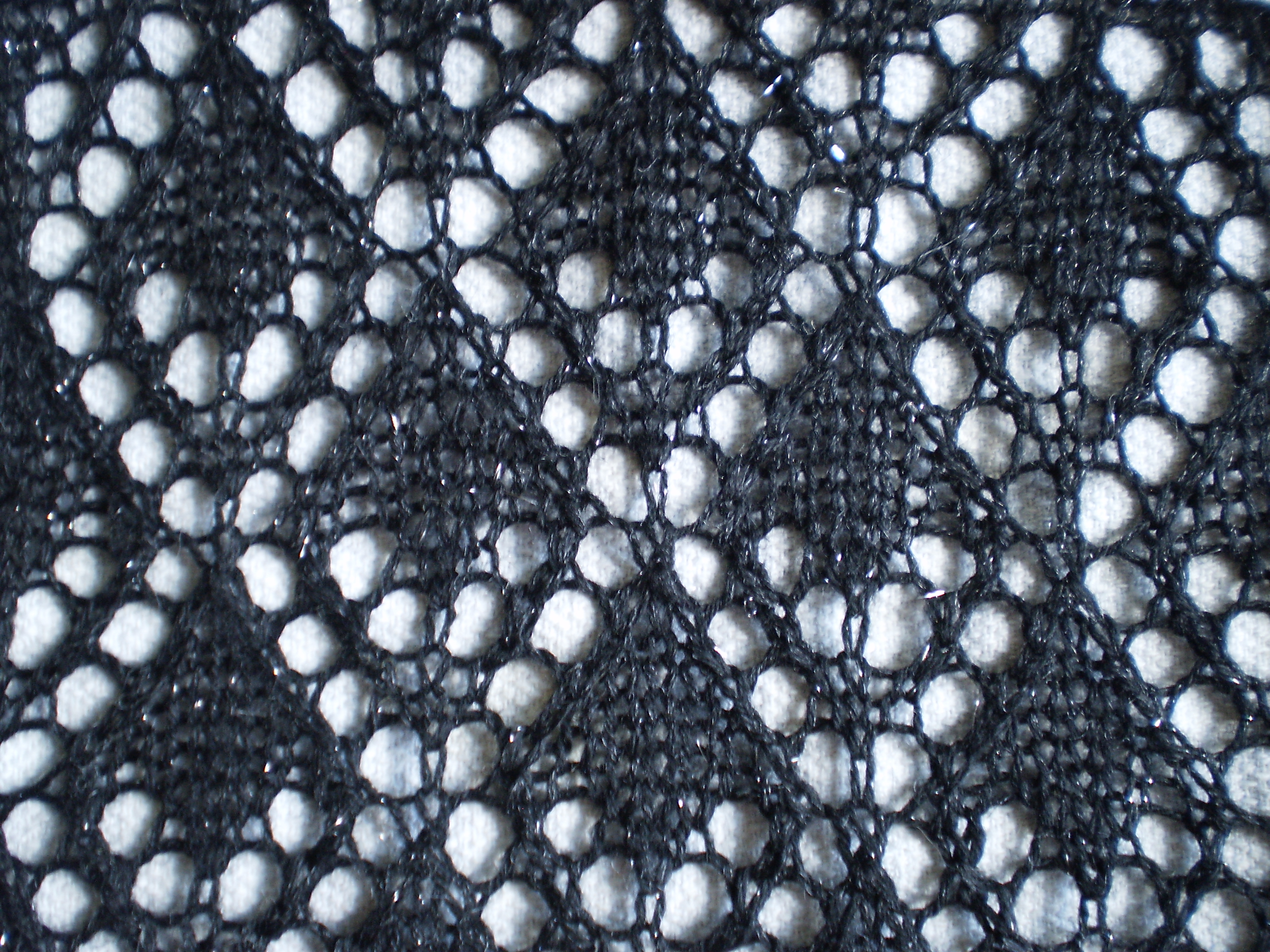
It stretches, and changes, and I think I’m going to accidentally rip it in half (especially if it’s something particularly delicate).  But, then, I get it pinned out, and hey, presto!  You can suddenly see all the lovely stitch detail.OLYMPUS DIGITAL CAMERAEven when you remove it from the board, the fabric is totally transformed from the ugly knot you started with.  Now, it’s flat, beautiful and incredibly drape-y and wonderful.

OLYMPUS DIGITAL CAMERAAnd, of course, pinning out scallops and points on finished lace shawls always makes them look even better!  (Remember how we tried to avoid stretching the knitting so much that it made points on scarves and socks?  You can do it on purpose now!)

Here are a couple shawls I’ve made over the years with interesting borders:

Panache by Lankakomero

OLYMPUS DIGITAL CAMERA

Aeolian Shawl by Elizabeth Freeman8176172544_3cfd6827e5_z[1]

Knitting lace can be a tedious and slow process, but there’s nothing more satisfying than pulling out the last pin from your dried shawl and looking at your beautiful creation.

Inspiration: Fast Projects

I’ve been so busy- I have a half-dozen patterns in various levels of done-ness and with various deadlines (some of which are coming up faster than I would like).

So, with all these deadlines, my knitting has become a bit of a chore.  (Which is lame.  I want knitting to be fun.  Obviously.)

What can I do to make knitting more fun?  Quick, little, projects I can do in an hour or two with a couple dozen yards of yarn.   Want to join me?

These bunnies are so adorable and would be a great way of using up little bits of leftover yarn.  Look at their tiny faces!

Bunny Nuggets by Rebecca Danger

3407592043_acbbd7a523_z[1]

These little gnomies are so super fun.  (I’ve actually made a few for friends with matching baby sweaters for fantastic new-baby presents.)

Gnome Baby by Tonya L Gunn

3353149809_8becc25244_z[1]

I don’t need this crown, but I think I might need this crown.

A Very Regal Crown by Kayleigh LeBlanc

861545_10100319266865320_557215492_n_medium2[1]

Look at these fantastic little fish!  How amazing would a  school of these be hanging from a mobile?

My Little Goldfish by Sara Elizabeth Kellner015_medium2[1]Aah… I can feel the inspiration washing back over me! Yay!

Blocking: Sweaters

You understand how to block something simple (a scarf, a coaster, or maybe even a blanket).  Now, it’s time to do something more complicated.  Something with sleeves.

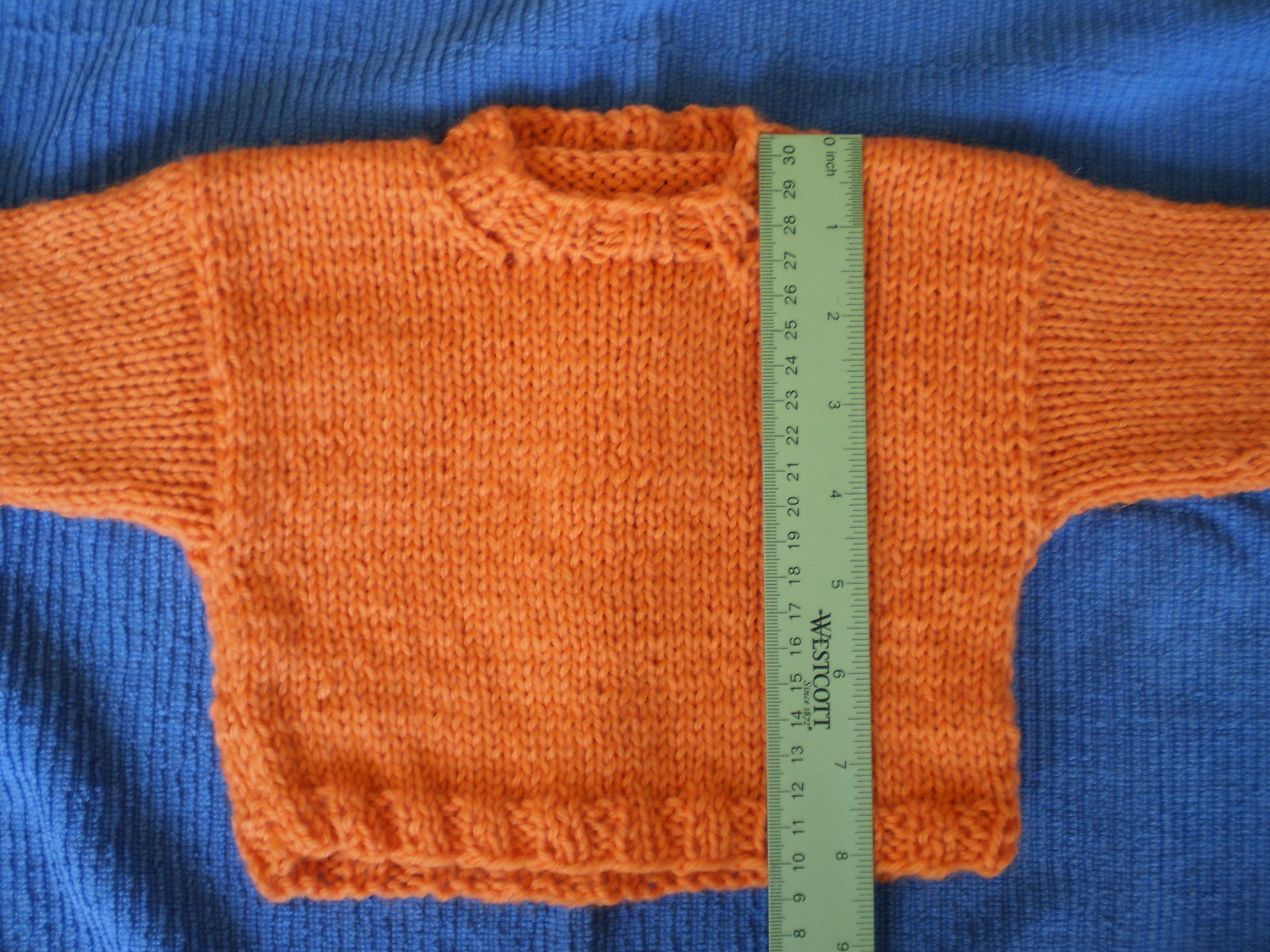
Let’s block a sweater!  (In this case, a baby sweater, but the same process works for a grown-up sweater, too.)

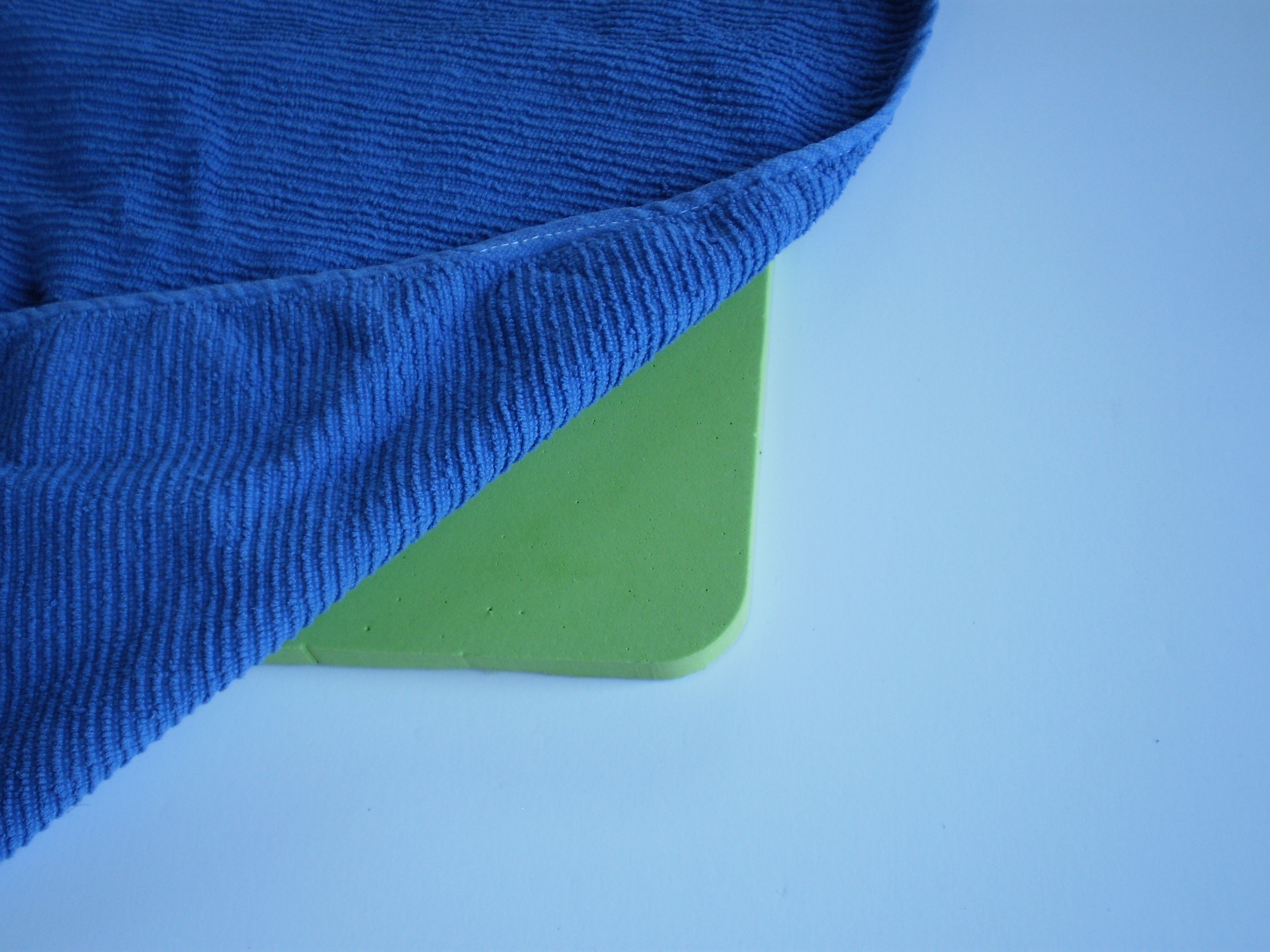
We’ll start by soaking the sweater in a bowl of warm water for 10-20 minutes.  Make sure it’s nice and soaked through.OLYMPUS DIGITAL CAMERAThen, just like last time, roll it up in a nice clean towel and squeeze out most of the moisture.  Put out your foam tiles and cover them up with a new clean, dry towel.

Lay out your sweater as best you can  to roughly the right proportions.  When you’re working with a grown-up sized sweater, it can be kind of tricky.  Don’t worry if you don’t get it right away-we’ll rejigger everything in a minute.  Just eyeball it.

OLYMPUS DIGITAL CAMERA

Now, it’s time to measure the sweater and make sure it ends up the size you want it.  Begin with the chest measurement.  Now, since this is a baby sweater, I want the chest to be 9 inches across.

OLYMPUS DIGITAL CAMERA

Close enough.

Now that the chest measurement is about right, I’ll stretch out the body to the right length,  double-checking that the chest measurement doesn’t get stretched out of shape.

OLYMPUS DIGITAL CAMERA

(Did you notice how I’m not using pins for this sweater?  That’s on purpose.  I try not to use pins on sweaters, because they can create little points and weird bumps on a garment like this.  And, in the case of this particular sweater, I’m not far off from my desired size, so I can just stretch the sweater a little bit and count on the friction between the yarn and the towel to keep it in shape.  If I was trying to use blocking to fix something, I would use pins.  For example, if I needed to add more than an inch to the body length, I would stretch the wet sweater out with pins.)

The body is all arranged correctly, so now let’s do the same thing with the sleeves.

OLYMPUS DIGITAL CAMERA

These sleeves should be about 6 inches long. With the sleeves, it’s really important to make sure both sleeves match one another- no one likes lop-sided sleeves.

Once your sweater has the right measurements, stop fussing with it!  Just leave it!  (And make sure any kids/dogs/cats/gremlins you have running around your house don’t mess with it, either.)

Something small, like this baby sweater, won’t take long to dry, but big, adult sweaters can take a while (especially if you live somewhere humid).  So, to speed the process along, try pointing a fan at it for a day or two.

Once the sweater is completely finished, put it on and do a twirl in front of the mirror, admiring your awesome work!


Design Process Series: Heart and Sole

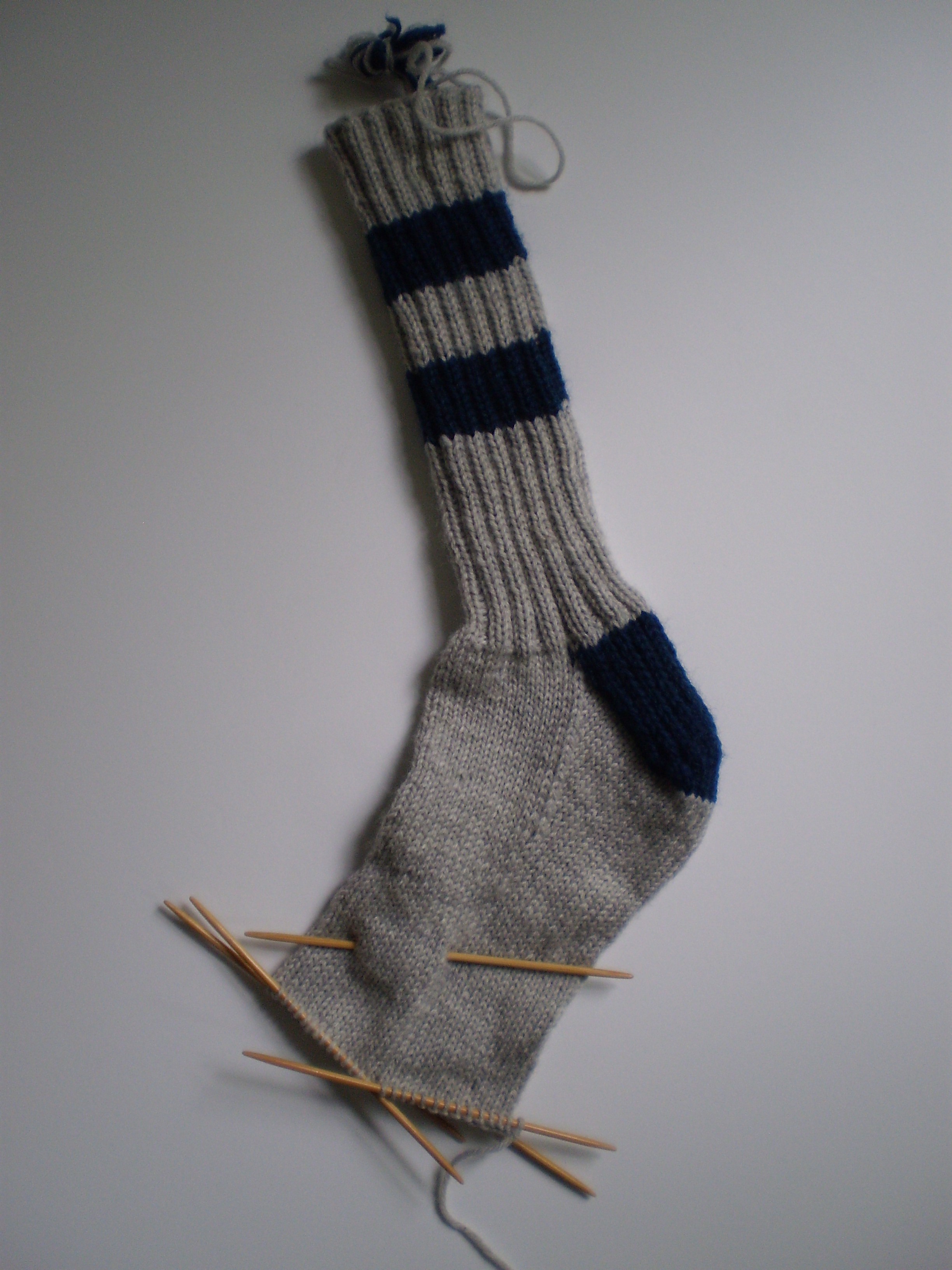
Our socks are nearly finished, guys!  And just in time for it to get all hot and summery.  (Nothing better than wearing big woolen socks in the July heat.  Ick!)

Let’s get started!

OLYMPUS DIGITAL CAMERA

With the Main Color, knit back across the heel flap, moving the marker as you go.  Using the same  needle, pick up and knit 12 (13, 14, 15) stitches along the side of the heel flap.

Knit across the next 24 (26, 28, 30) stitches normally (these are the top of the foot).

Then, with your spare needle (the one we set aside at the beginning of the heel flap), pick up another 12 (13, 14, 15) stitches along the remaining side of the heel flap and knit to the marker. Remove marker.

You’ll have the stitches arranged on 4 needles.  Two (the ones on the top of the foot) will have 12 (13, 14, 15) stitches each, and the other two (the ones on the sole of the foot) will have more.  The beginning of the row from now on will be between the two “sole of the foot” needles.  Confused?  This might help.

Now that we’re all set up for the foot, it’s time to start knitting.

  • K to 2 before the end of the first needle, k2tog.  K the next two needles even.  On the fourth needle, ssk, then knit to the end.
  • K all stitches even.

Repeat these two rows, alternating decrease and even rows, until all needles have the same number of stitches (12 (13, 14, 15) stitches each).  You’ve finished the gusset and it’s all easy sailing (er… knitting) from here.

Knit all stitches even until the sock measures 2 inches shorter than desired from heel to toe.  End at the bottom of the sole.  Break yarn and get ready for some exciting toe action next week!

OLYMPUS DIGITAL CAMERA

Blocking: The Basics

OK, so if you’ve blocked before, this’ll be a refresher for you.  If you haven’t tried wet blocking before, you’re in for some excitement (but maybe it’s just me that’s excited about blocking…).

I’m using a little bitty swatch for this example, but you can use this technique for just about any shape for basic blocking.  This swatch is a little piece of stockinette.  Stockinette is super curly when it’s unblocked, so I definitely need to block it.OLYMPUS DIGITAL CAMERAThis is a tiny little project, so I’m just using a little cereal bowl to soak my knitting.  I’ve filled it with warm (think bathwater) water, and I let the swatch hang out for a bit (about 20 minutes) or until its completely soaked through.  If I’m in a hurry, I’ll squeeze the knitting gently to get all the air out and really soak the fibers.

OLYMPUS DIGITAL CAMERANext, I’ll get out a clean towel and roll up my wet knitting, squeezing it to get out the extra water.  You want your knitting to be damp, but not dripping.  Sometimes, I’ll even step on the rolled-up knitting (like squishing grapes for wine), especially if it’s a really big project.OLYMPUS DIGITAL CAMERAOnce most of the water is squeezed out, I’ll break out my foam blocks (or your carpet, if you have carpet) and lay a new, dry, clean towel on top.

OLYMPUS DIGITAL CAMERAThen, I’ll take the damp knitting and pin out the corners to the dimensions I want.  I want this square to be nice and, well, square.  So I’ll start here.  The sides will pull in at first, but that’s OK.  We’ll fix that in the next steps.

OLYMPUS DIGITAL CAMERANext, I’ll grab more pins and tack down the center points of each side. OLYMPUS DIGITAL CAMERAAnd then I’ll add another pin in-between each existing pin.  Since this swatch is so small, I’ll stop here.  If I was blocking something larger (like a scarf), I’d keep adding pins until I had surrounded the whole item and gotten rid of the little swoopy edges.

OLYMPUS DIGITAL CAMERAYou’ve finished the hard part! (If you can even call it hard.)  Let your knitting dry completely (if you’re in a hurry, point a fan at it or put it in a sunny window), and remove the pins.

And, voilà la! A perfectly finished project! (Or at least an almost perfectly finished project.)OLYMPUS DIGITAL CAMERANext time, we’ll talk about blocking something a little more complicated- sweaters!

Pattern: One Row Wonder

Weee-Ahhhhh, Weee-Ahhhh!  (That’s the “New Pattern Alarm”… couldn’t you tell?)

I came up with this project on vacation, in the back of a minivan, when I was stuck with a ball of lovely blue gradient hand-spun, a pair of needles, and no pattern.  I wanted to make a shawl, but not a normal shawl.  A shawl that was easy enough to knit in the back of a minivan while sightseeing.  Something with an interesting shape, but virtually no pattern to memorize.

Thus was born the One Row Wonder.

OLYMPUS DIGITAL CAMERAThe One Row Wonder Shawl might just be the perfect pattern. With only one row to memorize, you’ll have a brand new shawl with almost no effort! It can be knit at any gauge and with any yarn. It’s a perfect way to use up leftover yarn or that extra-special skein that’s been waiting in your stash (you know the one). The finished shawl has a unique shape, which wears like a scarf, but has the look of a triangle shawl. The One Row Wonder will knit up in no time and quickly become a favorite part of your wardrobe.

OLYMPUS DIGITAL CAMERAI made mine with a lovely, chunky yarn, but now I’m itching to work one up in fingering yarn.  How cute would it be made with stripes of leftover sock yarn?

Get the pattern for free!

One Row Wonder Shawl

EDIT 9/20/2015:  Sorry for the confusion about the “Loop Increase.”  Apparently lots of places have different definitions.  This tutorial from Knit Picks outlines how I do the Loop Increase.