Inspiration: In the Puget Sound

The weather says it’s going to be gorgeous this weekend-60s and sunny. I think it’s time to break out the wellies and head down to the Sound for some tide pooling. It’s been too cold and wet to do much of that lately, which is a shame.

They’re will probably be lots of kelp. Which, if you can find a piece that’s clean enough, you can eat. It’s slightly crunchy. Not bad. (Not good either.)

kelp-forest[1]Dan’s ‘Kelp’ Scarf by Elizabeth Jarvis

3058832318_d48b175446_medium[1]
Ochre sea stars hang out on the beach, too. Look at those pretty colors. Isn’t it weird how one species can come in orange, maroon and purple?

a4fdabc65445e5084fb4f466e973185c[1]Starfish Pillow by Sarah Sacco

imagejpeg_2_medium2[1]Seagulls are as common here as pigeons, but they are a pretty kind of pest. I was hanging out in one of the city parks the other day and I watched one eat a small starfish. It took the poor bird about 5 minutes to get it down, and when he finally managed to swallow, you could see the lump go all the way down his throat. It looked super uncomfortable.  Makes me glad that I have teeth that let me chew my food before swallowing it.

seattle_seagulls[1]Seagull by Ruth Sorensen

DSCN0721_medium2[1]And, even though I probably won’t be able to see one, I’ll keep my eyes peeled for a Giant Pacific Octopus. They live all over up here, but they hang out pretty deep down in the water. I suppose I could go scuba diving if I wanted to see one, but that water is dang cold.

giant-pacific-octopus-big-red[1]Octopus Mittens by Emily Peters

OctoMitts_medium2[1]Speaking of cold water, splashing around in the sound, even with wellies on, gets mighty chilly mighty quick. Do you think I have time to make these boot liners before low tide?

Warm Wellies Boot Liner by Jeanne Stevenson

bootliner17_medium[1]

Pattern Spotlight: Baby Sophisticate

A few years ago, it seemed like everyone I knew was getting married (including me, so I don’t really have any room to complain).  For some reason I decided that the perfect wedding gift was a hand knit or crocheted blanket.  I soon began to hate that decision.  When you have one wedding a year, it’s fine.  However, when you start having three weddings every month, that’s a lot of late nights.

Now, as the song goes, first comes love, then comes marriage, then comes…  a whole passel of babies (what’s a group of babies called?  A herd? A pod?  A holler?).

But this time, I am being smart about what hand knits I give out.  Babies get sweaters. Not great big blankets.  Maybe a little stuffed animal or a matching pair of bootees, if I’m feeling generous.  I’m a big fan of EZ’s Baby Surprise Jacket, but sometimes knitting even a tiny sweater in sock yarn is more than I’m up for.  When I learned that a friend was expecting twins, and invited me to a baby shower in a week, I knew that even I couldn’t bang out two BSJ’s in time.

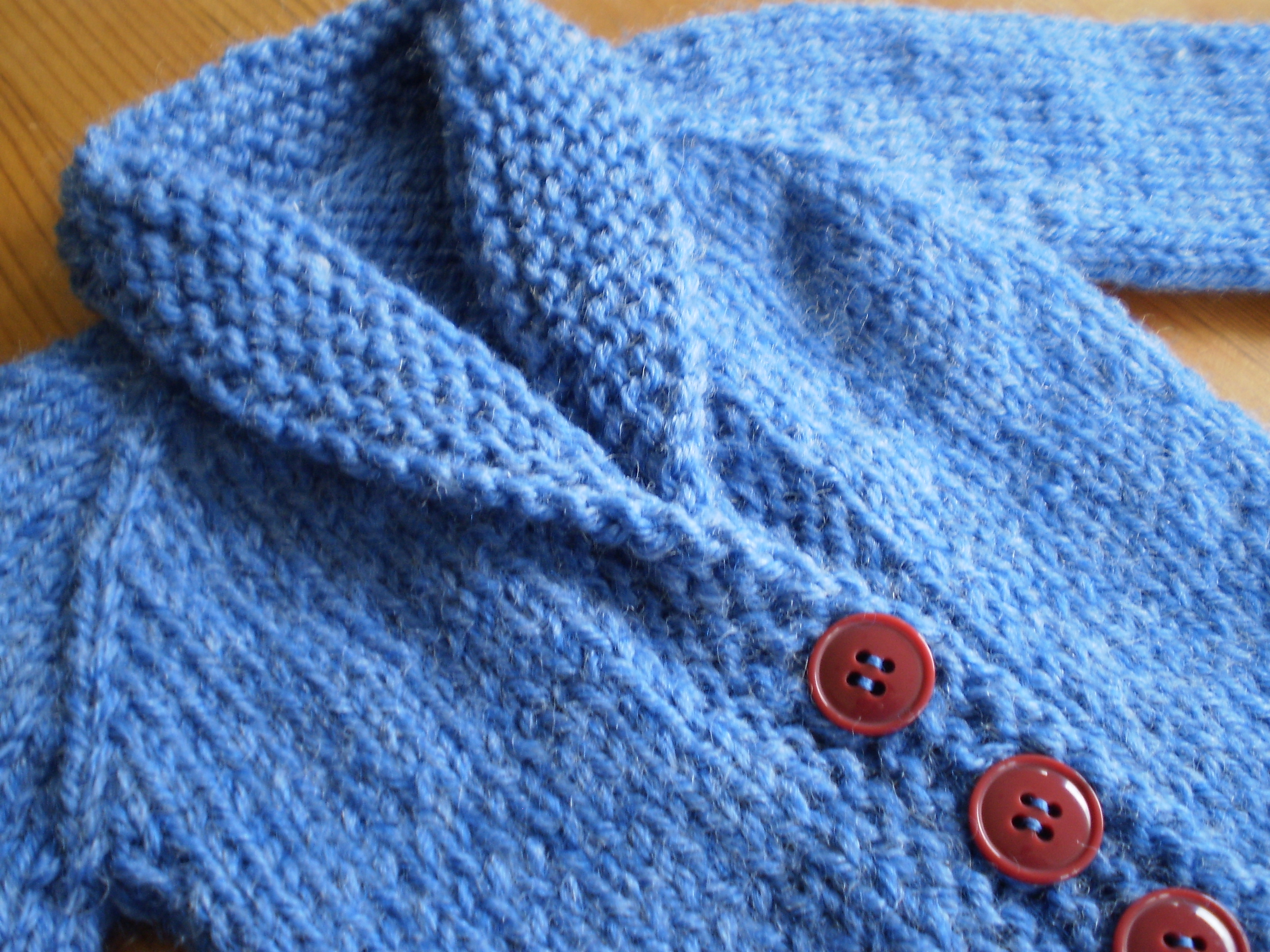
I went to Ravelry and started poking around for an alternative, and I found the perfect baby sweater.  It’s the Baby Sophisticate by Linden Down.  It’s a free download and comes in two sizes, 0-3 months and 6-12 months.  It’s knit up on size 8 needles and Aran yarn (although I used worsted, which worked fine). OLYMPUS DIGITAL CAMERAIt’s an absolutely adorable pattern.  It’s well-written and easy to follow.  The garter-stitch shawl collar makes the sweater look fancy, but it’s completely easy to do.  And, since it’s knit at a larger gauge, I managed to knit up two sweaters in about a week.

OLYMPUS DIGITAL CAMERASo, if you have a skein or two of something superwash, and you know of someone (or six people) in the family way, keep the Baby Sophisticate in mind.

Pattern: Little Knit Doll Easter Set

Flowers are blooming, the sun is blue and I’m sneezing all over the place.  It must almost be Easter!  Candy and treasure hunting; what more could you ask for in a holiday?

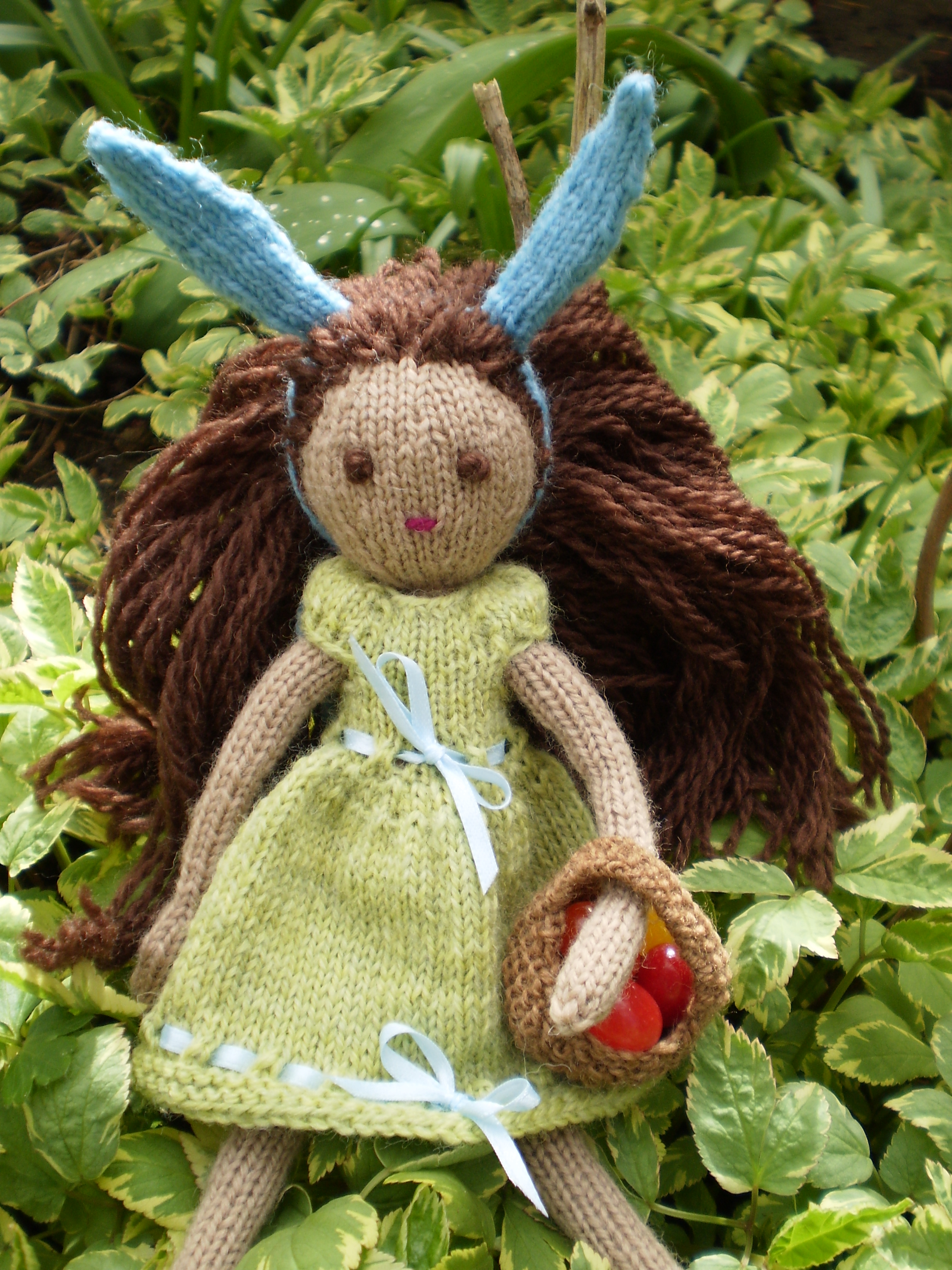
The Little Knit Doll loves Easter, too and is ready to go hunting for Easter eggs.  She’s got a cute new party dress, a festive bunny-ear headband and a tiny basket to hold the eggs (or jellybeans) she finds.

OLYMPUS DIGITAL CAMERAThis festive little outfit knits up in a snap, and will be ready to add to your kid’s Easter basket by the Sunday after next.   The dress is knit in the round with short row shaping to make the puffy sleeves and yarn-overs which make adding the ribbon details a snap.  The ears are knit separately and attached to an I-cord headband.  And, the basket is knit in a single piece with very little finishing.

OLYMPUS DIGITAL CAMERA

Find the patters here:

Little Knit Doll (includes doll and sundress)

Little Knit Doll Easter Set (includes dress, headband and basket)

Getting the Fit

I’ve only got time for a quick little post today. (It’s sunny!  SoI have to take this opportunity to do yard work without sinking up to my knees into mud.  Seattle is just the best.)

So, this is a tip that sounds totally obvious, and when I heard it, I totally kicked myself for not coming up with it myself:

When you’re picking the size for a new sweater, find a sweater or shirt in your closet that fits well, and is a similar style (in other words, if you are making a baggy sweater, go find a baggy sweater in your closet, if you’re making a tight-fitting sweater, find a tight-fitting sweater in your closet).

Lay the sweater flat and measure across the chest, just under the armpits.  Multiply that measurement by 2.  This is the finished chest/bust circumference.

Measure under the armpitsThen, look at your pattern, and pick the size that has the closest finished bust circumference to your finished sweater.

Why is this better than measuring your body?  Frankly, it’s easier to measure something flat on the floor, than something all bumpy and three-dimensional, like your body.  There’s less math.  You don’t have to worry about calculating ease for a sweater if you already have a finished garment with the perfect amount of ease.  And, it’s a great way to be sneaky about knitting a sweater for someone else.  Your kid/husband/friend/neighbor/dude-you-just-met-on-the-street will know something’s up if you ask to measure their chest, but if you sneak off to a quiet corner of the house with one of their sweaters, you can measure away to your heart’s content!

I’m a Baller, And You Can Be, Too!

You’ve got your skein untied and ready to go.  What’s the next step?  Rolling your yarn into a ball.

Start by wrapping the yarn in a figure 8 around your thumb and forefinger.

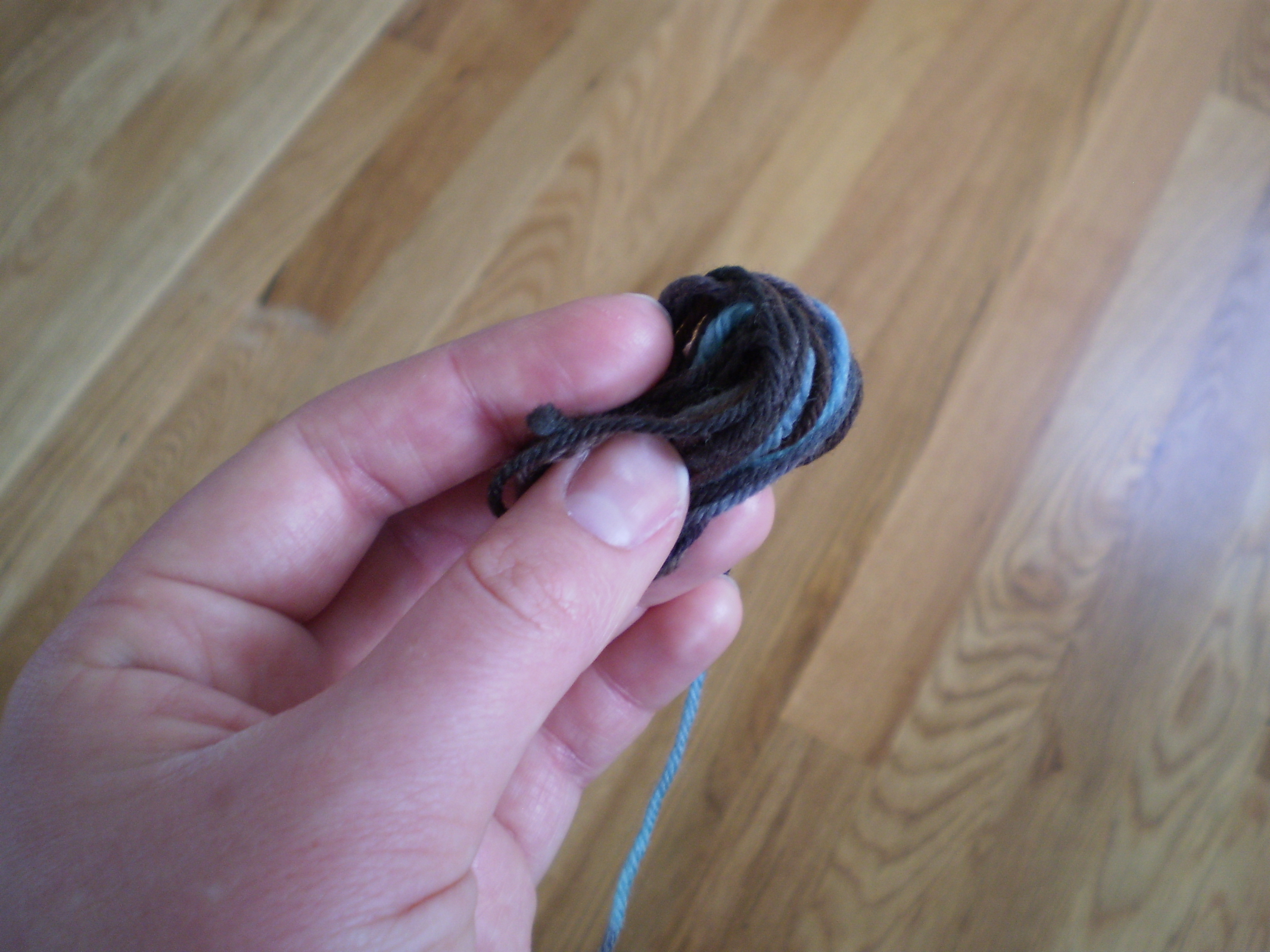
OLYMPUS DIGITAL CAMERAFold the figure 8 in half.  (Does that make it a figure 4?  Probably not.)

OLYMPUS DIGITAL CAMERAThen, start wrapping around the little yarn nubbin you made from your figure 8.

OLYMPUS DIGITAL CAMERAWrap it snugly, not so tight that you have to put muscle into it, and not so loosely that it’ll just fall apart.  Keep going until your proto-ball gets nice and chubby.

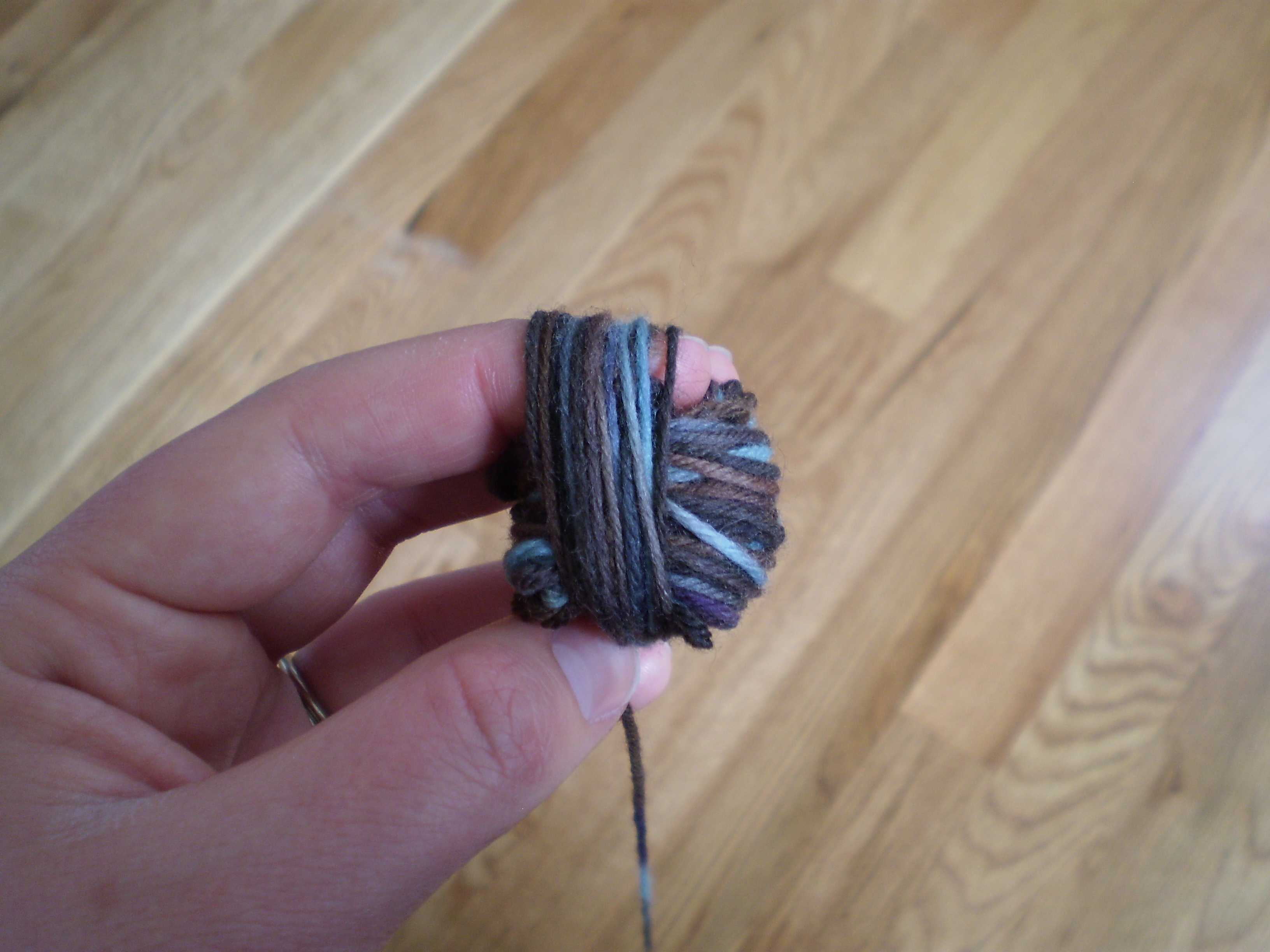
OLYMPUS DIGITAL CAMERAThen, turn it 90 degrees, and hold it between your thumb and forefinger.  Wrap the yarn around the ball in the new direction, catching your fingertips as you go.

OLYMPUS DIGITAL CAMERAKeep going, turning the ball  every 20 or so wraps.  Turning the ball and wrapping in different directions will give you a nice round, even ball.  Making sure that your fingers get caught every time you start wrapping in a different direction will ensure that you end up with a squishy ball of yarn.  This will stop you from wrapping the yarn too tightly, which can end up removing all the springiness from your yarn (imagine keeping a spring stored in the stretched-out position, it would eventually stick that way).

OLYMPUS DIGITAL CAMERAWhen you finish, your ball of yarn should be firm enough to hold its shape, but loose enough  that you can squeeze it like one of those foam stress balls.

OLYMPUS DIGITAL CAMERATuck the end of your yarn around the last group of wraps, and your yarn is ready to go into storage.  Or, cast on and start knitting!

With a Bow on Top

It seems like everyone I know is having a birthday this month.  (Except for me.  Wah wah.)  And a rash of birthdays means one thing for knitters like me and you; lots of gift knitting.  My go-to knit gift for anyone over the age of 15 is a pair of hand-knit socks.  They’re (relatively) quick, small enough that you don’t have to spend your entire food budget on the yarn, and totally customizable.   And, of course, they’re fun to make, and always well-received.

Now, you could just wrap up your socks in wrapping paper, or stuff them in a gift bag, but where’s the DIY spirit in that?

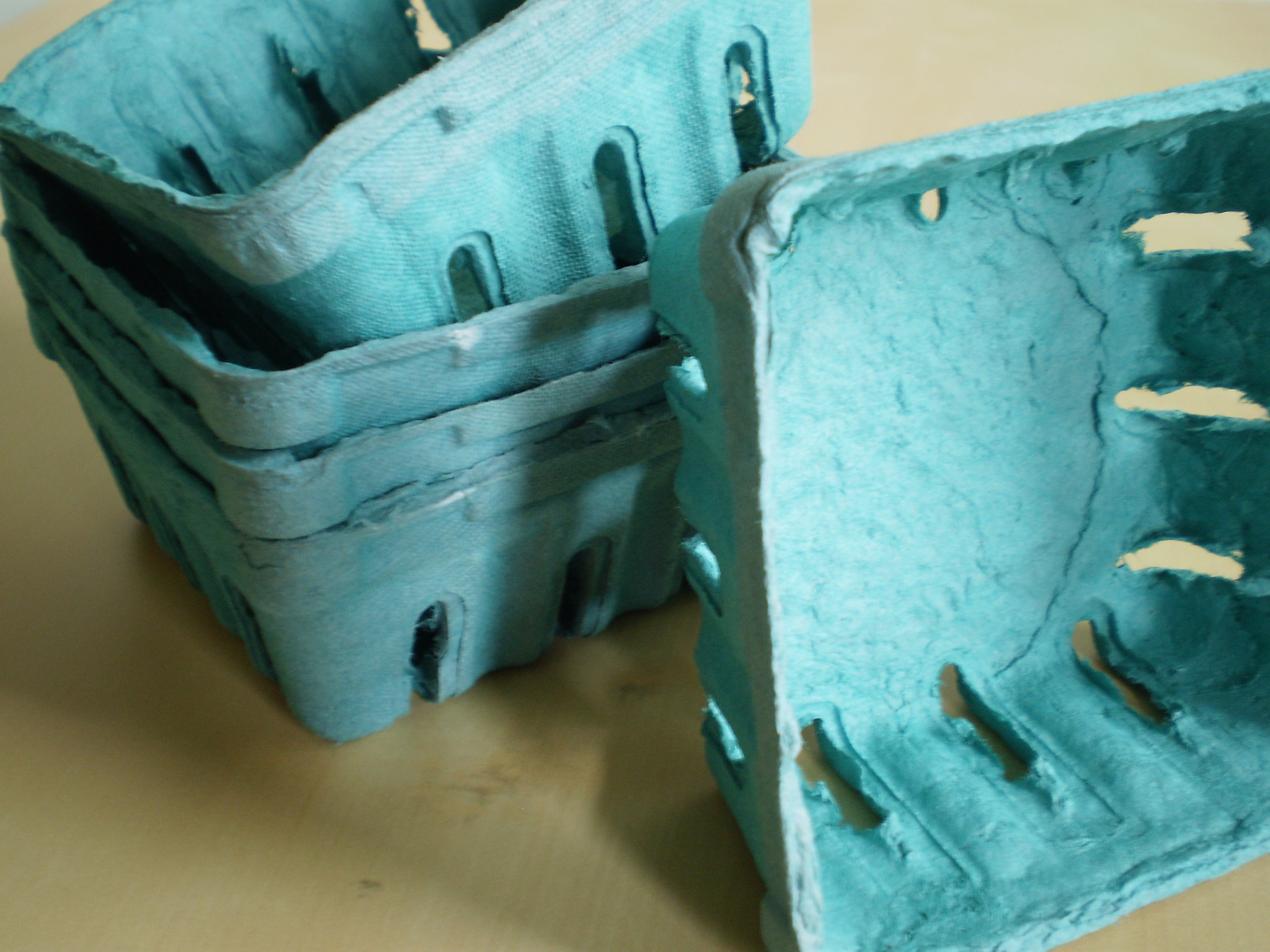
My favorite way to package hand knit socks is in one of those little half-pint berry containers that you get from the grocery store.  Have you ever realized that they’re the perfect size to fit a pair of socks*.  These are made from recycled paper, but you can find plastic ones, too, sometimes.

OLYMPUS DIGITAL CAMERAI roll up a pair of socks, and put them in the berry container, and take a little bit of pretty contrasting ribbon or yarn and tie a nice bow.  It’s that easy to make a perfect little gift charming enough that even Martha Stewart would approve.

OLYMPUS DIGITAL CAMERA

*They would fit a pair of mittens, a hat, washcloth or other small accessory well, too.  I just have a thing for socks.

Leftovers

I am convinced that every knitter is a bit of a pack-rat.  Or at least has some pack-rat-ish tenancies.  I catch myself doing it all the time, and have to consciously make myself stop it when I go to far.

I’m not talking about buying more yarn than you could ever knit (which would be a problem, but I’m not convinced that it is possible.  At least, I haven’t reached a critical mass of unknit skeins yet).  I’m talking about those little bits of leftover yarn that you end up with at the end of every project that you are sure you can use for something else.  You can’t just throw away 50 feet of merino hand-spun.  That would be heresy!

So, when those little bits of yarn get ready to overflow your craft bin/closet/room, what to do?

I organize my scraps by weight (worsted together, sock yarn together, etc), then i pick a project.

I am a big fan of scrappy afghans to use up my little leftover bits.  My Call the Midwife-inspired blanket sits on my couch, and used up approximately a metric ton of sock yarn scraps.

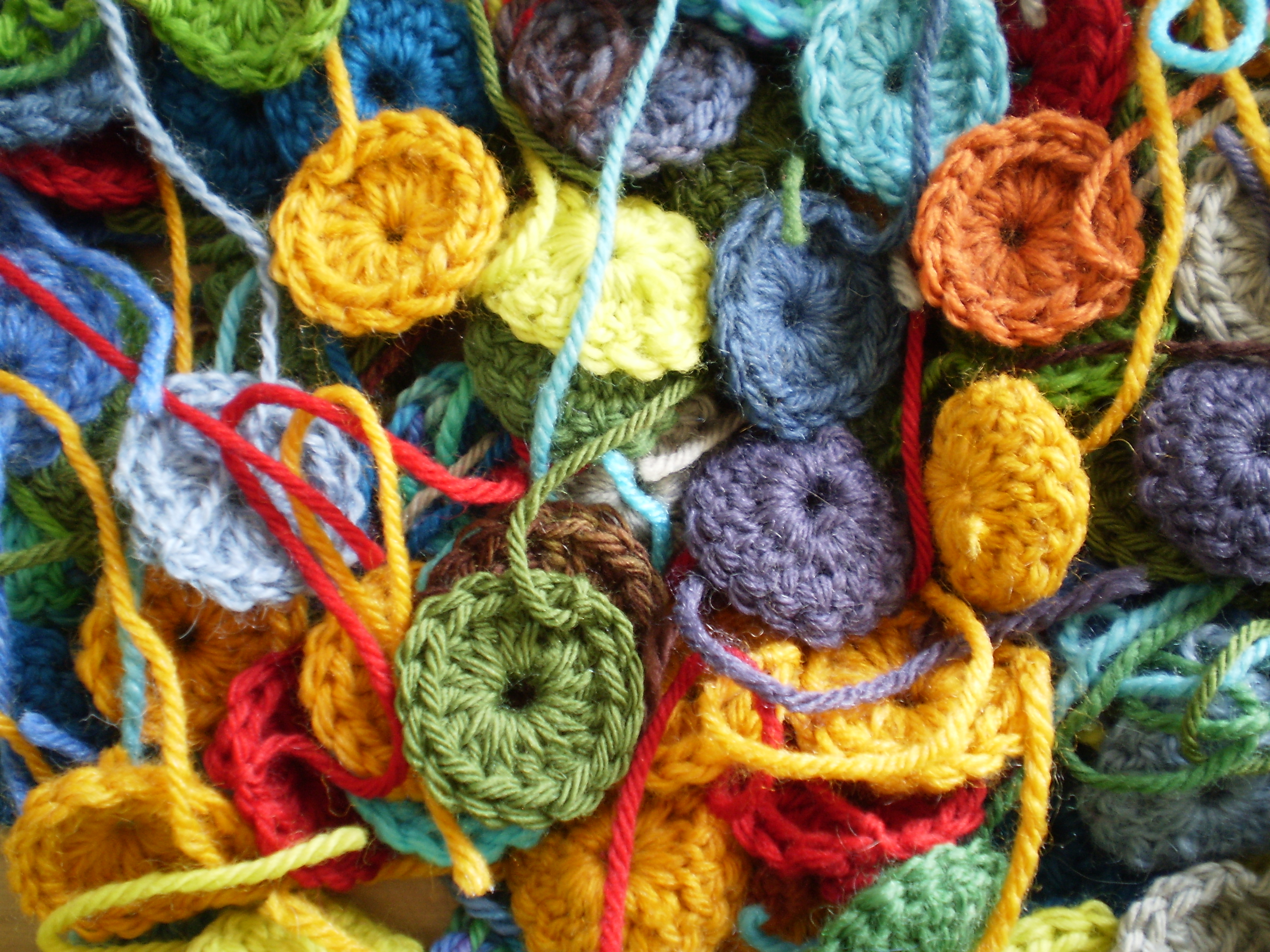
OLYMPUS DIGITAL CAMERAI’m in the midst of making a great big Yo Yo Lapghan with all my worsted weight scraps.  I can make a handful of yo-yos during a rerun of Law and Order.  And, once I have about 2000 (no joke… they’re pretty small), I’ll crochet them together.  I like this pattern especially because, even though I’m making thousands of little circles, if you do it right, you have no ends to weave in.

OLYMPUS DIGITAL CAMERAAnother afghan that people are going head over heels for is the Beekeeper’s quilt.  I’ve never made one; I think knitting that much at such a tiny gauge without ending up with a pair of socks (or ten) would give me an aneurism, but if that’s your jam, I say: Go for it!  It looks like a super cozy blanket when it’s done.DSC_0518_medium2[1]Don’t want to make a blanket?  Think about stripes.  Match up your scraps of a similar weight, and make a cool abstract striped sweater, or a pair of fraternal twin socks.

Whatever you do, just don’t let the yarn just languish on your shelf.  Yarn is for knitting (and crocheting) and keeping you cozy and warm, so let it do what it wants to do!

Inspiration: Spring!

It’s official!  As of last Thursday, it’s spring!  And here in the PNW, it’s just gorgeous!  (Sorry to those of you in the Great White North still dealing with snow and cold.  You might want to skip this post.  I don’t want to make you jealous.)

The flowers here are just starting to bloom and we’re getting some beautiful warm spring days.  I’m having a great time exploring our new garden (we moved to a new house in the fall) and finding gorgeous spring flowers as they make their appearance.

In honor of these flowers, I thought we could do some spring flower-inspired knitting.

Tiny little snowdrops were the first to bloom:

OLYMPUS DIGITAL CAMERASnowdrop Beret by Marya Speton

3440218173_2e11349f2c_z[1]Hellebore are subtle and gorgeous.  They remind me of an old, overgrown forest.

OLYMPUS DIGITAL CAMERA151-30 Hellebore – Jacket in seed st in Andes and Fabel by DROPS design

30-2_medium2[1]We have a handful of daffodils just starting to open:

OLYMPUS DIGITAL CAMERADaffodil by Martin Storey

Daffodil_back_medium2[1]And camellia bushes are covered with fluffy, cheerful flowers:

OLYMPUS DIGITAL CAMERACamellia by Meg Myers

6305-cover_medium2[1]Our cherry tree (which I’m sure I will be cursing come fall when I have to clean up all the dropped cherries) is just beautiful and smells even better.

OLYMPUS DIGITAL CAMERABaby Cherry Blossom by Sarah Franklin

sweater_baby_cherry_blossom_medium[1]What’s spring look like in your neck of the woods?

All Twisted Up: Dealing With Skeins

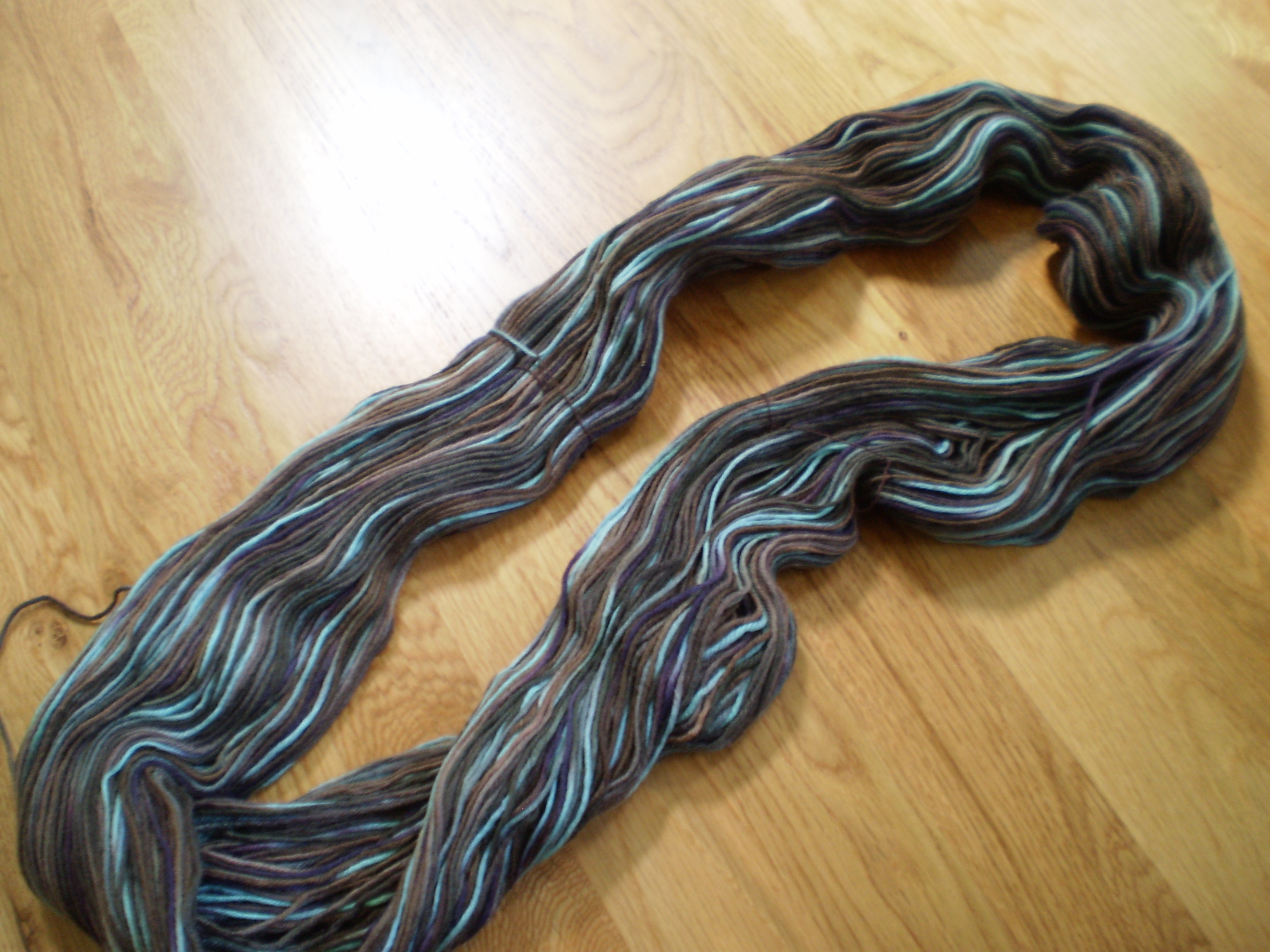
Let’s talk about skeins. This is a skein:

OLYMPUS DIGITAL CAMERASometimes yarn is sold in skeins (instead of pre-wound balls).  Skeins are looser than balls, which allows you to see the texture and color of the yarn more accurately.  It’s also less work for the dyers and spinners, so often if you find fancy-pants yarn from some small fiber company, it’ll be sold in a skein.

But, skeins are a pain in the butt for knitters.  You get home from the yarn store with your brand-new purchase, and instead of starting to knit right away, you have to spend a half hour rolling the yarn into a ball first.  Infuriating!

But, have no fear.  Skeins are easily dealt with, as long as you exercise a little patience.

First, unloop the ends of the skein from one another.

OLYMPUS DIGITAL CAMERAThen carefully tease apart the skein until it lays nicely in a big ring, being sure to keep the strands from tangling.  I like to do this step on the floor to give myself plenty of space to work.

OLYMPUS DIGITAL CAMERADepending on the brand of yarn, the skein will be held together by one or more (usually between 2 and 4) bits of scrap yarn.  You can cut or untie the scrap yarn, whichever is less scary to you.

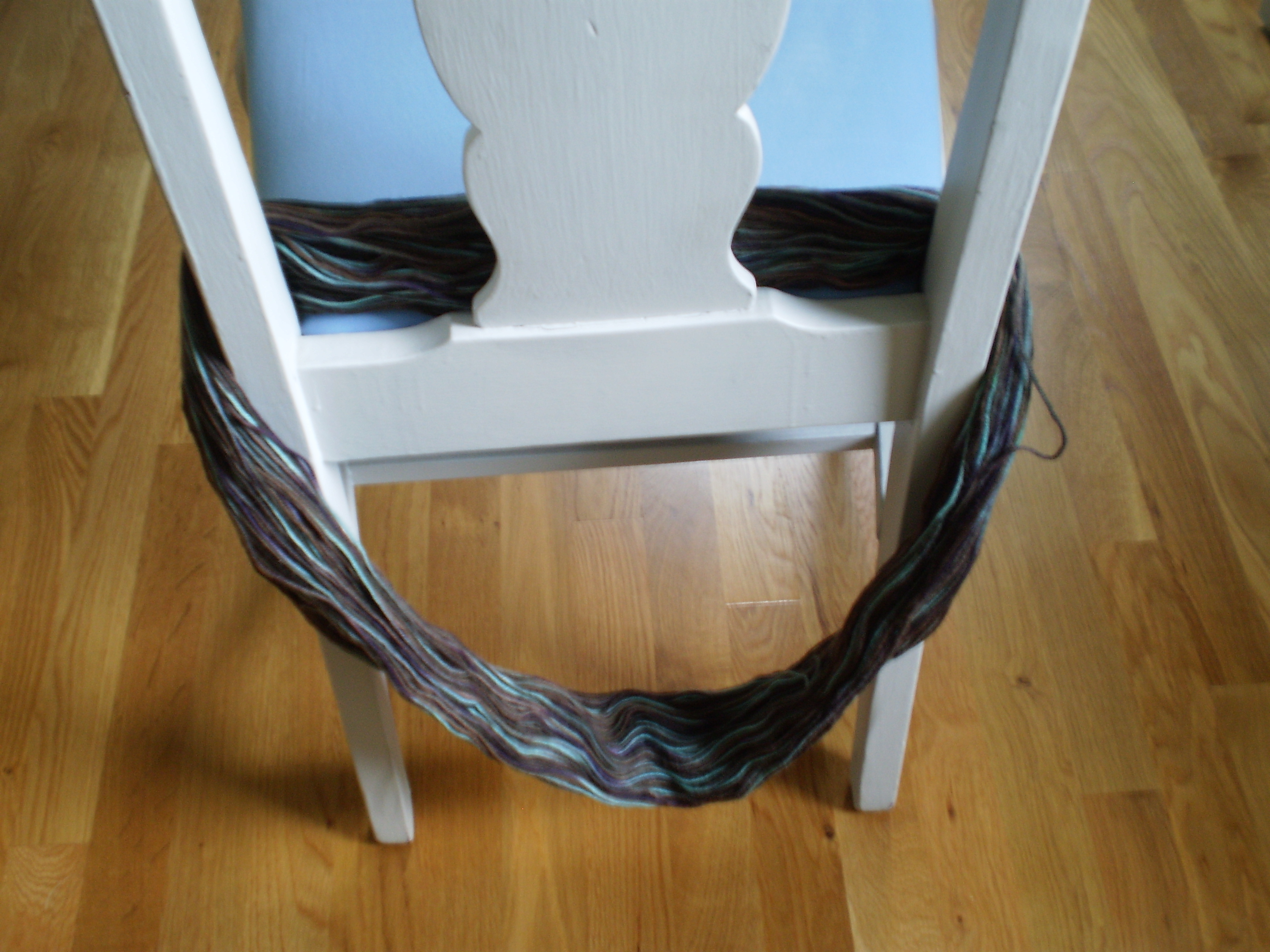
OLYMPUS DIGITAL CAMERAThen, I to loop the whole skein over the back of a chair, my knees, or around my husband’s hands (if he’s in a helpful mood).  This will keep the big loop of yarn from tangling as I roll it into a ball.

OLYMPUS DIGITAL CAMERA Go slowly and be patient, and if something weird happens (like loops of yarn start flying around) stop immediately and put the loops back around the chair.  If you start getting a tangle, if you keep going it will only get worse.

Next week we’ll talk about how to roll yarn into the perfect ball.

**And a note on Swifts:  If you are a moneybags, there is a tool called a yarn swift that is specifically designed to hold your skein of yarn (instead of a chair back) while you wind it into a ball.  Some people swear by them, but I have never had an extra $65 to spend on a swift (not when I could buy yarn instead!)

And This Is How I Did It

Wednesday, I talked about a sweater I made for my grandfather, based off one that his mother made for him decades ago.

I thought it might be interesting to talk about how I combined a couple patterns, added my own details to create this customized sweater, and went from an idea to a finished product.

I started with the description my Grandfather gave me, “A brown and blue sweater with deer on it.”  From there I guessed that he meant an old-school ski sweater with some sort of color work pattern on the front and back.

235792[1]I looked at patterns for ski sweaters, and none of them were quite right.  They were either too fancy (too many colors or too fussy-looking), or more formal than I knew my grandfather would like to wear (he is a hunting, fishing, outdoors-y type).

Instead, I decided to start with a very simple pattern that I had used before, and modify it to my liking.  I picked the Weasley Sweater by Alison Hansel.  It’s a simple and easy drop-shoulder sweater that comes in a million sizes from infant to grown-up.  I’ve knit a couple sweaters from the pattern before, and they have all turned out really well.  (And the pattern is available for free!)1116161018_78043aab2b_z[1]

The only thing that I don’t care for with the Weasley Sweater is the rolled hem and collar.  Instead, I knit a k2p2 rib for the bottom, and a k2p2 crew collar.

OLYMPUS DIGITAL CAMERAAnd, instead of working the whole shebang in plain brown, I added a stripe of blue just above the cuffs and hem.  Adding a little bit of color work at cuffs and hem is a very “ski sweater” thing to do, and a stripe is the simplest color work you can do.

OLYMPUS DIGITAL CAMERAMy next problem was the deer motif that I had to put on the chest.  I looked at a lot of patterns, and finally decided to use the deer motif from the His & Hers Reindeer Jackets from Patons.  I originally planned to work the deer using the intarsia technique, but then I decided that I wasn’t insane.  (Intarsia and I don’t get along very well.)

Deer_Sweater_-_front_medium[1]Instead, I knit up the whole sweater in plain brown (except for the blue stripes at cuffs, hem, and the edges of the chest panel), and used the duplicate stitch to add the deer after once the knitting was done.  It took approximately 100 years to finish the deer (not really), but I think it was worth it.  Because the whole chest panel is knit plain, the sweater is stronger than it would have been if I had worked the deer in intarsia (and I think it looks better, too).

OLYMPUS DIGITAL CAMERASo, with a couple different patterns, some planning, a little futzing, and inspiration from the ghost of my great-grandmother, I think I managed to make exactly the sweater that my grandpa was looking for.

OLYMPUS DIGITAL CAMERA