Inter-generational Knitting

Over Christmas, I got to visit my grandparents in The Great White North (aka, Wisconsin).  In between blizzards, I chatted with my grandfather, and we started talking about his mother (my grandmother).  She was an amazing woman and an extremely accomplished knitter.  She was actually buried with her blue ribbon that she won at the Wisconsin State Fair. Pretty impressive, right?

In the process of our conversation, my grandfather mentioned that his mother made him a sweater when he was younger.  He had loved it, but it had somehow gotten lost over the last 50+ years.  She had designed it especially for him, in brown and blue, and had put deer on the front and back, since he is an avid deer hunter.

The conversation stuck with me (since I am apparently very sentimental), and the more I thought about it, the more I thought it was sad that the sweater had been lost.  It kept bugging me until I decided that I had to try and recreate the lost sweater.

I don’t have a photograph of the original sweater, but I knew that it was a sweater made for my grandpa in the fifties (or so).  I imagined it would have been a sort of traditional Norwegian ski sweater, the kind that you see on vintage postcards from Colorado.   And, I knew that it was blue and brown.

So I just guessed the rest of the way and came up with this:OLYMPUS DIGITAL CAMERA
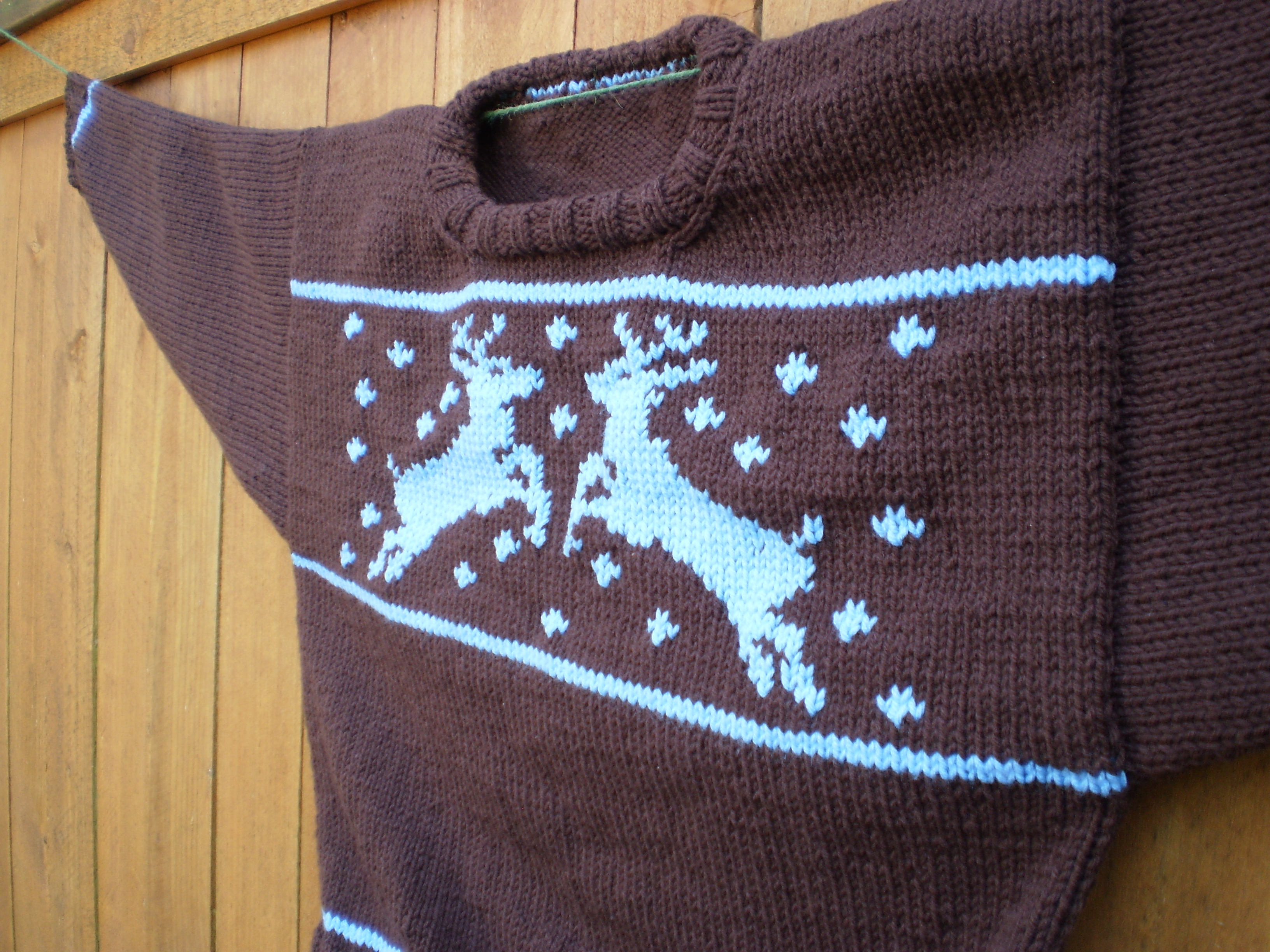
I’m sure it’s not an exact replica, but I think it turned out pretty well.   My grandpa loves it, and that’s what matters.  I hope I did my great-grandmother proud.

Inspiration: Aran Knitting

It’s St. Patrick’s Day, and instead of drinking (virtual) green beer and wearing obnoxious glittery green shamrock jewelry, let’s talk about something that’s more traditionally Irish (and way less racist).

partypatty[1]Aran Sweaters are gorgeous and so cozy.  They are traditionally made on the Aran Islands, located off the west coast of Ireland.  And with most traditional crafts, they live in a fog of tradition and old wives’ tales.   Supposedly, they were supposedly knitted in untreated wool for fishermen by their wives.  They left the lanolin on the wool to add an extra water-proofing layer.  (I suppose this makes sense, but can you imagine the stink of a fishing boat full of people in unwashed wool sweaters?  Ugh!)

Some people say that families (or individual knitters) each had traditional motifs that they would use on each sweater.  I’m sure there’s some truth to this.  Everyone has patterns they gravitate to and patterns they can’t stomach.  But, as a knitter who gets bored when she has to make a second sock, I can’t imagine that someone would tie them self to making sweaters with the same pattern over and over forever.

My favorite piece of lore surrounding the Aran sweater is the idea that each motif has a symbolic meaning.  I don’t know how true it is, but it’s a great thought.  The traditional honeycomb pattern  means “hard work”, cables mean “safety,” and diamonds mean “prosperity.”  It’s like the sweater is a good luck charm for your family member to wear, which is an idea I really like.

Want to try your hand at Aran knitting?  Here are a couple (more or less traditional) patterns:

Staghorn Aran Second Edition by Janet Szabo

5280327608_aa0025b2ac_z[1]Baby Poonam by Norah Gaughan

baby_poonan_lg_medium[1]Aran Felted Hot Water Bottle by Ann Budd

ep1172_small[1]

Pattern Spotlight: the Pi Shawl

Happy Pi day!  (In America, anyway March 14th (3/14) is Pi day.)  Let’s celebrate by eating pie and talking about Elizabeth Zimmerman’s super nifty pattern, the Pi Shawl.

This pattern (or un-pattern, since, like most of EZ’s patterns this one is more of a guideline or than written out instructions) is available in several of her books, but it was originally published in the Knitter’s Almanac.  Hey look!  There’s the Pi shawl right on the cover.

Elizabeth-Zimmermann-s-Knitter-s-Almanac-9780486241784The Pi shawl is a circular shawl knit in the round from the center out (so it’s great if you hate casting on.  Less great if you hate binding off).   It’s based on the relationship between circumference and diameter, so that every time you double your rows, you double the number of stitches by working a row of (knit 1, yo) increases.  So, all the shaping happens in only a handful of rows, which means that the rest of the shawl can be used for adding whatever lace, stripes, or whatever else you want.  It’s a great way to play around with new stitch patterns, or to try out a lace stitch that’s been bouncing around in your head.

You can go lacy and delicate with thin lace yarn and openwork designs.

2005150285_6c0618787c_z[1]You can do stripes and simple eyelets.PICT0342_medium2[1]You could even make a cozy round blanket with thick wooly yarn.

photo_1__medium2[1]Happy Pi Day!

Pattern: Sunday Morning Slipper Socks

OLYMPUS DIGITAL CAMERAPour yourself a cup of tea, pull out a favorite book, and slip on these thick and cozy socks for the perfect lazy Sunday morning.  Delicate lace flows from the leg to the top of the foot, making these super-warm slippers surprisingly girly and flattering.  They’re thick enough to be extra-cozy, but thin enough to leave on when you slip on your clogs and run to the store for some fresh doughnuts.  Worked in wooly DK-weight yarn and larger-than-normal needles, these socks knit up in a snap, so you have time to make a pair for yourself, your mother, your sister and your best friend.

See the pattern details on Ravelry.

Or, get the pattern here for $3: 

OLYMPUS DIGITAL CAMERA

Finishing and Felting

Finishing a project properly makes the difference between a “thing I just knit” and an “heirloom-quality hand-knit”.   If you’re knitting up something with a “right side” and a “wrong side” (like a sweater or socks) weaving in the ends is perfectly adequate.  With these garments you can just let your little ends dangle inside, and no one will know or care.  But what about when you make something without a wrong side?  For instance, a shawl or a scarf?

That’s where I deploy this little torture device:

OLYMPUS DIGITAL CAMERAIt’s my needle felter.  Look closely.  See those razor-sharp little needles with tiny little skin-ripping barbs?  Terrifying.

OLYMPUS DIGITAL CAMERAThese little puppies cost about $10 and are available at most craft stores or online.  They are used to do (duh) needle felting.  But they are awesome at dealing with knitted ends.

Hey, look!  I have an example end that I want to hide.  I wove it in like normal, and then trimmed it to about 1 inch.

OLYMPUS DIGITAL CAMERAAll you do is hold that sucker against your knitting and poke it with your needle-felting tool.  I like arranging the end in such a way that it “disappears” into the pattern.  For example, into the trough of a patch of garter stitch, or (like here) up along a column of  ribbing stitches.  Once you have the tail where you want, poke it a couple times with the needle-felting tool. (Carefully!  Don’t stab your fingers!)  Those little barbs on the needles will catch the fibers in the tail and tangle them with the fibers in the knitting.

OLYMPUS DIGITAL CAMERAAfter poking the tail a handful of times, you’ll see your tail virtually disappear!  Isn’t that cool!OLYMPUS DIGITAL CAMERA

There are two tiny caveats for this technique, though.  First, it really only works on yarns made with natural animal fibers, since it is a variation of felting.  Acrylics, cottons and linens don’t have the right fiber structure to let the felting alchemy take place.  And second, don’t felt it too much.  The more you poke the tail with the needle-felter, the more fibers get pushed out the other side of the fabric, which can leave you with a fuzzy backside.  And no one wants a fuzzy backside.

What’s on Your Needles?

It’s that time again!  Time for me to be a nosey so-and-so, and for you to tell me what you’re working on.

But fair is fair, so here’s what I’ve been working on.  I’m on a bit of a sock kick these days.  I just finished blocking a pair of socks (made with KnitPick’s Stroll in Tree Fort).  I absolutely love the colorway when it is in a ball, but I don’t love how it knit up.  I definitely picked the wrong pattern for variegated yarn.  It’s all weird and pool-y, and the shell texture I knit in isn’t really visible when they’re worn.  Oh well.  At least they’re warm and cozy.OLYMPUS DIGITAL CAMERA

And, yesterday I cast on for a belated birthday gift for my friend Shirley.  She wanted slipper-socks in grey.  Ask and ye shall receive!  These are knitting up thick and super-cozy looking with Patons Classic Wool DK Superwash in Dark Gray Heather on size 5 needles.  It’s weird, knitting socks for someone with little feet at such a big gauge.  My typical socks use 60 stitches, but these only use 40.  I’m flying through!OLYMPUS DIGITAL CAMERAI’ve shown you mine, so now you show me yours!  What do you have on your needles?  Send me a photo, and I’ll put it up on the blog next week!

Inspiration: RuPaul’s Drag Race

One of my favorite TV shows (and the only reality show I bother watching) has started up again!  And it’s more fabulous, fiercer and shadier than ever.  It’s RuPaul’s Drag Race Season 6!  (It’s on Logo, but the full episodes are all available online, so you have zero excuse for not watching it.)

RuPauls-Drag-Race-Season-6-Premiere-Date-Announced[1]It’s American Idol, but for Drag Queens.  And It. Is. Amazing.  The queens are all gorgeous, talented and feisty, and the show (like a good drag queen) knows exactly what it is and embraces itself wholeheartedly.  It’s campy, yet earnest.  It’s all about being exactly who you want to be and expressing yourself to the best of your ability.  It makes you care about the contestants, and it always leaves me inspired.

The contestants constantly blow my mind with their range of talents.  They have to be seamstresses, costumers, makeup artists, hairstylists, actors, performance artists, comediennes, dancers, and singers.  And have to be tough and sassy on top of everything.  rpdrseason6header[1]

And,  if that wasn’t enough, they have some fantastic wigs.  These knit and crochet ones aren’t nearly as fabulous as a top of the line lace-front wig, but they cost a heck of a lot less, and are totally within the DIY-esthetic of drag.

Space-Princess Fabulous

Leia Wig by Ansley Bleu

233236040_febbb97cb0_z[1]Disney Princess Realness

Princess Merida Costume Wig by Funky Polkadot Giraffe

merida_wig_01_medium2[1]Giving Halloween Face

Hallowig by Megan Reardon

508054613_6d01a4ff5f_z[1]And in the words of Ru herself, “If you don’t love yourself, how the hell you gonna love someone else?  Can I get an Amen?”

Knitting as Therapy

This weekend I realized something that I have known for a really long time in the back of my mind, but crystallized on Saturday.

My roller derby league had a bout this weekend (Tilted Thunder Rail Birds, if you’re in the Seattle area… you should come watch us play.  It’s pretty rad).  I was doing my usual pre-game running around with my team (running stairs, beating up a punching bag, listening to gangsta rap… you know, the usual).  But, when we finished our usual pre-bout ritual, we had an extra fifteen minutes before we had to go out and start playing.

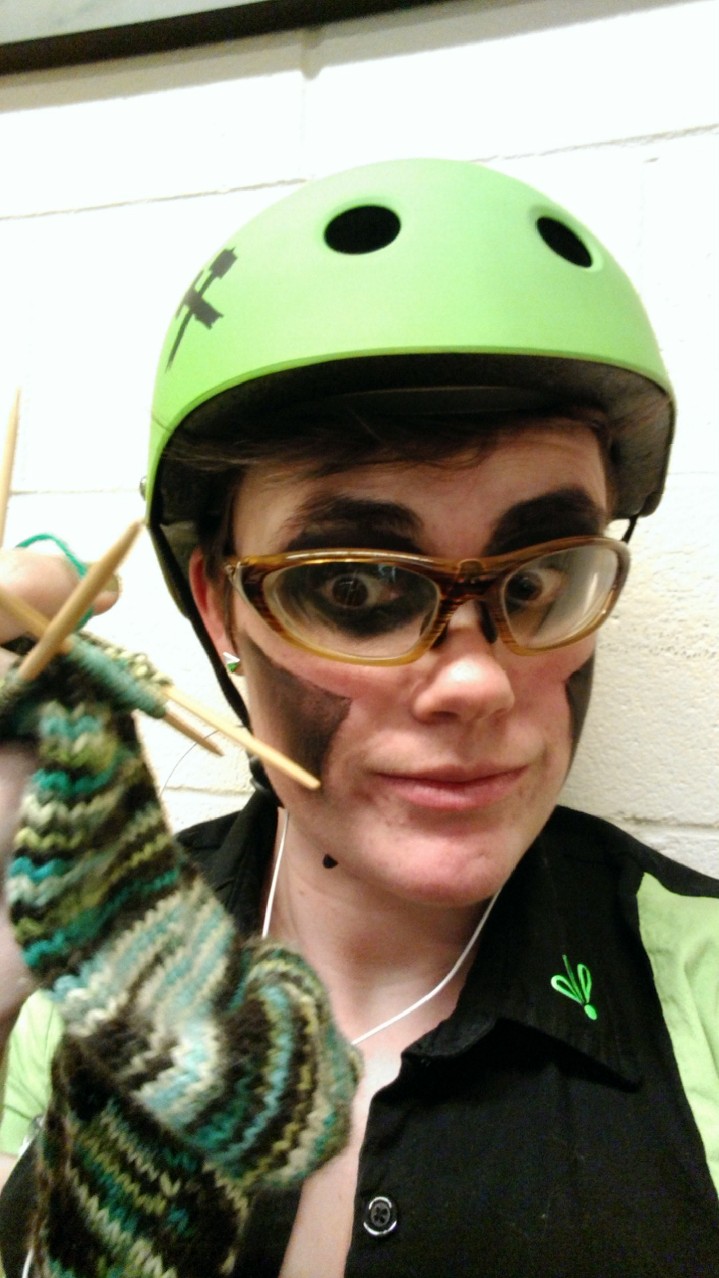
We were all antsy and hyped up on adrenaline.  I was so anxious I could hardly sit still, much less think about the strategy we were about to execute.  So, I did what every good knitter would do.  I pulled out a half-finished sock and worked a few rows.

WP_20140301_001(My teammates-as usual- teased me about it.  But if it makes me a better skater, I think they should just shut their mouths.  So there.)

I do this before every game.  It helps me calm down, focus and take a deep breath before having to do something difficult or scary.  I even bring my knitting along when I go on job interviews.  I (obviously) don’t knit during a game or an interview, but knowing that it’s there is somehow comforting.

It’s like therapy, or mood stabilizing drugs, but fuzzier.  And you get a sock at the end.  I know I’m not the first (or the last) to discover the therapeutic uses of knitting, but still.  It’s definitely something that needs to be put in the list of “Reasons You Should Knit.”

When do you use knitting as therapy?

A Call for Ideas

As much as I try to be more, I am only one person, with one person’s ideas.  So, I wanted to ask you a favor.  It would be awesome if you could let me know if you have any questions, ideas, thoughts, or other knitting-related ramblings you want to hear about.

Do you have a project you want to make, but can’t find a pattern for?  Do you want to learn how to do a specific technique?  Did something weird happen to you the last time you worked on a pattern, and you want to share?

Or, do you have an itch to try writing yourself?  Do you want to contribute to an On the Needles guest post?  Did you write a pattern, that you want to get a little more exposure?

Email me (knittingontheneedles@gmail.com), tweet at me (@on_the_needles), or contact me through the blog if you have ideas/questions/submissions.  I’ll have my people talk to your people (in other words, we’ll chat).

Let’s make On the Needles bigger and better than ever!

Pattern: Hellenic Pullover

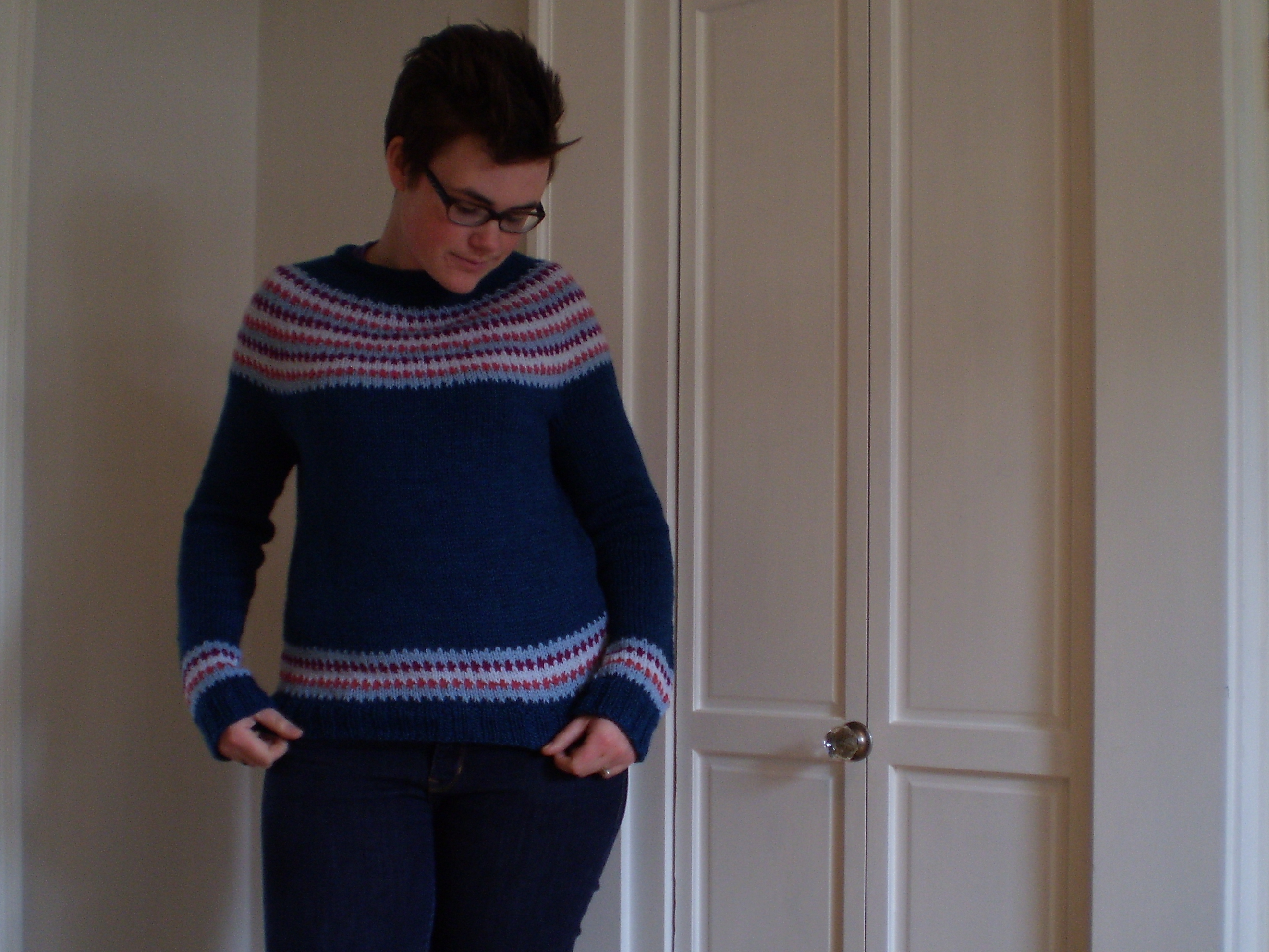
OLYMPUS DIGITAL CAMERAHey, did you like my Ravellenic Games sweater?  Want to make one yourself?  I wrote out a pattern!  (Word of warning, it’s the first time I’ve really written out a full-on-sweater-in-multiple-sizes pattern, so there might be some math errors.  I tried to make all the math come out right, but you never know.)

Anyway, this sweater is a simple top down yoke pullover with slip-stitch colorwork at shoulders, hem and cuffs. A few short rows at the back of the neck make the sweater lay nicely over your shoulders, and a rolled ribbing collar gives this sweater a beautiful finish. It’s knit a fairly large gauge with cozy (and affordable) Knit Picks’ Wool of the Andes, making it perfect for when you want a new hand-knit sweater right now.

The pattern is available here:

Hellenic Pullover

Ravelry