Inspiration: Call the Midwife

Have you watched this show?  Holy crap, it’s so good!  It’s one of these BBC costume dramas that show up on PBS sometimes.  Beautiful costumes and sets, great characters, compelling stories. Look for it. Watch it. It’ll make you cry. Every. Episode.

It really should be called “Call the Midwife: Why You Should Never Get Pregnant.”  Seriously, nothing ends well.  Actually, that’s not true.  Most things end well, but they are very scary, gross, and/or painful in the middle.

But, really, the stars of the show are the fantastic hand-knits the babies are all wrapped up in.  Look at these!

Gorgeous, right?

Feeling inspired?  Have a friend who’s expecting?  Considering a career in midwifery? Try these patterns for a similar result:

Baby Cardigan/Shrug by Julia Noskova

Saartje’s Bootees by Saartje de Bruijn

Lullaby Layette by Lion Brand Yarn

A Recipe for Anarchy

This recipe is for a basic yarn bombing piece.  I’ve purposefully neglected to give you yarn requirements, gauge measurements, sizes and other specifics.  Because, well, this is graffiti, and should be sort of free form.  And rules are for squares.  So, feel free to change, modify, add to, and alter to your heart’s content.  Change is good!  Anarchy!  Down with the Man!

OLYMPUS DIGITAL CAMERA

Materials:

Yarn-As much or as little as you like.  Don’t use anything expensive, since it’ll get gross out in the rain, and may be torn down quickly.  Odds and ends that you have laying around will work fine.  I used some Red Heart that I had laying around, waiting to be used.

Needles- To match your yarn.  I recommend a large gauge, so that your knitting goes quickly and you can cover a larger area.  I used 10 1/2.

Crochet hook (optional)- In a gauge to match your needles.

Buttons (optional)-Again, nothing fancy or expensive.  If you have some laying around that you don’t mind parting with, feel free to use them.  Or, you can make your own buttons using an old plastic container (like a milk jug or other food container).  Cut out circles about an inch around, and use a hole punch (or a knitting needle) to poke two holes in each button.  They won’t be pretty, but, they’ll do the job.

Scissors and tapestry needle.

Instructions:

1. Cast on any number of stitches.  This should be easy and free-flowing, so don’t worry about gauge or where the knitting is going to end up.   I’ll just make something, and then find somewhere to put it.  However, if you have a particularly sad tree or something that you think needs a little knitted excitement, feel free to measure the circumference of the tree, make a gauge swatch, and figure out the number of stitches you’ll need to go around it.

2. Knit for a while.  Let your creativity take over!  Change colors, mix patterns together, do things that you wouldn’t usually do.  Think of this as an opportunity to “sketch” with your needles.  Here are some ideas that you might want to include:

  • Stripes
  • Ribbing
  • Lace patterns (How cool would a tree look covered in gigantic lace?  I just thought of this… and I might go try this soon.)
  • Cables
  • Intarsia, Fair Isle, or other Color work
  • Adding beads or other unconventional materials

3.  When your piece is finished, cast off loosely.

4. Optional-Use the crochet hook to edge the whole piece with a single crochet edge.  You can use this to burry any yarn tails that you may have, so you don’t have to actually sew them in.OLYMPUS DIGITAL CAMERA

5. Optional- Add buttons and button holes.  You can skip this step if you want to sew your piece directly onto your tree/light pole/sign post. If you want buttons, attach them to one side of your piece (mine are on the right in the above picture).  On the opposite side of the piece, make some button loops.  You have two options:

  • Use the crochet hook to make loops in the edging.  Make another row of single crochet along the edge.  When you reach a spot where you want a button hole, chain 3 stitches, then continue doing the single crochet edging.
  • Using your tapestry needle and a length of yarn, you can add simple button loops as follows:  Sew in one end of the yarn.  Wrap the yarn around your non-dominant thumb, right down by your knitting.  Sew other end of the yarn.  You’ll end up with a 1” loop of yarn hanging off the side of your knitting.  This loop will act as your buttonhole.

OLYMPUS DIGITAL CAMERA

6. Sew in any ends that haven’t been sewn in already.

7. Install your work.  This is the sneaky part.  I recommend doing it under cover of darkness.  But it’s up to you.  Find where you want to put your knitting.  Trees in parks are good, or maybe there is a bike rack near your house that needs a little perking up.  Look for something with a circumference that is roughly equal to the width of your knitting.  When you have found a good spot for you knitting, install your graffiti!

  • If you have buttons:  Button the piece to your tree/pole etc.  Easy!
  • If you didn’t put on buttons: Using a long piece of yarn, sew the piece into place.  A simple whip stitch works well.  Work quickly!

8. Run away!

9. Come back the next day to appreciate your work.  Take pictures.  Pretend to just be a passer-by who is tickled by the cool knitting.

OLYMPUS DIGITAL CAMERA

Not Quite Banksy

I am a goody-two-shoes.  I kind of hate that about me, but I also am terrified of getting in trouble… always have been.  I’m sure a lot of you guys are, too.  After all, you’re reading a knitting blog, not out committing felonies and doing drugs.

But, sometimes I get fed up playing by the rules, and I want to do something a little bit rebellious.  Not enough rebellious that I go to jail, or hurt anyone,  or cause any permanent damage, or really bother anyone much, or anything.  Just enough to give me a little excitement.  So, as someone weirdly obsessed with knitting, what am I to do?  Knitted graffiti.

If you’ve spent any time online looking at knitting-type things, you might have heard about this.  Knitted graffiti or yarn bombing basically means making knitted decorations for something in a public space that you may or may not be supposed to be messing with.

Yarn bombing can be something as small as knitting a little heart and leaving it on the bus for someone to find, to entirely covering a tree with a knitted tree-cozy.  We had a great big statue at my college when I was in undergrad.  I crocheted it a striped hat and matching scarf when I was a junior.  I thought she looked pretty snazzy.  (I was going to put a picture of it here, but I can’t for the life of me find it.  This makes me a little sad.  Here’s a monster parking meter that I found instead.)

Want to give it a go?  Do it!  It’s pretty much the best way to get an adrenaline rush while knitting.  True, knitting isn’t exactly a high-octane pastime, but still.

Inspiration: Top Chef

Say what you will about reality TV, but sometimes even on dumb TV shows you get good knitting inspiration.  A couple weeks ago (I think… I’m woefully behind on my TV watching), on Top Chef, the contestants went on a cruise, and during the QuickFire Challenge judge Curtis Stone wore this sweater:

Good, right?  Even my husband pointed it out.  Either my obsessive eagle-like searching for knitting has rubbed off on him, or this is a pretty cool sweater.

It’s a fairly simple cardigan with set-in sleeves and a shawl collar. The twist comes with the texture of the knitting.  The collar is not just knit plain, but in fact consists of great big cables.  The body is (I think) worked in seed stitch.  If you wanted to make something similar, try modifying these patterns:

Brownstone by Jared Flood

Charcoal Ribbed Cardigan by Kate Kuckro

Gramps Cardigan by Kate Oates

Lace-Edged Shawl

Well, now you have this pile of beautiful stitch markers, what to do with them?  How about making a really cool lacey shawl?  I realize the “shawl” word is kind of old-lady-y, but whatever.  They’re basically just triangular scarves, so what’s not to like?

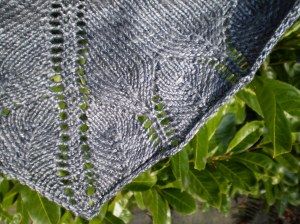
I’m using Blue Moon Marine Silk Worsted yarn , but you can use whatever you want.  I think this shawl looks best in a heavy, drapey yarn, but feel free to use whatever you want.  I am always prepared to be wrong. My shawl is quite small, just big enough to go around my neck and tuck into the collar of my coat.  If you want a bigger shawl, repeat rows 2 and 3 of the shawl body until you have 200, 224, or 248 stitches, and increase the number of times you work the lace pattern.OLYMPUS DIGITAL CAMERA

Materials:

1 skein Blue Moon Marine Silk Worsted (243 yards) or whatever the heck you feel like using.

Size 8 needles (or so.  It’s not like a sweater or something, so there is plenty of leeway regarding gauge)

4 stitch markers

Scissors, tapestry needle

Abbreviations:

k3tog-knit three together

pm-place marker

yo-yarn over

Instructions:

Make the body of the shawl:

CO. 8

  1. k2, pm, k1, place marker, k2, pm, k1, place marker, k2
  2. k2, *pm, yo, k to next marker, yo, pm, k2, repeat from *
  3. k2, *pm, purl to next marker, pm, k2, repeat from *

Repeat rows 2 and 3 until you have 176 stitches on your needles, finishing with row 3

Begin lace pattern:

  1. k2, *pm, yo, (k1, yo, k4, k3tog, k4, yo) 7 times, k1, yo, pm, k2.  Repeat from *
  2. k2, *pm, purl to next marker, pm, k2.  Repeat from *
  3. k2, *pm, yo, k1 (k2, yo, k3, k3tog, k3, yo, k1) 7 times, k2, yo, pm, k2.  Repeat from *
  4. k2, *pm, purl to next marker, pm, k2.  Repeat from *
  5. k2, *pm, yo, k2 (k3, yo, k2, k3tog, k2, yo, k2) 7 times, k3, yo, pm, k2.  Repeat from *
  6. k2, *pm, purl to next marker, pm, k2.  Repeat from *
  7. k2, *pm, yo, k3 (k4, yo, k1, k3tog, k1, yo, k3) 7 times, k4, yo, pm, k2.  Repeat from *
  8. k2, *pm, purl to next marker, pm, k2.  Repeat from *
  9. k2, *pm, yo, k4 (k5, yo, k3tog, yo, k4) 7 times, k5, yo, pm, k2.  Repeat from *
  10. k2, *pm, purl to next marker, pm, k2.  Repeat from *
  11. k2, *pm, yo, k4 (k3tog, k4, yo, k1, yo, k4) 7 times, k3tog, k4, yo, pm, k2.  Repeat from *
  12. k2, *pm, purl to next marker, pm, k2.  Repeat from *OLYMPUS DIGITAL CAMERA

Repeat rows 11 and 12 until you’re bored, you run out of yarn, or both.  I repeated them 6 times for my shawl.

When you’re finished, bind off loosely, removing the stitch markers as you go.  If you feel so inclined, block your shawl by soaking it in warm water, and pinning it out flat to dry.OLYMPUS DIGITAL CAMERA

Get the PDF here: Lace Edged Shawl-Updated

Edit:  Originally, I had included LLD and RLD in the Abbreviations list.  This was a mistake-there was never any LLD or RLD’s in the pattern. I have removed them from the abbreviations list.  Happy knitting!

Knitting Bling

I have been known to use the poor man’s stitch markers (loops of scrap yarn, twist-ties, I even used my wedding ring once when I was stuck without stitch markers.  That was dumb, but it worked in a pinch.).  But I love my pretty stitch markers, and I like making stitch markers, too.  It’s like making jewelry for your knitting needles, which is pretty swell.  This is just one way to make stitch markers, feel free to play around with it and make it your own.OLYMPUS DIGITAL CAMERA

Materials:

Headpins- 1 per stitch marker, plus a couple for when you mess up.  I’m using 2 inch long ones, but my beads are tiny.  If you plan on using really big beads or using lots of beads, be sure to get longer head pins.

A few pretty beads-as many or as few as you like for each marker.  Having some markers with different colors/shapes can be helpful with your knitting.  Make sure the holes in the beads are small enough that they won’t fall off the headpin.

Needle nose pliers

1 metal knitting needle a size or two larger than the needles you want to  use the markers on (for example, if I want to use these stitch markers on size 8 needles, I will use a size 10 needle for this project)

Wire cutters (or crappy scissors that you don’t mind messing up when you trim the pins)

Instructions:

  1.  Take a headpin and thread on a couple beads in a pleasing pattern.  Make sure that you have at least 1.5 inches of non-beaded pin, or the rest of this won’t work.
  2. Using the pliers, bend the pin into a 90 degree angle just above the beads.OLYMPUS DIGITAL CAMERA
  3. Wrap the wire around the knitting needle, making a circle.OLYMPUS DIGITAL CAMERA
  4. Wrap the end of the wire a couple times around the pin, just above the beads.  You will probably want to use the pliers for this, unless you have crazy monkey hands.
  5. Slip the stitch marker off the needle, and trim any extra wire from the marker.  Using the pliers, make sure that the end of the wire is tucked neatly away (poky bits of wire can cause snags in your knitting).OLYMPUS DIGITAL CAMERA
  6. Make a bunch more.OLYMPUS DIGITAL CAMERA
  7. Profit.

Stitch Markers

Stitch markers are pretty neat little tools.  You might not use them for every project, or maybe you’ll just use one or two, but it’s really handy to have a handful in your knitting kit.  They’re super easy to use, they make complicated patterns (like lace) way easier to manage, PLUS you can get really pretty ones that look like jewelry for your knitting.  Win/win/win.

First off… what are they exactly?  They’re nothing more than a little loop that fits over your needle, between your stitches.  You know when kids learn to read (or when you’re really tired and trying to finish reading something before bed), and they use their finger to point at the words they are reading so that they know where they are?  That’s what stitch markers do.

They come in a bunch of sizes, and about a million styles.   If you’re super poor, or stuck somewhere where you don’t have access to a knitting store (poor you!), you can improvise, using little loops of yarn, twist-ties, or even soda can tabs, if your needles are small enough.

Mid-range stitch markers are usually made of plastic, and can be purchased for a couple bucks from any big box store with a knitting section.  They also come in these fantastic tiny little containers. (Don’t look at me like that.  I know you like tiny containers, too.)80593

If you’re looking for something with a little more flare, you can go to your local yarn store, or onto Etsy to buy some really beautiful markers.  I really like these, if anyone wanted to get me an early Christmas present…

But, no matter what kind of stitch marker you have, they all work the same way.  As you’re knitting along and you want to mark a specific stitch (your pattern may say “PM” or “place marker”, or you may want to mark the beginning of a particularly tricky pattern repeat), you’ll take the stitch marker and place it on your right-hand needle. You’ll then continue knitting, as if nothing happened.  Don’t stitch into the stitch marker.  No yarn should ever go into the marker, or wrap around it or anything.  On your next row, you’ll knit up to the stitch marker, at which point you’ll think “Ah ha!  This is the point that I have to do something important!”  To keep on knitting, you’ll then move the marker from the left needle to the right needle, and keep on knitting.  Easy peasy.

Inspiration: Downton Abbey

I hate Downton Abbey.  Also, I love Downton Abbey.  It’s so awful and so great.  I know you guys are totally into it too.  It’s such a soap opera, but they have fancy British accents and it’s on PBS, so it makes you think that you’re watching something smart.  And then you get all attached to the characters, and then BAM! Spanish flu.  BAM! Eclampsia.  BAM! Car accident.  It messes with my brain.

The one real problem I have with the show, however, is its lack of hand knits.  For real!  The costumes are all so gorgeous and richly textured and (one assumes) historically accurate.  How can there be no knitting?   Maybe knitting was out of vogue with the richie-rich of the early 20th century.

DOWNTON_ABBEY_EP3_57

Even if the Grantham sisters don’t really wear any knitting, you can still make some Downton-inspired knitting projects:

Aeolian Shawl by Elizabeth Freeman

Annis by Susanna IC

Old Town by Carol Sunday

Fat Quarter Project Bag

Now that you know the important parts of your knitting kit, you might want to put one together for yourself.  Here’s a quick and easy pattern for a sewn project bag that you can put together in an afternoon or less.  I’ve used a sewing machine, but you could totally sew it by hand, if you don’t have access to a machine.  I’ve also used eyelets and an eyelet setter to make the holes for my draw string.  It’s not a terribly expensive tool, and I’ve used mine more than I ever expected to.  But, if you don’t want to invest in an eyelet setter, you can use your sewing machine to stitch button holes to thread your ribbon through.
Materials:

2 fat quarters in coordinating colors (available at fabric and quilting stores)

Coordinating thread

Sewing machine (or needle and thread if you like to kick it old school)

Eyelet setter

8 1/4 inch eyelets (8 fronts and 8 backs)

Ruler

Pencil

Iron (optional)

1 yard of ribbon or cord

  1. Iron the fat quarters and cut 3 inches off the long edge of each piece of fabric, and trim off the selvage edge.  Discard the small pieces, or use them to make tiny quilts for mice or something.OLYMPUS DIGITAL CAMERA
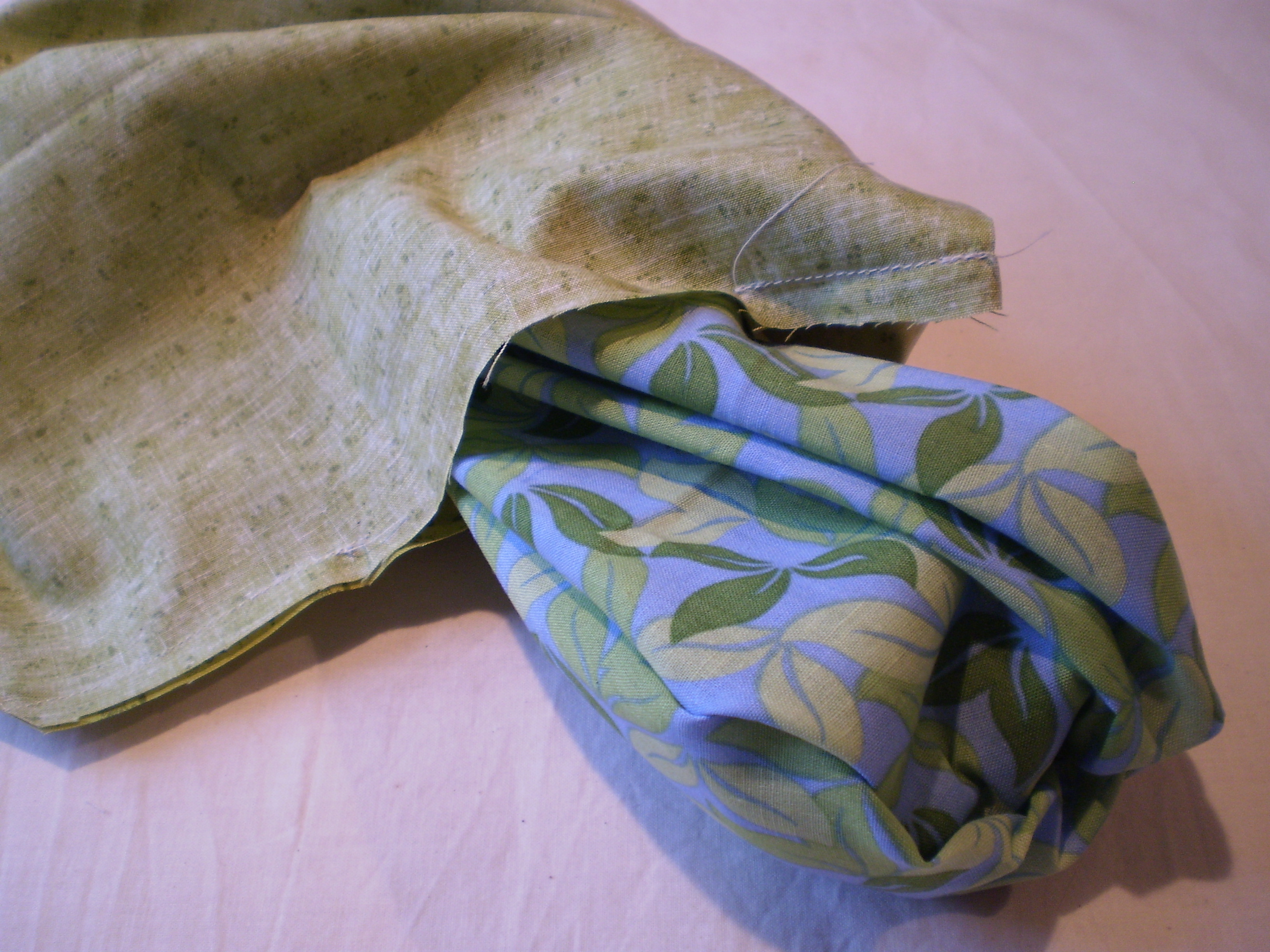
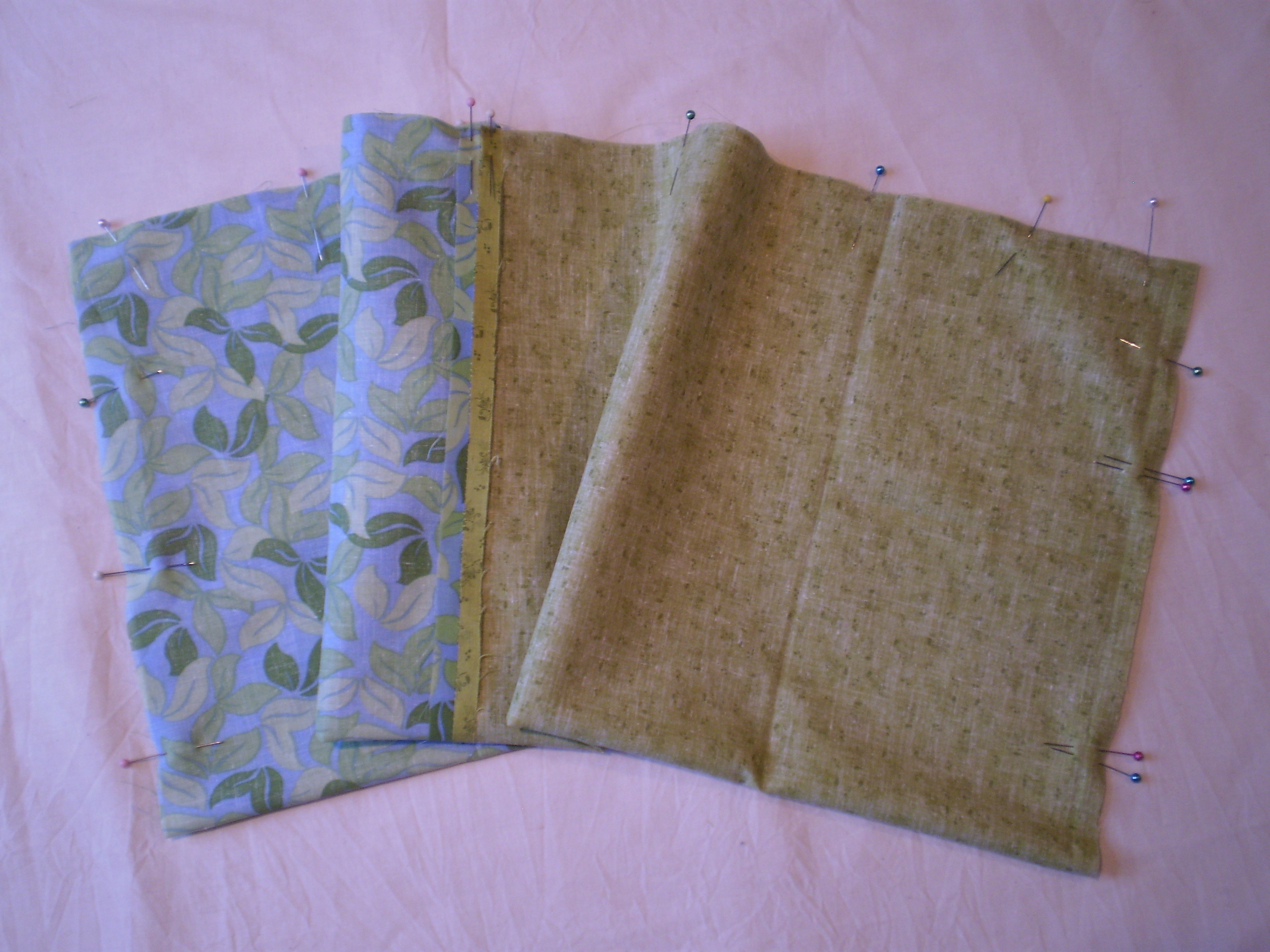
  2. Lay out the fat quarters, right sides in, and sew them along one long edge with a ½ inch seam allowance.OLYMPUS DIGITAL CAMERA
  3. Fold the fabric in half long ways (like a hot dog as my elementary art teacher said) and pin along the outside edge.  You’ll have your lining fabric pinned to itself, and your outside fabric pinned to itself.  Sew around the edge, leaving a ½ inch seam allowance.   Leave a  3 inch gap on the lining end.  You’ll need this gap to turn the project inside-out.OLYMPUS DIGITAL CAMERA
  4. Clip the corners, and turn the bag right-side out.OLYMPUS DIGITAL CAMERA
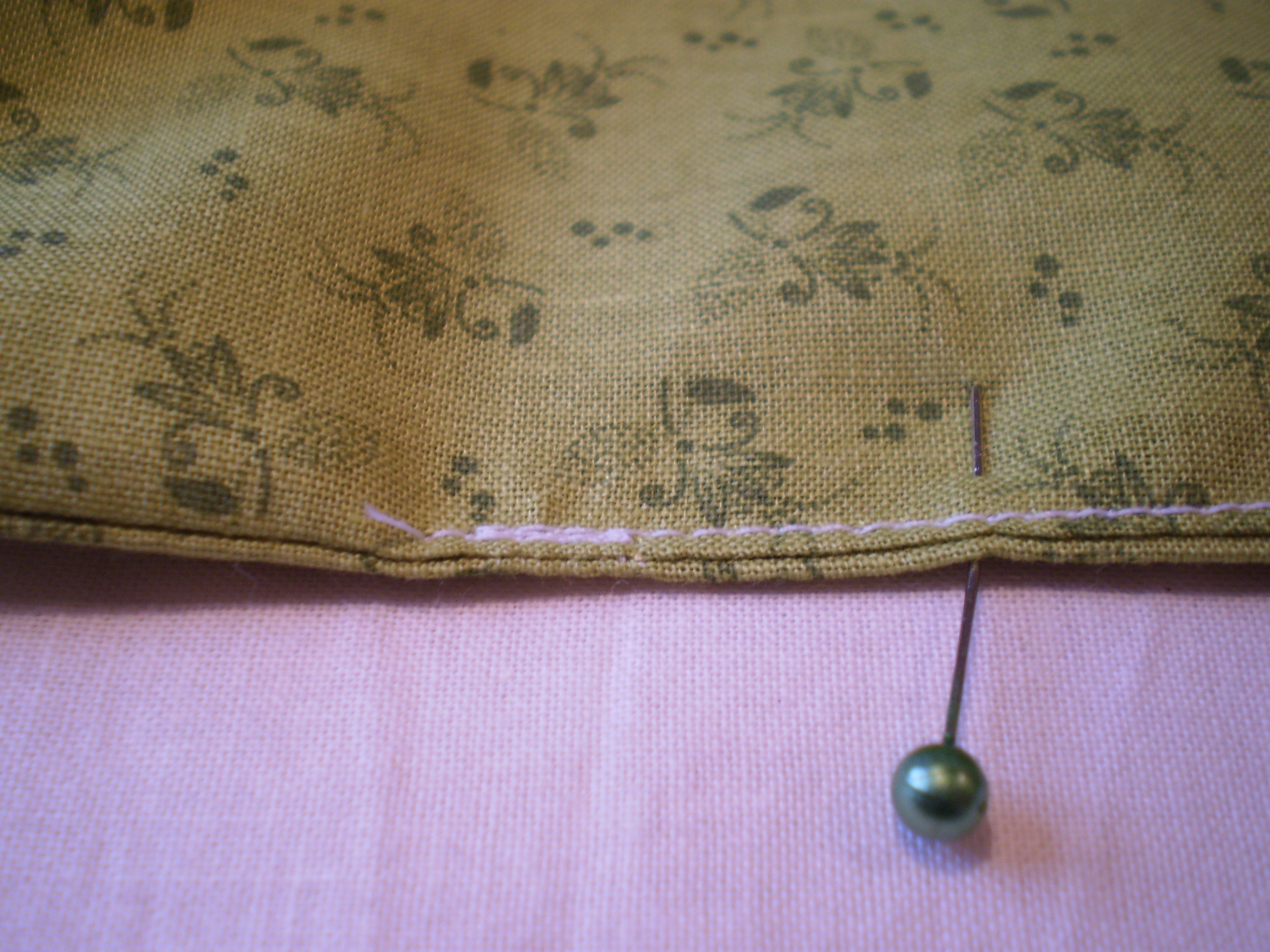
  5. Press the opening  so that the edges of the opening are flush with the seam on either side.  Stitch the opening closed.  OLYMPUS DIGITAL CAMERA
  6. Push the lining into the bag and press the whole thing, making it as neat as possible.  Make sure the seam between the lining and the outside fabric is even (this is the very top edge of the bag’s opening.OLYMPUS DIGITAL CAMERA
  7. Measure 2.5 inches from the top edge of the bag.  Evenly mark 4 points across this line on the front of the bag (front or back doesn’t really matter, but just put 4 points on one side… we’ll put the others on there later).  These points will be where you put in the grommets.OLYMPUS DIGITAL CAMERA
  8. Using the instructions that came with your eyelets, install the 4 eyelets on the front of the bag.OLYMPUS DIGITAL CAMERA
  9. Lay the bag flat, and mark where your eyelets fall on the back of the bag (just poke your pencil through the front of the bag).  This makes sure that your eyelets are evenly spaced around the whole bag.  Install the remaining 4 eyelets.OLYMPUS DIGITAL CAMERA
  10. Weave the ribbon through the grommets.OLYMPUS DIGITAL CAMERA

Done!  Now go fill it with knitting or other projects.  This bag is a good size for small to medium projects (1 or 2 skeins).  If you want a bigger project bag, start with bigger pieces of fabric, but use the same technique.    Because the bag is double-layered, even the pointiest needles won’t poke through, and it’s strong enough to keep your delicate yarn nice and clean and protected.OLYMPUS DIGITAL CAMERA

What’s in your bag?

What’s in your bag?

I don’t know about you, but I love seeing what other people have in their purses.  Maybe it’s just me being a weirdo, but there’s always something interesting in there.  Of course, you always have the usual; keys, wallet, cell phone, spare change, wadded up receipts, random old pens (I have one old purse that I just found that had, I kid you not, 10 pens in it.  What was I thinking?).  But there is always something weird in there, too.  Maybe it’s an old notepad with some cryptic notes scribbled on it, or maybe a tiny plastic hippopotamus that someone got out of one of those 25 cent vending machines at the grocery store, or maybe a single big hoop earring that got left in there after you lost the other one at a new year’s party.  Who knows?

Anyway, to satisfy my voyeurism, let’s talk about what you carry around in your knitting bag.   Here’s what I have in my bag (I suppose it’s exhibitionism, not voyeurism, but still):

OLYMPUS DIGITAL CAMERA

  1. Knitting (duh.)
  2. A pen.  Always useful!
  3. My knitting toolkit.  This is a little wallet-y pouch thing that I received in a swap years ago.  I’ve got a couple of these little kits rattling around my knitting things.  It’s great to have one of these always loaded up with useful little bits and bobs so that you don’t have to go running around looking for a needle or scissors.  So, what’s in mine?
    1. Stitch markers-several kinds, several sizes for all your stitch marking needs.
    2. Scissors-I like these because they are tiny and pretty.  I think I got them at JoAnn’s years ago for a couple bucks.  They make me feel all fancy-like.
    3. Tapestry needles- organized on the plastic dealy that they came on, so they aren’t just rolling around loose and getting lost.
    4. Diaper pins-I actually got these in a swap, too, and had no idea why someone would send them to me.  It seemed dumb.  But, I use them all the time.  You can use them to mark the beginning of a row when a stitch marker won’t work.  You can use them to pin two pieces of knitting together when you’re seaming it.  You can use them to organize buttons or stitch markers when are afraid you’re going to lose them before you get home.  Also, they’re better than just using safety pins, since they don’t have as many jagged metal bits to cause snags.
    5. A cable needle- Never leave home without it.  Easy to loose, not used a lot, but essential when you need to find it.
    6. Buttons that I took off of a sweater when I frogged it months ago.  I should put them away…

So, I showed you mine.  You show me yours.  What’s in your knitting bag?