Category Archives: Patterns

Spheroid and Oblong

So, now you know about the Toy Society, eyeballs and I-cord.  What to do with your new knowledge?  How about making a cute, round(ish) little creature to brighten someone’s day?

I like making these little guys with sock yarn on tiny little needles.  That way they can ride around in a pocket or purse.  But, using bulky yarn and larger needles, you’ll end up with a bigger, more huggable critter.

Feel free to play around with the shape of your Spheroid, too.  Adding more even knit rows between the increase and decrease rows will make your guy more oblong.  Removing the knit rows will make him more UFO-shaped.

Remember, if you’re making this little guy for a kid under the age of 3 (or anyone who is dumb enough to eat buttons) forgo button or beaded eyes.  Safety eyes, while they’re safer than buttons, are still not 100% for little kids.

Materials:

A few yards of scrap sock yarn.  A ball about the size of a Ping-Pong ball should be plenty.

Size 2 double-pointed needles

Polyfill or wool roving for stuffing

Safety eyes, buttons, beads, or contrasting-color thread for the face

Scissors and a tapestry needle

Gauge:

7 sts/inch, but it really really doesn’t matter

Instructions:

Spheroid:OLYMPUS DIGITAL CAMERA

Cast on 8 stitches, and join to work in the round

1. k

2. [k1, inc 1] around(16 stitches)

3. k

4. [k2, inc 1] around(24 stitches)

5 and 6.  k

7. [k3, inc 1] around(32 stitches)

8-10. k

11. [k4, inc 1] around(40 stitches)

12-15. k

16. [k3 k2tog] around(32 stitches)

17-19. k

20. [k2 k2tog] around (24 stitches)

21-22. k

23. [k1, k2tog] around(16 stitches)

24. k

25. [k2tog] around (8 stitches)

Cut a 1 foot long tail.   Using the tapestry needle, pull the tail through the loops.  If you’re using safety eyes, add them now.  Stuff the body, and close up the top.

Oblong:OLYMPUS DIGITAL CAMERA

Complete rows 1-7 of Spheroid.

Knit 20 rows even.

Complete rows 20-25 of Spheroid.

Cut a 1 foot long tail.   Using the tapestry needle, pull the tail through the loops.  If you’re using safety eyes, add them now.  Stuff the body, and close up the top.

Limbs:

Using double-pointed needles, cast on 3 stitches, leaving a 1-foot tail.  Work as an I-cord for 8 rows.  Cut a 1 foot tail, and use your tapestry needle to pull the tail through the loops, and tie a knot so the leg doesn’t unravel.  Hide the end of the tail in the middle of the limb and trim.  Leave the cast-on tail to use to sew the limb to the body.

Repeat until you have enough limbs.  (Usually this is 4.  But, if you want to make an octopus, 8 would be more appropriate.  Or of you wanted to add antennae, you should make 6)

When you have enough limbs, carefully sew them onto the body, using the remaining cast-on tails.  Weave in the ends and trim.  Hide the ends in the body of your little guy.

If you haven’t already added a face, do so now.

OLYMPUS DIGITAL CAMERA

Slouchy Hipster Hat

Freaking hipsters.  Here in Seattle, they’re everywhere.  With their smug attitudes and their fixed-gear bicycles, and their super skinny jeans.  And suddenly, it’s cool to have gigantic glasses?  For real.  The poor kids who have perfect vision are actually wearing glasses frames without lenses because they think they look cool.  How weird is that?

Admittedly, if I really wanted to get away from hipsters, I could a.) not live in Seattle, b.) not play roller derby, c.) not hang out in brew-pubs and independent coffee shops or, or d.) all of the above.  But I like doing all of those things.

Actually… I think I might be a hipster.  Oh shit!

I like eating from food trucks, and think “organic” is pretty swell.  I wear cardigans and scarves, and my idea of a nice afternoon is one spent blogging from my local coffee shop.

God, that’s depressing.

But, I suppose, if you have to do a thing, you might as well go all-in.

So, fine! I give in!  Here’s a slouchy, hipster hat.  It’s knit with pretty fine yarn on largeish needles to give it a plenty of floppiness.  Deal with it.

(I even tried to make instagram-ish photos for this pattern, because why not.  Don’t laugh too hard.)

instagramish2


Materials:

1 skein sock or fingering weight yarn.  (I’m using Dale of Norway’s Baby Ull in color 9436)

Size 5  16″ circular needle (or size to get gauge)

Size 7 16″ circular needle (or size to get gauge)

Size 7 double-pointed needles (or size to get gauge)

Scissors and Tapestry needle

Gauge:

Size 5: 6.5 stitches/inch in stockinet stitch

Size 7: 5.5 stitches/inch in stockinet stitch

Size:

Women’s Small(Women’s Large)

Shown in size Large

Instructions:

  • Using your size 5 circular needle, cast on 120(136) stitches.  Mark the beginning of your row.  Work in the round, in a k2p2 rib for 2 inches.
  • Change to size 7 circular needle, and knit in stockinet stitch (knit all rows), until the piece measures 7(7.5) inches from the edge.
  • Work crown decreases as follows:

1.  [k6, k2tog] around
2. & 3. Knit
4. [k5, k2tog] around
5. Knit
6.[k4, k2tog] around
7. Knit
8. [k3, k2tog] around
9. Knit
10. [k2, k2tog] around
11. [k1, k2tog] around
12. [k2tog] around

  • Cut yarn, leaving a longish tail.  Draw the yarn through the loops at the crown of the hat to close up.  Sew in ends.
  • Put on hat and jump on your fixie to go down to the coffee shop for a nice organic matcha green tea latte with soy and a vegan cupcake.

instagramish

Pattern:The Boyfriend Scarf

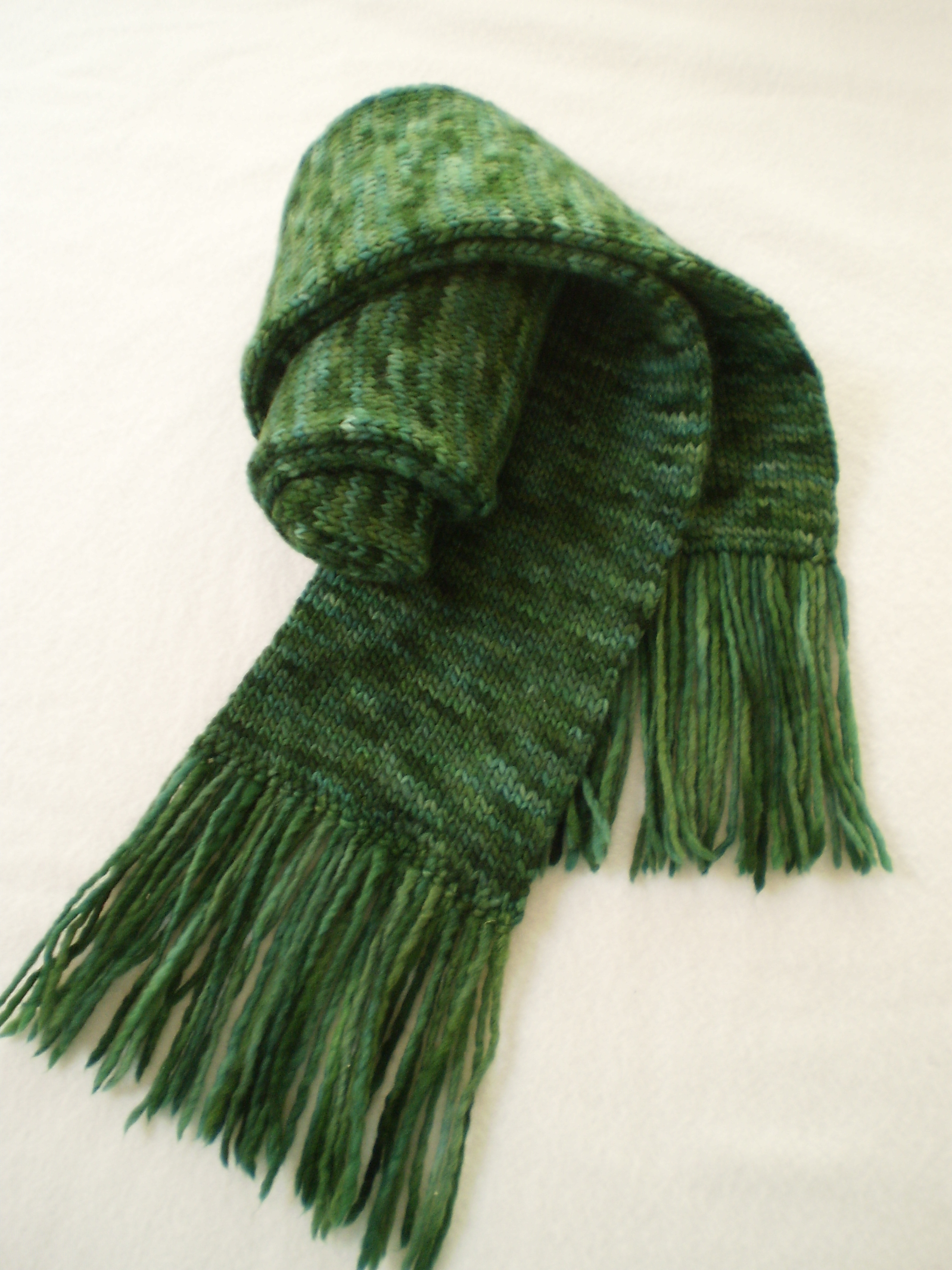
So,  if you can’t may your significant other  a sweater without getting cursed, what’s a girl to do? (Unless you want to be cursed, but that’s a personal issue.)  How about a fancy-enough-to-be-special-but-not-too-fancy-to-be-worn-every-day scarf?  It’s plain enough to be manly, but is made with gorgeous, soft, hand-dyed yarn to keep you happy as you knit. The Boyfriend Scarf will keep your main squeeze toasty warm, and is guaranteed not to be cursed. (I can’t promise that you won’t break up, but if you do, it is not the fault of this scarf.)

This project was designed to be given as a special gift, so I splurged on the yarn.   You’re welcome to use another more cost-effective yarn, but  you will not regret knitting with Malabrigo.  It’s a hand-dyed single-ply merino wool from Uruguay.  So soft and warm!  (If I had a million dollars I would knit myself a suit from it, but since I do not have a million dollars, a Malabrigo scarf will do nicely.)

The scarf is actually knit in the round, as one very long, thin tube, like a small sleeve.  Because of this, you’ll end up with a double-thick, non-rolling, smooth stockinet scarf.  The only problem with this construction is that it can get a tad boring, so make sure you have something good queued up on your Netflix.

The ends of the scarf are finished off with a simple fringe that serves two purposes.  First, it’s fringe, which just looks snazzy.  And, second, it closes up the ends of the scarf, so that you have a nice, double-thick scarf, not a weird tubey-thing around your neck.  If you/your guy is not interested in fringe, a neat whip stitch will finish the ends just as effectively.

OLYMPUS DIGITAL CAMERA

Materials:

2 Skeins Malabrigo Worsted (shown in Verdes 203)

1 Size 8, 8 inch circular needle

1 Size 8/H crochet hook (if you have a slightly smaller hook, that will work, too)

Stitch marker (optional)

Ruler

Scissors and tapestry needle

Instructions:

1. Cut fringe:  Measure and cut 50 10-inch pieces of your yarn.  These will be your fringe when you’re done knitting your scarf.  Set them aside until later (I recommend protecting them in a Zip-Lock baggie or something, just to be sure they’re safe).

2. Cast on 50 stitches.  Place marker (if you like; it’s not technically necessary), and join in the round.  Work in stockinet (knitting all stitches) until your first ball of yarn runs out.

3. Join the second ball of yarn and keep knitting.  (I like using a spit join.)

4. Keep knitting

5. Knit some more

6. When you’re just about out of yarn, bind off.

7. Apply fringe: Dig out your fringe pieces from wherever you hid them.  Lay out the scarf flat (so that it looks like a scarf, not a sleeve), with one short end facing you.  Slip the crochet hook through both layers of the scarf, just above the cast-on or bound-off edge.  Pick up and fold one of the fringe pieces in half.  Use the crochet hook to pull the middle of the fringe piece partway through the scarf end.  Then pull the cut ends of the fringe through the loop you just made.  Pull the fringe tight.  Repeat the process so that 25 fringe pieces are attached to each end of the scarf.  When you’ve attached them all, trim any pieces that are a little wonky.

8. Block: Soak your scarf in warm water for about 20 minutes.  Squeeze out most of the water with a clean towel.  Lay out flat on another clean towel on a counter or a nice empty part of the floor to dry.

Cabled Container Cozy

I firmly believe that you can never own too many containers.  Bags, boxes, jars, crates… it doesn’t matter.  I can always find something to put in them.  Maybe it’s more containers… but the point still stands.

When those containers are pretty, it’s even better.

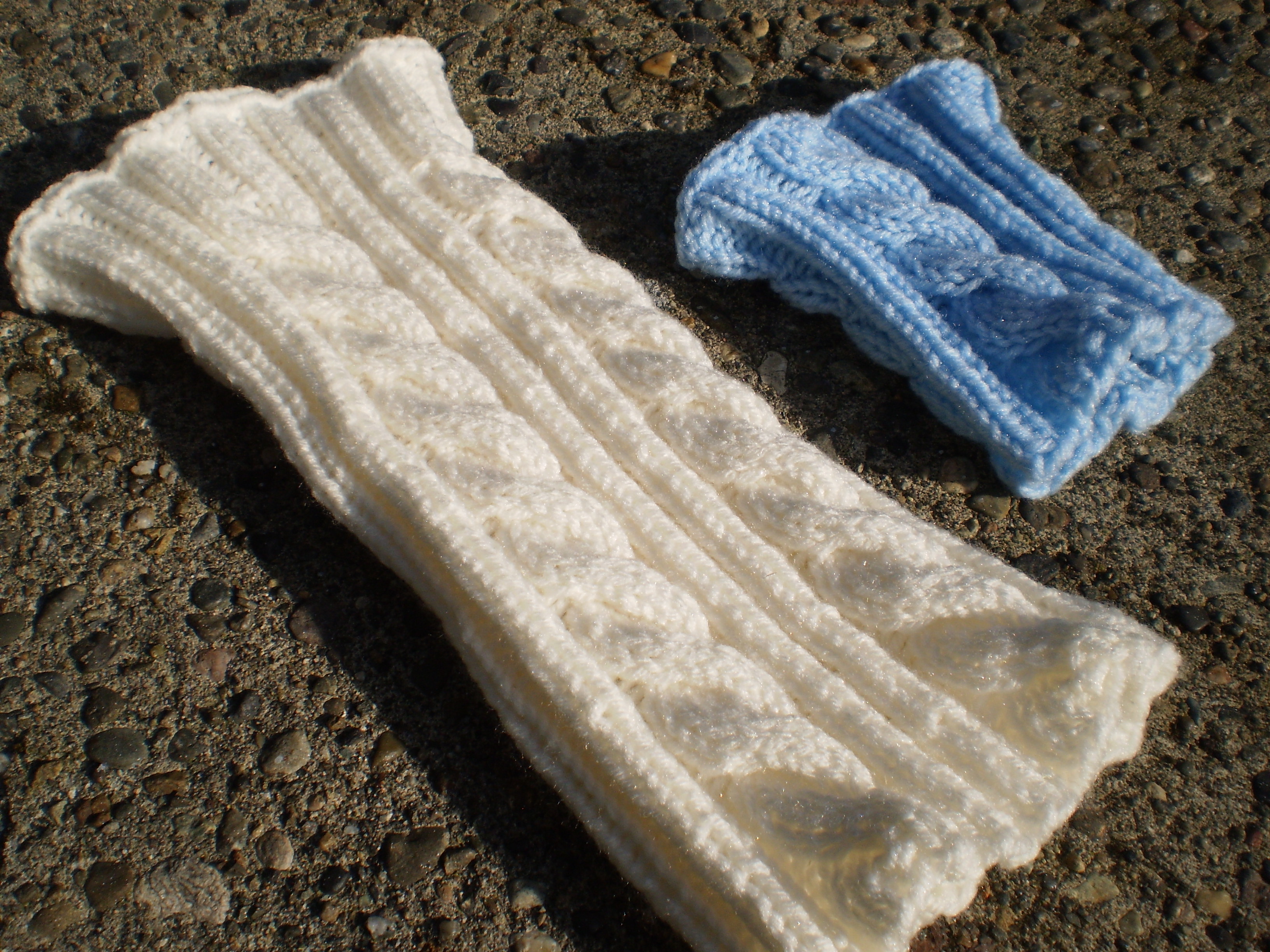
Here’s a recipe for a cabled sleeve that you can use to pretty-up any straight-sided containers around your house.  I’m using an oatmeal canister and a small coffee can, but you could use the same recipe to cover jars, pots, vases, or other plastic or ceramic containers.  They make great places to keep needles, flowers, and the tiny little balls of sock yarn that are left over at the end of a project that you don’t want to throw away.  (Don’t look at me like that… I know I’m not the only pack-rat out there.)

OLYMPUS DIGITAL CAMERA

Materials:

1 straight-sided container (Coffee cans, oatmeal canisters, old (clean) juice cartons with the tops cut off neatly, storage crate-the kind without big holes in them, vases etc.  Look around your house… I can guarantee you have something that would work for this project)

1 (or more) skeins of worsted-weight yarn.  (Use more than one skein if the container you are covering is gigundo.  Don’t spend too much money on this project… It’s not like a sweater or something that you’ll have to wear around close to your skin.)

Size 8 needles (DPNs or appropriately sized circulars, depending on the size of the project.  I’m working on a smallish coffee can, so I’ll be using DPNs.  If I was covering a big crate or something, I’d use circulars that were a little smaller than the diameter of the container.)

An appropriately sized cable needle

Tape measure

Calculator (optional if you’re good with math in your head)

Stitch markers

Scissors and tapestry needle

Spray paint (0ptional)

Hot glue (optional)

Instructions:

  1.  Make a stockinet (knit 1 row, purl one row) gauge swatch.  I know.  Lame.  But, it will be important later.  The container cozy really has to fit nicely to give you a good result.  Measure your gauge and write it down.  My gauge is 6 sts/in.
  2. Rip out the gauge swatch.  Or not.  Finished gauge swatches make excellent coasters.
  3. Measure the circumference of your container by wrapping the tape measure around the outside of the container.  (My container’s circumference is 12 inches.) Multiply this number by your gauge.  (6 sts/in x 12 in=72 stitches)OLYMPUS DIGITAL CAMERA
  4. Round this number to the nearest multiple of 4.  (72 already is a multiple of 4, so I can skip this step.)
  5. Cast on your number of stitches (in my case, 72), place a marker at the beginning of your round, and work 2 rows in the round in a k2p2 rib.
  6. On your next row, you’ll continue working the k2p2 rib, but at the same time you’ll start your cables.  I will be doing 3 cables on my coffee can, placed more or less evenly.  Make as many or as few as you want.  (You don’t have to do any.  I won’t call the cops or anything.)  Work along the row until you reach the spot where you want your first cable to be.  After a p2, place a marker, k6, and go back to your k2p2 rib pattern.  Continue to where you want your next cable to be, and the same thing (after the p2, place marker, k6, continue in pattern).
  7. Now that you’ve got your cables established, the rest is easy.  Continue working in pattern, following what you’ve been doing (k2, p2 rib, k6 when there’s a cable) for 3 more rows.
  8. Next row, get out your cable needle, and work up to your first stitch marker.  Transfer the first 3 stitches from the “K6” to your cable needle, and hold them in front of your work.  Knit the second 3 stitches of the cable.  Then knit the 3 stitches from the cable needle.  Continue working in pattern to your next cable and do the same thing. (Here’s a video with instructions if you’re having trouble with your cable.  She talks a lot, but gets around to instructions eventually.)
  9. Work in pattern for 6 rows, then work another cable row.  And rinse and repeat.   Keep adding height to your sleeve until the piece measures 1/2 inch less than your container height.
  10. To finish, work 3 rows even (after your last cable row), then work 3 rows of k2p2 rib, and bind off loosely.  If you want, you can continue the k2p2 rib for a few inches, if you want a folded-over edge.
  11. Weave in the ends, and trim the tails (making sure they lie on the inside of the tube).OLYMPUS DIGITAL CAMERA
  12. (Optional)  If your container has lots of colors and patterns on it, you may want to spray paint it with a color similar to that your yarn.OLYMPUS DIGITAL CAMERA
  13. Slip your piece over your container, like a sock.  If the tube is too long, fold the top of the tube over, inside the container to make a nice finished-looking edge.   If the tube is too loose, add a couple dabs of hot glue at the top of your container to hold the sleeve up.
  14. Add in flowers, knitting needles, or whatever else you want to display in your cool new container.  Brag to your friends about the handmade vintage vase on your mantelpiece that you got from Anthropology for about 500 bucks.  (They don’t have to know it’s an old coffee can and about 50 cents worth of yarn that you had in the back of your closet.)OLYMPUS DIGITAL CAMERA

A Recipe for Anarchy

This recipe is for a basic yarn bombing piece.  I’ve purposefully neglected to give you yarn requirements, gauge measurements, sizes and other specifics.  Because, well, this is graffiti, and should be sort of free form.  And rules are for squares.  So, feel free to change, modify, add to, and alter to your heart’s content.  Change is good!  Anarchy!  Down with the Man!

OLYMPUS DIGITAL CAMERA

Materials:

Yarn-As much or as little as you like.  Don’t use anything expensive, since it’ll get gross out in the rain, and may be torn down quickly.  Odds and ends that you have laying around will work fine.  I used some Red Heart that I had laying around, waiting to be used.

Needles- To match your yarn.  I recommend a large gauge, so that your knitting goes quickly and you can cover a larger area.  I used 10 1/2.

Crochet hook (optional)- In a gauge to match your needles.

Buttons (optional)-Again, nothing fancy or expensive.  If you have some laying around that you don’t mind parting with, feel free to use them.  Or, you can make your own buttons using an old plastic container (like a milk jug or other food container).  Cut out circles about an inch around, and use a hole punch (or a knitting needle) to poke two holes in each button.  They won’t be pretty, but, they’ll do the job.

Scissors and tapestry needle.

Instructions:

1. Cast on any number of stitches.  This should be easy and free-flowing, so don’t worry about gauge or where the knitting is going to end up.   I’ll just make something, and then find somewhere to put it.  However, if you have a particularly sad tree or something that you think needs a little knitted excitement, feel free to measure the circumference of the tree, make a gauge swatch, and figure out the number of stitches you’ll need to go around it.

2. Knit for a while.  Let your creativity take over!  Change colors, mix patterns together, do things that you wouldn’t usually do.  Think of this as an opportunity to “sketch” with your needles.  Here are some ideas that you might want to include:

  • Stripes
  • Ribbing
  • Lace patterns (How cool would a tree look covered in gigantic lace?  I just thought of this… and I might go try this soon.)
  • Cables
  • Intarsia, Fair Isle, or other Color work
  • Adding beads or other unconventional materials

3.  When your piece is finished, cast off loosely.

4. Optional-Use the crochet hook to edge the whole piece with a single crochet edge.  You can use this to burry any yarn tails that you may have, so you don’t have to actually sew them in.OLYMPUS DIGITAL CAMERA

5. Optional- Add buttons and button holes.  You can skip this step if you want to sew your piece directly onto your tree/light pole/sign post. If you want buttons, attach them to one side of your piece (mine are on the right in the above picture).  On the opposite side of the piece, make some button loops.  You have two options:

  • Use the crochet hook to make loops in the edging.  Make another row of single crochet along the edge.  When you reach a spot where you want a button hole, chain 3 stitches, then continue doing the single crochet edging.
  • Using your tapestry needle and a length of yarn, you can add simple button loops as follows:  Sew in one end of the yarn.  Wrap the yarn around your non-dominant thumb, right down by your knitting.  Sew other end of the yarn.  You’ll end up with a 1” loop of yarn hanging off the side of your knitting.  This loop will act as your buttonhole.

OLYMPUS DIGITAL CAMERA

6. Sew in any ends that haven’t been sewn in already.

7. Install your work.  This is the sneaky part.  I recommend doing it under cover of darkness.  But it’s up to you.  Find where you want to put your knitting.  Trees in parks are good, or maybe there is a bike rack near your house that needs a little perking up.  Look for something with a circumference that is roughly equal to the width of your knitting.  When you have found a good spot for you knitting, install your graffiti!

  • If you have buttons:  Button the piece to your tree/pole etc.  Easy!
  • If you didn’t put on buttons: Using a long piece of yarn, sew the piece into place.  A simple whip stitch works well.  Work quickly!

8. Run away!

9. Come back the next day to appreciate your work.  Take pictures.  Pretend to just be a passer-by who is tickled by the cool knitting.

OLYMPUS DIGITAL CAMERA

Lace-Edged Shawl

Well, now you have this pile of beautiful stitch markers, what to do with them?  How about making a really cool lacey shawl?  I realize the “shawl” word is kind of old-lady-y, but whatever.  They’re basically just triangular scarves, so what’s not to like?

I’m using Blue Moon Marine Silk Worsted yarn , but you can use whatever you want.  I think this shawl looks best in a heavy, drapey yarn, but feel free to use whatever you want.  I am always prepared to be wrong. My shawl is quite small, just big enough to go around my neck and tuck into the collar of my coat.  If you want a bigger shawl, repeat rows 2 and 3 of the shawl body until you have 200, 224, or 248 stitches, and increase the number of times you work the lace pattern.OLYMPUS DIGITAL CAMERA

Materials:

1 skein Blue Moon Marine Silk Worsted (243 yards) or whatever the heck you feel like using.

Size 8 needles (or so.  It’s not like a sweater or something, so there is plenty of leeway regarding gauge)

4 stitch markers

Scissors, tapestry needle

Abbreviations:

k3tog-knit three together

pm-place marker

yo-yarn over

Instructions:

Make the body of the shawl:

CO. 8

  1. k2, pm, k1, place marker, k2, pm, k1, place marker, k2
  2. k2, *pm, yo, k to next marker, yo, pm, k2, repeat from *
  3. k2, *pm, purl to next marker, pm, k2, repeat from *

Repeat rows 2 and 3 until you have 176 stitches on your needles, finishing with row 3

Begin lace pattern:

  1. k2, *pm, yo, (k1, yo, k4, k3tog, k4, yo) 7 times, k1, yo, pm, k2.  Repeat from *
  2. k2, *pm, purl to next marker, pm, k2.  Repeat from *
  3. k2, *pm, yo, k1 (k2, yo, k3, k3tog, k3, yo, k1) 7 times, k2, yo, pm, k2.  Repeat from *
  4. k2, *pm, purl to next marker, pm, k2.  Repeat from *
  5. k2, *pm, yo, k2 (k3, yo, k2, k3tog, k2, yo, k2) 7 times, k3, yo, pm, k2.  Repeat from *
  6. k2, *pm, purl to next marker, pm, k2.  Repeat from *
  7. k2, *pm, yo, k3 (k4, yo, k1, k3tog, k1, yo, k3) 7 times, k4, yo, pm, k2.  Repeat from *
  8. k2, *pm, purl to next marker, pm, k2.  Repeat from *
  9. k2, *pm, yo, k4 (k5, yo, k3tog, yo, k4) 7 times, k5, yo, pm, k2.  Repeat from *
  10. k2, *pm, purl to next marker, pm, k2.  Repeat from *
  11. k2, *pm, yo, k4 (k3tog, k4, yo, k1, yo, k4) 7 times, k3tog, k4, yo, pm, k2.  Repeat from *
  12. k2, *pm, purl to next marker, pm, k2.  Repeat from *OLYMPUS DIGITAL CAMERA

Repeat rows 11 and 12 until you’re bored, you run out of yarn, or both.  I repeated them 6 times for my shawl.

When you’re finished, bind off loosely, removing the stitch markers as you go.  If you feel so inclined, block your shawl by soaking it in warm water, and pinning it out flat to dry.OLYMPUS DIGITAL CAMERA

Get the PDF here: Lace Edged Shawl-Updated

Edit:  Originally, I had included LLD and RLD in the Abbreviations list.  This was a mistake-there was never any LLD or RLD’s in the pattern. I have removed them from the abbreviations list.  Happy knitting!