Tag Archives: sweater

Pattern: Hellenic Pullover

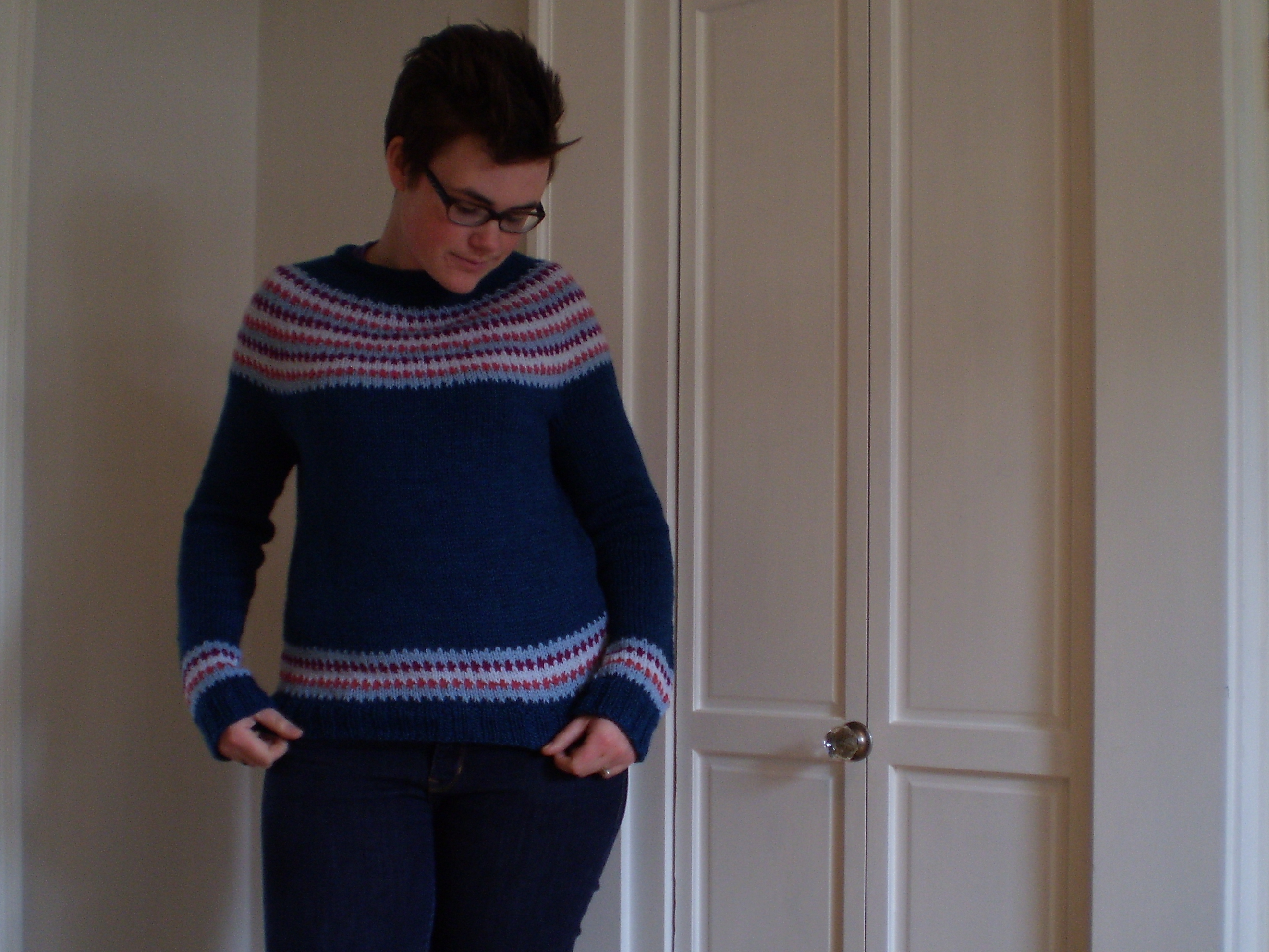
OLYMPUS DIGITAL CAMERAHey, did you like my Ravellenic Games sweater?  Want to make one yourself?  I wrote out a pattern!  (Word of warning, it’s the first time I’ve really written out a full-on-sweater-in-multiple-sizes pattern, so there might be some math errors.  I tried to make all the math come out right, but you never know.)

Anyway, this sweater is a simple top down yoke pullover with slip-stitch colorwork at shoulders, hem and cuffs. A few short rows at the back of the neck make the sweater lay nicely over your shoulders, and a rolled ribbing collar gives this sweater a beautiful finish. It’s knit a fairly large gauge with cozy (and affordable) Knit Picks’ Wool of the Andes, making it perfect for when you want a new hand-knit sweater right now.

The pattern is available here:

Hellenic Pullover

Ravelry


Accross the Finish Line

Phew!  The Olympics are over, and the Ravellenic Games are finished!  I don’t know if you took part, but I had a really great time.  And I knit like a Norwegian cross-country skier (in other words- really, really quickly).

My sweater came together without too much trouble.  I did have a little issue during the first weekend of the games, when I had a little math issue (compounded by the fact that I – overachiever that I am – was trying to finish an entire sweater in a week) that forced me to re-knit my sleeves a couple times.  (Apparently my arms are not 12 inches long and pointy.  Who knew?)  But, other than that, I skated through this project at a nice little clip.

Anyway, here’s my final product in all it’s glory!  (Please ignore the slightly awkward poses.  I can make a sweater in two weeks, but I’m damned if I can take a decent photograph.  It’s a curse.)

OLYMPUS DIGITAL CAMERAI blocked the sleeves slightly too much, so they’re a smidge long, but that’s OK.  I have long monkey arms, so it’s sometimes a treat to have too-long sleeves.

OLYMPUS DIGITAL CAMERAI love how the slip-stitch color-work panels turned out.  (And they were crazy easy to do!  I’ll post instructions soon.  Maybe Wednesday, if I have time.)

The sweater was worked in KnitPicks’ Wool of the Andes, and the colors were:

  • Sapphire Heather (body)
  • Bluebird (darker contrast blue)
  • Clarity (pale contrast blue)
  • Papaya Heather (orange)
  • Fairy Tale (fuchsia)

OLYMPUS DIGITAL CAMERADespite the dorky pictures, I’m quite pleased how this project turned out.

Did you participate in the Ravellenics?  What did you make?

I’m Ease-y

When you are getting ready to start knitting a new pattern, you might come across phrases like “Meant to be worn with positive ease” or “Designed to have 1 inch of negative ease” or even “Zero ease.”  What the heck is ease?

Ease is a really easy (sorry, I had to) way for a pattern designer to tell you how fitted (or not) a garment is meant to be.  A garment with positive ease (like this sweater) is meant to be worn loosely.OLYMPUS DIGITAL CAMERA

A garment with negative ease (like these socks) are knit slightly smaller than my feet, so they end up nice and snug.OLYMPUS DIGITAL CAMERA

A garment with zero ease (like this hat) has exactly the same dimensions as my head, so the hat is neither too tight nor too loose.OLYMPUS DIGITAL CAMERA

Ease is measured in inches (or centimeters, if you’re not in America).   To calculate the ease, you measure both the garment, and the person who will wear it.  Then you subtract the person’s measurement from the garment’s measurement.

For example, if a sweater has a bust line of 40 inches, and the person who is meant to wear it has an actual bust line of 36 inches, the ease for the sweater is +4 inches.  (40-36=4)

If a different sweater has a bust line of 35 inches, and if the same person wears it, the ease of this sweater is -1 inch.  (35-36=-1)

Got it?

Ease makes a huge difference in how a finished garment looks.  You wouldn’t want a fitted, structured sweater with positive ease- it would look baggy and too big.  And, you wouldn’t want a slouchy, cozy sweater with negative ease- it would look like you were trying to wear your little sister’s clothes.  And the last thing you want to do is knit up an entire sweater, only to have it look like you pulled it from the by-the-pound bin at Goodwill.  Ew.

Inspiration: Parade of Knitwear

I don’t know about you, but I was glued to the TV on Friday night, eagerly awaiting the awesome (or the semi-awesome, as it often ends up) that is the Olympic Opening Ceremony.  Especially since this is the Winter Games, I was expecting some excellent knitwear.  I was less than happy, therefore, when a disturbing amount of Gore-Tex came out on the athletes.

But, nevertheless, there were a few points of light in a darkness of polar fleece and weatherproof jackets.

Slovakia went all-in on a heart-motif for their hats and scarves.2014 Winter Olympic Games - Opening Ceremony

Kyrgyzstan wore red-and-white scarves with a very cool curlicue motif.2014+Winter+Olympic+Games+Opening+Ceremony+_ksK8nJ2t5kl[1]

Andorra went all-out with (pardon my French) bitchin’ color work sweaters.OLY-2014-OPENING-CEREMONY-DELEGATION

And, well… This happened.1391805399020-USP-Olympics--Opening-Ceremony39[1]

It’s a knitting blog, so I have to include us in this post, after all.  But, let’s just not talk about them ever again.  Embarrassing and tacky, to say the least.  Not good, USA.  Not good at all.

Another awesome knitting moment happened during the Men’s Slopestyle (which, if you haven’t seen it yet, you need to watch it.  It’s super cool).  Check it out:1654697_10152558586959918_501735966_o

See that?  It’s Antti Koskinen, the coach from Finland.  Apparently the whole Finnish team are passing around the scarf, so that everyone who wants to will get a chance to work on it.  I can’t imagine a cooler project, or a better way to calm your nerves when you’re at the Olympics!

Olympic Knitting and Social Media for Dummies

When I first started this blog, one of the first things I did was get a Twitter account, and link it to the blog.  Then I immediately forgot about it.  My poor Twitter page has been sitting all alone and neglected for almost a whole year.

But no more!  I’m determined to learn about Twitter!

1249827-twitter-logo[1]You’d think that Twitter would be easy enough for someone raised on computers to figure out, but it’s rather more complicated than I expected.  Retweets, @’s, hashtags…  This might be the first time that I truly felt like an old Luddite.

But I will persevere!  And tweet about my Ravellenic Games sweater.  Twitter seems like the perfect venue to give you updates on my sweater progress.  Doesn’t it?

OLYMPUS DIGITAL CAMERASo, if you tweet, follow me @on_the_needles.  Or, if you don’t have an account of your own, you can look at my tweets here.

Get Ready! It’s the Olympics!

Apparently, I have a sports blog now.  (Go Seahawks, by the way!)

Are you excited about the Olympics?  I know I am.  So much knitwear (at least in the parade of nations), so many sequins (at least in the Ice Dancing), and so much Argyle (thank you Norwegian Curling Team).

norway-curling-team-olympics-red-checkered-pants-21351780812d806d_largeI am so excited about the Olympics, I’m going to be participating in the Ravellenic Games this year, in the Sweaterboard Cross event.

Ravellenics2014banner.3What the heck does that mean?

Basically, a whole bunch of ladies (and gents) over on Ravelry get together (virtually) every time the Olympics roll around.  They cast on a project during the opening ceremony, and try to have their projects off their needles by the end of the closing ceremony, two weeks later.   It’s all about pushing yourself, trying new things, and finish something awesome while watching people do awesome sports things that you totally could do to, if you really felt like it.

My Olympics project will be a nice cozy wool pullover with a slip stitch/color work yoke and cuffs.  My goal is to design, knit, and write up a pattern for the sweater by the end of the Olympics, which will definitely be a stretch.  But that’s the whole point of the Ravellenic Games!  To try something new, something that you didn’t think you could do.

Get ready to cast on on Friday!

Are you going to take part in the games?  What do you think your project will be?

Pattern Spotlight: The Knitter’s Handy Book of Top-Down Sweaters

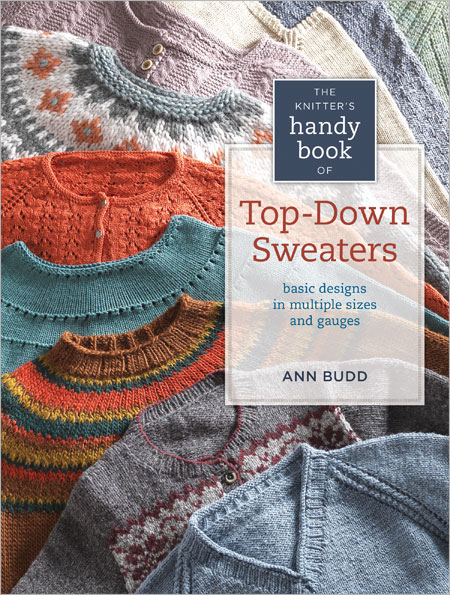
I don’t know if y’all remember my Persistence Sweater (the green one with cabled sleeves) from this summer, but I made it based on a pattern from Ann Budd’s The Knitter’s Handy Book of Top-Down Sweaters.  It’s a super cool book if you’re interested in designing your own sweaters, but still want someone to hold your hand a little bit while you do it.

12KN02The book is based on the idea of constructing a sweater, starting by casting on at the neck and working your way down the body and arms.  This allows you to try on your sweater as you go, to see how it’s fitting, and if you need to change anything while you work.  It’s really great, especially if you are a self-doubting, frogging and reknitting knitter like me.

She includes a few complete patterns for sweaters which are pretty, simple, and classic with interesting little details.  But, the golden part of this book are the tables.  The glorious, glorious tables!  I know I’m a bit of a data geek, but, come on.  They’re amazing.  Pages and pages of really comprehensive, and totally useful tables.

She includes basic outlines on how to do four different shoulder styles, as well as instructions on how to do several different necklines, cardigans and pull-over variations, long sleeves, and short.  And everything is written for 15 sizes and at 5 different gauges (that’s where the tables come in-she’s done all the math for you already!).

So, basically she lets you pick out your design elements from her buffet of knitterly goodness, add in a few decorative touches of your own, and before you know it, you’ll have a one-of a kind, custom-designed, hand-knit sweater.  Amazing!

Of course, if you’re a brand-new knitter, the charts and tables might be a bit intimidating, but this book is seriously worth taking a look at.  (Also, it’s quite a big book, because of all the great tables, so it might be a “knitting at home” project, instead of a traveling one.)  If you have a sweater swimming around in your head that you haven’t found a pattern for, give this book a shot, it might be just what you’re looking for.

Inspiration: In the Fog

Usually fall in Seattle entails rain.  And drizzle. And more rain.  And overcast skies.  And more rain.  Delightful, no?

But, for some reason, this year, Seattle looks like this:

grey_square[1]It’s been crazy foggy for approximately two weeks, and I’m about ready to go crazy up in here.  It’s pretty much the worst.  It’s gray and never really gets any brighter than sort of a wan pre-dawn kind of light.  And, driving is terrifying!  You can’t see more than a block or two ahead of you with any sort of clarity.

But, I suppose, when life gives you lemons (or fog), you make lemonade (or fog-inspired sweaters).

So, here’s what I would like to knit to hold the fog at bay:

Fog Sweater by Tiennie

2183219713_e49a79cf80_z[1]Seattle Fog Beanie by Julie Grantz LeFrancois

6668403171_02b1682249_z[1]Patchwork in Fog, by Mimi FautleyKSH_Stripe_for_pattern_medium2[1]

She’s got the World on Her Shoulders

Let’s talk about shoulders.

80s-Shoulder-PadNot those shoulders (although they are impressive).  Sweater shoulders!

I’ve been thinking about shoulders lately (because that’s what I do).  They’ve been on my mind especially since I’ve been wrestling with the Sweater-Formerly-Known-As-Peggy-Sue.

It’s important to know the types of shoulders when you’re planning out a sweater, since they totally change the look of a sweater.  Different sleeves/shoulders flatter different people.  I know that I have narrow (ish) shoulders, so raglan sweaters aren’t the best look on me (so why I chose to make a raglan-sleeve sweater, I’ll never know).   But my husband looks great in raglan-sleeves.  Go figure.

Anyway, here are some of the different types of sweater sleeves that you’ll come across in the wild, illustrated by yours truly (so forgive the lopsided-ness).

Set-in Sleeves

sweater set-inThese are your typical shoulders, they’re made to resemble the shoulders of a dress shirt.  They are a bit futzy to make, since you usually have to knit your sweater flat, then sew all the pieces of sweater together, but they end up looking really nice.  If you don’t like seaming, these might not be the way to go.

Raglan Sleeves

sweater raglanYou’ve probably seen shoulders like these on baseball t-shirts, and some hoodie sweatshirts.  They’re fun to make in a seamless sweater (although it is possible to make raglan sleeves on a pieced sweater, too).  For a seamless raglan sweater, you simply stack your increases or decreases (depending on if you are doing a top-down or bottom-up sweater) at the four points in front of and behind both shoulders.  They’re super easy.

Drop Shoulders

sweater dropThese are even easier than raglan shoulders.  Drop shoulders are the kind of shoulders you get if you make a sweater out of nothing but squares.  These are super good if you’re a new knitter, or if you want a cozy, slouchy sweater.  But, if you’re worried about looking sleek or sophisticated, drop shoulders probably wouldn’t be the way to go.

Yoke Shoulders

sweater yokeA yoke makes it look like your whole sweater is one single piece, with no obvious increases/decreases or seaming.  They’re really nice if you want to have a cool pattern or something wrapped around your shoulders (think about beautiful fair-isle sweaters).  However, they can look a little janky as you work them up, so make sure you block the sweater when you’re done to make sure it looks its best after all your hard work.

Of course, there are about as many variations of sleeves/shoulders as there are knitting patterns, but most sweaters you’ll find will fit into one of these categories, at least a little bit.  And, now you will be able to identify sweater shoulders when you see them in the wild.

Going with the Flow

Peggy Sue is dead.  (Not the person, the cardigan.)  I tried to fix it.  I wanted the pattern to work so much!  But, alas, it was not meant to be.  I started off with the wrong gauge (I knew this was going to happen.  I took a swatch and everything.  I’m just dumb.), and didn’t compensate accordingly.  My sweater was turning out much too small.  I got all the way to the armpits (it’s a top-down sweater) before I realized the error of my ways.

I ripped it out, and tried again on bigger needles, but the fabric just didn’t look right.  This time I only got halfway through the shoulders (thank goodness). I ripped it out again.

Then I got pissed and threw it in a corner of my craft closet.  It sat there for a while gathering dust while I sulked.

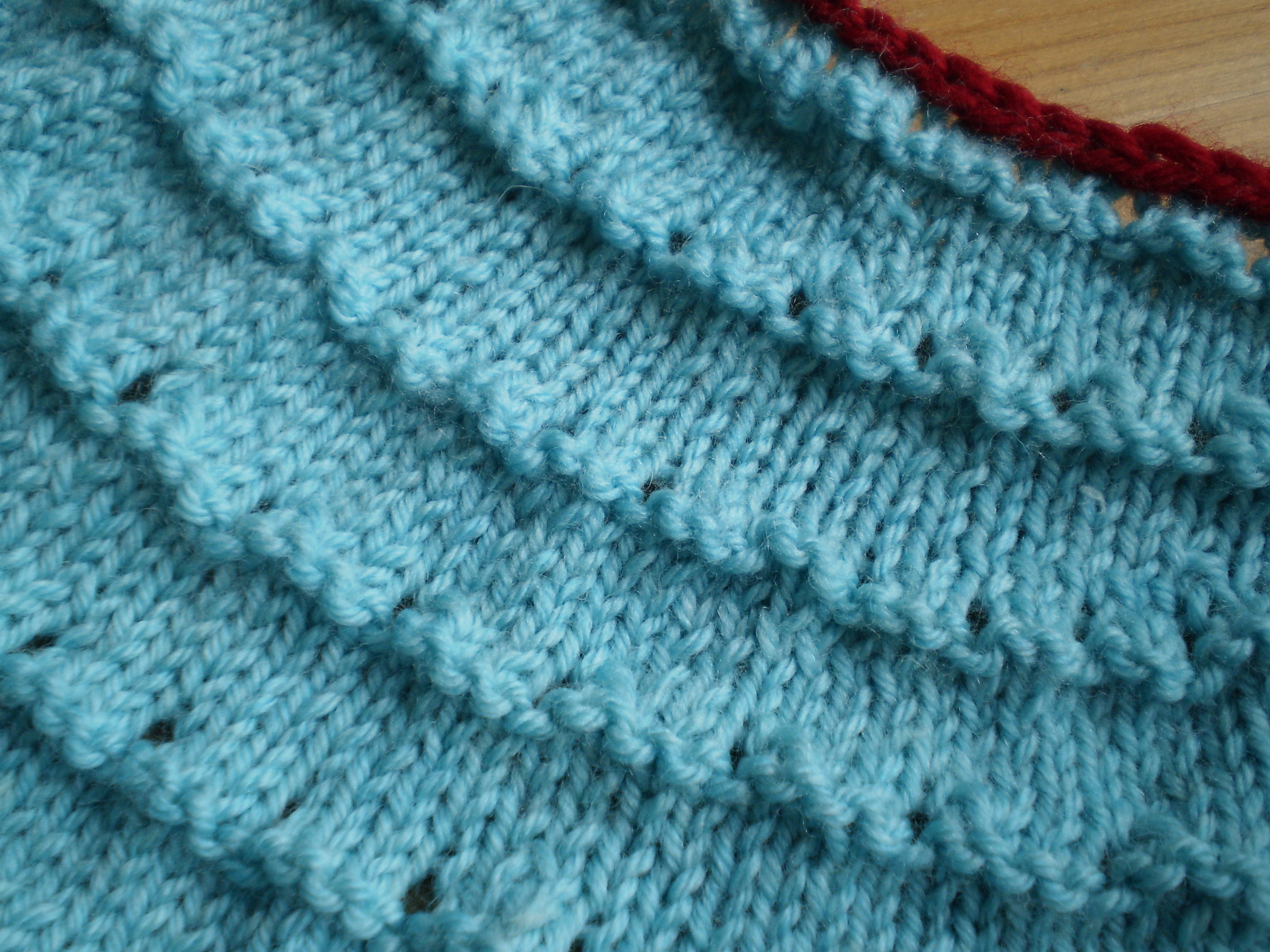
Now, I’m knitting up my pretty blue yarn again.  It’s still going to be a girly blue cardigan, but this time I’m sort of making my own pattern.  I’m using my new favorite sweater book, the Knitter’s Handy Book of Top-Down Sweaters.  It’s a Seamless Yoke Cardigan, based in part on her Feather and Fan Flare sweater.  It’s at a nice fine gauge (or at least fine compared to sweaters I’ve made before).  I like to make my sweaters with chunky yarn and big needles, but I wanted this sweater to turn out a little fancier and girlier than my usual projects).  But, instead of the fussy little cables on Peggy Sue, I’m using decorative increases and garter ridges around the yoke, hem and cuffs.  And, since it’s a yoke sweater, not a raglan, I think it will be more flattering on me.

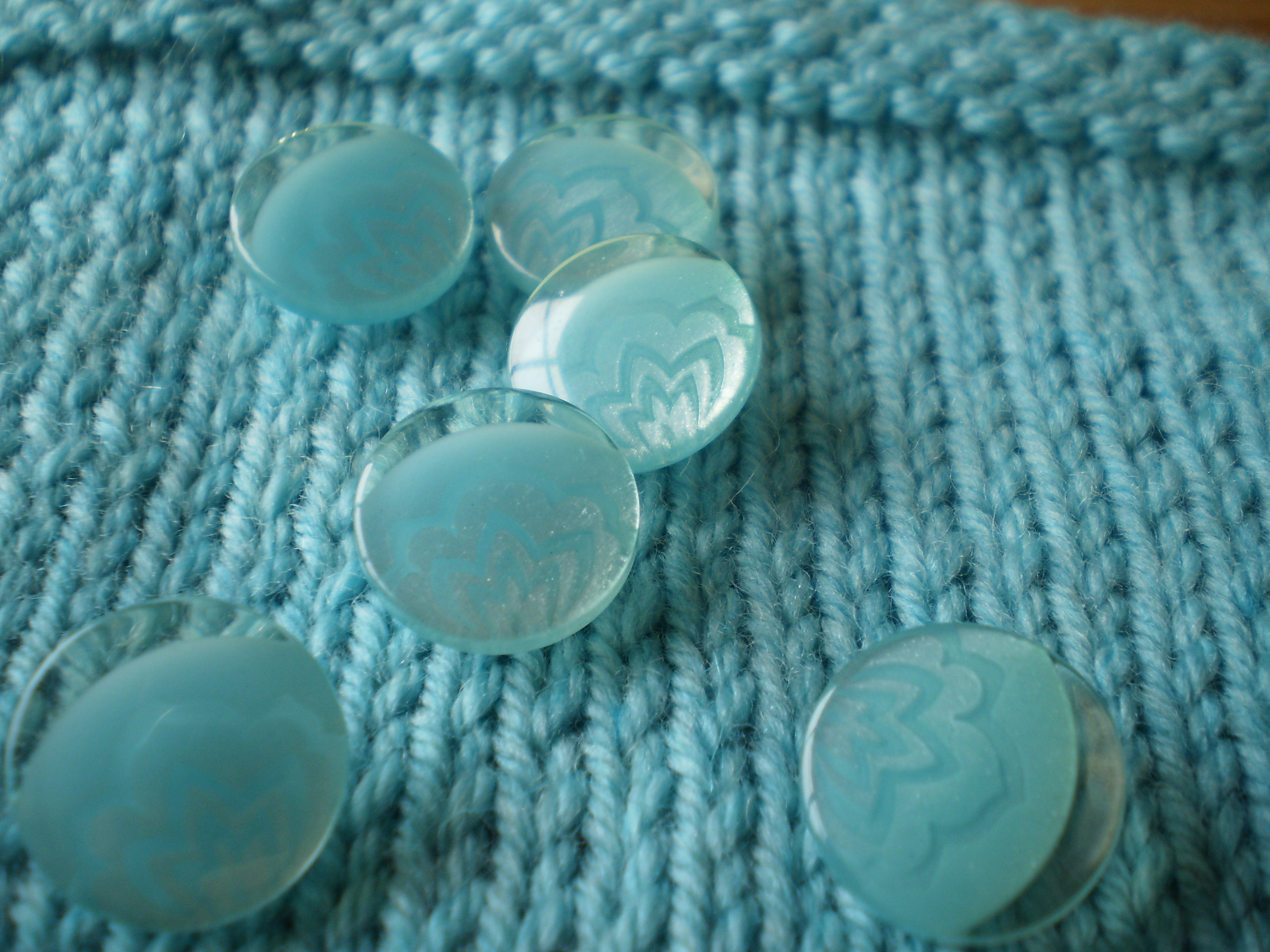
OLYMPUS DIGITAL CAMERAThe funny thing is, though, that now that I’ve got it growing on my needles, I really like the contrast between the red yarn of my provisional cast-on and the pale aqua blue.  It’s making me think that I want to use red or maroon buttons on the sweater.  Which is ridiculous, since the whole point of making this sweater in the first place was to use my pretty blue buttons.

OLYMPUS DIGITAL CAMERABut, I suppose that takes me back to my original point: It’s important to stay flexible when you’re knitting.  It’s so easy to get bogged down in the details, and keep slogging through a project that you no longer love, or something that you figure out won’t work for you.  And, it’s so hard to abandon a project that you’ve poured hours and hours of your life into. But, it’s so much more satisfying (and fun!) to make something that you love than to slave away, determined to finish the project as you planned in the beginning.  Just because you start on a project, doesn’t mean that it’s the one you have to finish.

How have you had to be flexible when you work on a project?